
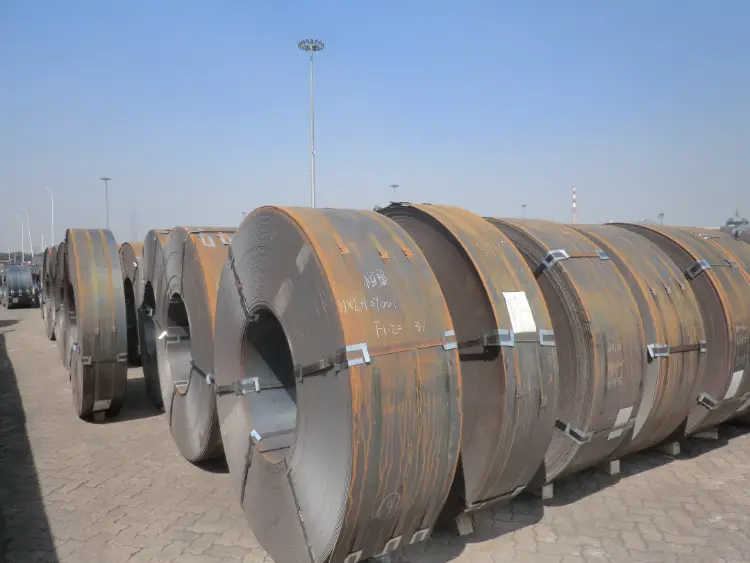
GB/T4171 Q460NH Weathering Steel Coil
GB/T 4171 Q460NH Weathering Steel Coil: High Strength Atmospheric Corrosion Resistance
Comprehensive data on Q460NH weathering steel coil per GB/T 4171, including chemistry, mechanical properties, thermal and electrical physical properties, international equivalents, and application guidance.
Hot rolling, cold forming, welding, machining, cutting
- Phone : +8618037372205
- Email : [email protected]
- WhatsApp: Contact via Whtsapp
- WeChat: +8618037372205
GB/T4171 Q460NH Weathering Steel Coil Introduction
GB/T 4171 Q460NH is a high-strength weathering structural steel with improved atmospheric corrosion resistance. It achieves its properties through the addition of alloying elements such as copper, chromium, and nickel, which form a protective oxide layer on the surface under alternate wetting and drying cycles, significantly reducing further corrosion. Key features:
- Minimum yield strength of 460 MPa for thicknesses ≤16 mm
- Excellent weldability and formability
- Self-protecting patina eliminates the need for painting in many environments
- Cost-effective lifecycle in bridges, containers, and building structures
- Available as hot-rolled coils, plates, and strips
Typical delivery condition is hot-rolled or normalized. Q460NH is widely specified for structural components exposed to the atmosphere without continuous coating maintenance.
GB/T4171 Q460NH Weathering Steel Coil Chemical Composition
Chemical composition of Q460NH as specified in GB/T 4171-2008. The steel is characterized by low carbon content for weldability and approved addition of copper, chromium, and nickel to develop a stable patina. Maximum limits for phosphorus and sulfur ensure good toughness. Notes:
- The total content of alloying elements may be adjusted to meet the strength requirement.
- Microalloying elements like Nb, V, Ti may be added individually or in combination, but not reported unless agreed upon.
| Element | Standard Value (max, unless range given) | Remarks |
|---|---|---|
| Carbon (C) | ≤0.12 | Cast analysis |
| Silicon (Si) | ≤0.50 | |
| Manganese (Mn) | ≤1.00 | |
| Phosphorus (P) | ≤0.025 | |
| Sulfur (S) | ≤0.020 | |
| Copper (Cu) | 0.25 - 0.55 | Essential for patina |
| Chromium (Cr) | 0.30 - 1.25 | |
| Nickel (Ni) | ≤0.65 | |
| Others (e.g. Nb, V, Ti) | Microalloying permitted | Not mandatory, used for grain refinement and precipitation strengthening |
GB/T4171 Q460NH Weathering Steel Coil Thermal and Electrical Physical Properties
These physical properties are typical for low-alloy weathering steels at room temperature unless temperature is indicated. They are not specified directly in GB/T 4171 but are derived from commonly accepted data for similar Fe-Cu-Cr-Ni alloys. Note: Values are approximate and for general engineering guidance.
- Density may vary slightly with alloy content.
- Temperature dependence: specific heat and thermal expansion increase with temperature.
- Electrical resistivity is range between 20 and 100°C.
| Property | Typical Value | Unit | Test Condition |
|---|---|---|---|
| Density (ρ) | 7.85 | g/cm³ | 20°C |
| Elastic modulus (E) | 210 | GPa | 20°C |
| Shear modulus (G) | 81 | GPa | from E and ν=0.29; 20°C |
| Poisson's ratio (ν) | 0.29 | - | Elastic range |
| Thermal expansion coefficient (α) | 12.0 | 10⁻⁶/K | 20 – 100°C |
| Thermal expansion coefficient (α) | 12.8 | 10⁻⁶/K | 20 – 200°C |
| Thermal expansion coefficient (α) | 13.5 | 10⁻⁶/K | 20 – 400°C |
| Thermal conductivity (λ) | 42 | W/(m·K) | 20°C |
| Thermal conductivity (λ) | 40 | W/(m·K) | 100°C |
| Specific heat capacity (cₚ) | 0.46 | kJ/(kg·K) | 20°C |
| Electrical resistivity (ρₑ) | 0.22 | μΩ·m | 20°C |
GB/T4171 Q460NH Weathering Steel Coil Mechanical Properties
Mechanical properties according to GB/T 4171 for Q460NH. Test piece orientation is longitudinal for flat products. The tensile test reflects room temperature performance. Impact energy values are for longitudinal Charpy V-notch specimens. Note: For product thickness beyond 16 mm, strength values decrease and are to be agreed upon as per standard. Values below are the minimum required unless stated otherwise.
| Property | Value | Unit | Test Condition / Thickness (mm) |
|---|---|---|---|
| Yield Strength (ReH) | ≥460 | MPa | t ≤ 16 |
| Yield Strength (ReH) | ≥450 | MPa | 16 < t ≤ 40 |
| Yield Strength (ReH) | ≥430 | MPa | 40 < t ≤ 63 |
| Tensile Strength (Rm) | 570 - 730 | MPa | t ≤ 63 |
| Elongation after fracture (A) | ≥20 | % | t ≤ 63, gauge length 5.65√S₀ |
| Charpy impact energy (KV₂) @ 0°C, longitudinal | ≥34 | J | Standard minimum value; optional lower temperatures may be agreed |
| 180° Cold bend test (bend diameter) | D=2a (for t ≤ 16mm) | - | D = mandrel diameter, a = specimen thickness; no cracks |
GB/T4171 Q460NH Weathering Steel Coil Direct Equivalent Standards and Replaceable Grades
These grades are considered fully equivalent or interchangeable with Q460NH per respective international standards. They share similar chemical requirements and mechanical properties for weathering structural applications.
| Country/Region | Standard | Grade | Remarks |
|---|---|---|---|
| Europe | EN 10025-5 | S460J0W | Minimum yield 460 MPa, impact energy KV at 0°C; similar chemistry with Cu, Cr, Ni |
| Europe | EN 10025-5 | S460J2W | Improved low-temperature toughness (KV at -20°C) compared to J0W |
| Europe | EN 10025-5 | S460K2W | Higher toughness (KV at -20°C, min 40J), suitable for demanding structures |
| Japan | JIS G3114 | SMA570W | Tensile strength 570-720 MPa, yield ≥ 460 MPa; used for welded structures with atmospheric corrosion resistance |
| ISO | ISO 4952 | S460W | Identical concept; often used as reference for international projects |
| USA (approximated) | ASTM A709 / A709M | A709 GR HPS 70W | High performance steel 70W (HPS 70W) with yield 485 MPa, higher than Q460NH but can be substituted after design review |
GB/T4171 Q460NH Weathering Steel Coil Application Introduction
Q460NH is ideally suited for structures requiring high strength and low maintenance in moderately to severely corrosive atmospheric environments. Its self-protecting ability reduces lifecycle costs by eliminating painting in many applications. Typical uses span heavy civil engineering, transport, and industrial construction. Advantages:
- Eliminates initial painting in suitable exposures (alternate wet/dry cycles).
- Maintains structural integrity with thinner sections compared to ordinary carbon steel.
- Compatible with common welding methods (SMAW, GMAW, SAW) using matching weathering filler metals.
- Available as coil enables efficient continuous processing for roll-formed profiles.
Processing: hot-rolled coil can be cut to length, slit, cold-formed, or welded. Direct weathering without coating is recommended for open-air, unpainted applications; in crevices or continuously wet conditions, protective measures may be needed.
Product Applications: Weather-resistant steel coils and plates, Roll-formed sections (angles, channels, Z- and C-shaped purlins), Welded structural hollow sections, Container fittings and corner castings, Bridge expansion joints and bearings, Prefabricated building modules, Protective barriers and noise walls
Processed into products: Bridge main girders and cross beams, Railway wagon underframes and side walls, Container door frames and corner posts, Transmission tower legs and bracing members, Architectural sunshade fins and louvres, Highway sign gantries and cantilever masts, Welded I‑beams and H‑columns for outdoor frames
Application industries: Bridge engineering (girders, box sections, bridge deck elements), Railway vehicle manufacturing (wagon bodies, frames, containers), Shipbuilding (deck fittings, non-immersed structures), Power transmission (lattice towers, poles), Architectural metal works (façade panels, cladding, sculptures), Highway equipment (guardrails, sign structures, lighting poles), Mining and earthmoving equipment (structural parts in open atmosphere)
GB/T4171 Q460NH Weathering Steel Coil Similar / Alternative Weathering Steels
These materials have close but not identical properties. They may be used as substitutes under adjusted design or when exact 460 MPa yield is not mandatory. Chemical composition and weathering mechanism are comparable.
| Country/Region | Standard | Grade | Remarks |
|---|---|---|---|
| China | GB/T 4171 | Q450NQR1 | Yield strength 450 MPa; slightly lower carbon, very similar corrosion resistance; widely used for rolling stock |
| China | GB/T 4171 | Q500NH | Yield strength 500 MPa; higher strength grade in the same standard, for heavier sections |
| Europe | EN 10025-5 | S355J2W | Yield strength 355 MPa class; widely available and cost-effective when lower strength is acceptable |
| USA | ASTM A588 / A588M | Grade A / K | Grade K has yield 345 MPa; general purpose weathering steel, lower strength than Q460NH |
| India | IS 11587 | Fe 540 W | Yield 350-390 MPa; Indian standard weathering steel for structural use, not direct match in strength |
Notes:
Special considerations:
- Welding consumables should be weathering type (e.g., AWS A5.29 E81T1-W, ER80S-G) to match corrosion performance.
- For cold forming, the minimum bend radius is typically 2t (where t is thickness) to avoid cracking; stress relieving may be required for severe forming.
- The patina develops fully after alternating wet-dry cycles; during initial exposure, the surface may show rust run-off – design should account for staining of adjacent materials.
- In marine or high chloride environments, the corrosion rate may be higher; supplemental coating or evaluation per ISO 9224 is recommended.
- Guarantee of impact properties at lower temperatures (e.g., -20°C) must be specially ordered and may require fine grain practice.
- Share



