
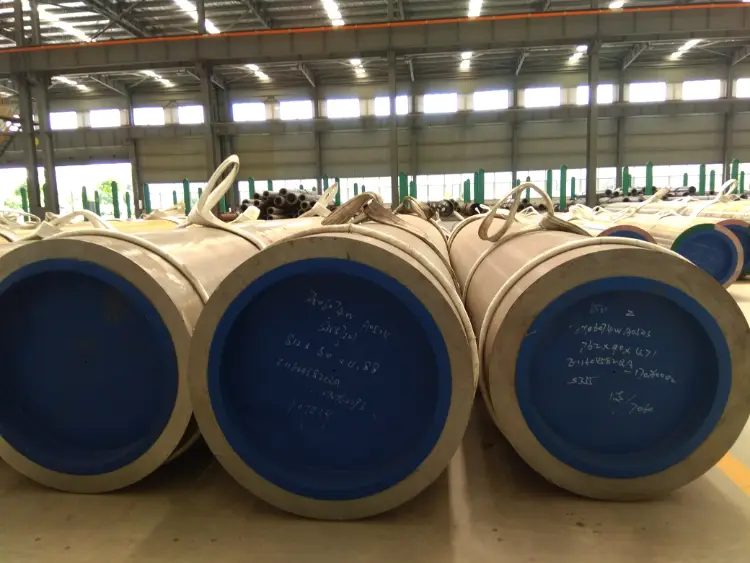
GB/T 9711-2011 PSL1 L450 LSAW Pipe
GB/T 9711-2011 PSL1 L450 LSAW Pipe - Comprehensive Material Data and International Equivalents
Explore detailed material properties, chemical composition, mechanical and physical characteristics of GB/T 9711-2011 PSL1 L450 LSAW steel pipe, with full international equivalent standards and application guidance.
Hot rolled plate/strip formed into pipe by UOE or JCOE process, joined by double-sided submerged-arc welding, followed by mechanical expanding and hydrostatic testing.
- Phone : +8618037372205
- Email : [email protected]
- WhatsApp: Contact via Whtsapp
- WeChat: +8618037372205
GB/T 9711-2011 PSL1 L450 LSAW Pipe Introduction
GB/T 9711-2011 PSL1 L450 LSAW pipe is a longitudinal seam submerged-arc welded steel pipe designed for oil and gas pipeline transportation systems. It corresponds to the L450 grade (yield strength minimum 450 MPa) under Product Specification Level 1 (PSL1) of the Chinese national standard. This material belongs to high-strength low-alloy (HSLA) steel group, offering excellent weldability, good toughness, and reliable mechanical properties for moderate service conditions. The LSAW manufacturing process ensures high dimensional precision and uniform wall thickness. PSL1 L450 is primarily used in onshore and offshore pipelines where less stringent notch toughness requirements are specified, as charpy impact testing is not mandatory unless agreed between purchaser and manufacturer. This data sheet provides authoritative information sourced directly from GB/T 9711-2011 and equivalent API, ISO standards to support engineering decisions.
GB/T 9711-2011 PSL1 L450 LSAW Pipe Chemical Composition
Based on cast analysis per GB/T 9711-2011 for PSL1 L450 LSAW pipe base metal. Elements not listed may be present as residuals. For PSL1, only C, Mn, P, S are mandatory limits; the sum of Nb, V, Ti shall not exceed 0.15% unless otherwise agreed. Other micro-alloying additions are permitted to achieve mechanical properties, but the product analysis tolerances apply. Silicon content is generally 0.15–0.40% for effective deoxidation but is not restricted by this standard.
| Element | Specified Value (max %) | Remarks |
|---|---|---|
| Carbon (C) | 0.26 | For welded pipe; max 0.28% for seamless |
| Manganese (Mn) | 1.40 | Maximum, typical range 1.00–1.35 |
| Phosphorus (P) | 0.030 | Maximum |
| Sulfur (S) | 0.030 | Maximum |
| Silicon (Si) | — | Not specified, commonly 0.15–0.40 |
| Niobium (Nb) | — | May be added; sum Nb+V+Ti ≤ 0.15% |
| Vanadium (V) | — | May be added; sum Nb+V+Ti ≤ 0.15% |
| Titanium (Ti) | — | May be added; sum Nb+V+Ti ≤ 0.15% |
| Copper (Cu) | — | Not specified; residual or intentional addition to be reported |
| Nickel (Ni) | — | Not specified; residual ≤ 0.30% typical |
| Chromium (Cr) | — | Not specified; residual ≤ 0.30% typical |
| Molybdenum (Mo) | — | Not specified; residual ≤ 0.10% typical |
| Aluminium (Al) | — | Total Al typical 0.015–0.060 for grain refinement |
| Nitrogen (N) | — | Not specified; typically ≤ 0.012% |
GB/T 9711-2011 PSL1 L450 LSAW Pipe Physical and Thermal Properties
All values are typical for low-carbon HSLA steel at ambient temperature (except where temperature indicated). These are not specified in GB/T 9711-2011 but are provided for engineering calculations. Density may vary slightly with alloy content. Thermal conductivity and electrical resistivity are moderately dependent on temperature.
| Property | Typical Value | Unit | Remark |
|---|---|---|---|
| Density (ρ) | 7.85 | g/cm³ | Room temperature |
| Modulus of Elasticity (E) | 205 | GPa | Room temperature; decreases to ~185 GPa at 300°C |
| Shear Modulus (G) | 80 | GPa | Calculated from E and Poisson's ratio |
| Poisson's Ratio (ν) | 0.30 | — | Elastic region |
| Thermal Expansion Coefficient (α) | 11.7 | 10&supminus;⁶/K | 20–100°C; 12.5 (20–200°C), 13.5 (20–400°C) |
| Thermal Conductivity (λ) | 50 | W/(m⋅K) | At 20°C; decreases to ~42 at 300°C |
| Specific Heat Capacity (c) | 470 | J/(kg⋅K) | At 20–100°C |
| Electrical Resistivity (ρe) | 0.22 | μΩ⋅m | At 20°C; increases with temperature |
GB/T 9711-2011 PSL1 L450 LSAW Pipe Mechanical Properties
Mechanical tests performed on transverse strip specimens (for pipe body) from the pipe, unless longitudinal specimens are specified. Required values per GB/T 9711-2011 PSL1. Yield strength and tensile strength are mandatory; elongation is calculated based on specimen gauge length and wall thickness. Guided bend test is required for weld zone; no mandatory Charpy impact test for PSL1 unless agreed. Pipe body hardness is normally not specified but typically ≤ 250 HV10.
| Property | Specified Value | Unit | Test Conditions |
|---|---|---|---|
| Yield Strength (ReH) | 450 – 600 | MPa | Transverse test, 0.5% total extension under load; for wall thickness ≤ 25 mm |
| Tensile Strength (Rm) | 535 – 760 | MPa | Transverse test, room temperature |
| Elongation (A) | ≥ 22 | % | Gauge length 50 mm, transverse strip specimen, wall thickness ≤ 20 mm; for other dimensions see standard formula |
| Elongation (A50) | 22 (minimum) | % | For specimens with 50 mm gauge length and wall thickness ≤ 20 mm. Minimum A50 for L450 is calculated as 1950*(Rm-0.17)/Rm^0.9 (approx. 22% at min Rm) |
| Guided Bend Test (Weld) | No cracks > 3 mm in any direction | — | Bend angle 180°, mandrel diameter = 6t for t ≤ 10 mm; 8t for t > 10 mm (t=wall thickness) |
| Charpy Impact (KV) | Not required by PSL1 | J | Optional; if specified by purchaser, typical requirement is ≥ 27 J average at 0°C or design temperature |
GB/T 9711-2011 PSL1 L450 LSAW Pipe Exact Equivalent Material Grades and Standards
| Country/Region | Standard | Grade | Remarks |
|---|---|---|---|
| China | GB/T 9711-2011 PSL1 | L450 | Original base grade / SMLS or WELDED |
| USA / Global | API Spec 5L (46th Ed.) PSL1 | X65 | PSL1; same chemical and mechanical requirements |
| International | ISO 3183:2012 PSL1 | L450 | Identical to API 5L PSL1 X65; LSAW covered as welded pipe |
| Europe | EN 10208-1:1998 | L450 (not standardised) | EN 10208-1 does not list L450; EN 10208-2 L450MB is PSL2 and not exactly equivalent. |
| Russia | GOST R ISO 3183 | K54 (L450) | Based on adopted ISO standard, PSL1 equivalent |
GB/T 9711-2011 PSL1 L450 LSAW Pipe Application Introduction
PSL1 L450 LSAW pipe is a workhorse material for oil and gas pipelines operating at moderate pressures and temperatures. Its balanced strength and toughness, combined with the cost‑effectiveness of PSL1 delivery, make it suitable for large‑diameter onshore gas transmission and liquid lines. For sour service or low‑temperature environments, PSL2 grades with mandatory impact testing should be considered. LSAW pipes in this grade can be supplied with various external coatings (3‑layer PE, FBE) and internal linings depending on transported media.
Product Applications: Onshore gas trunk lines (e.g., West-East Gas Pipeline segments where PSL1 adequate), Crude oil and refined product pipelines, Subsea flowlines (in non‑sour shallow water), Piling pipes for offshore platforms and jetties, Line pipe spools for compressor and pump stations
Processed into products: Straight pipe segments (12 m or 24 m length), Induction bends (hot-formed, quenched & tempered after bending), Cold-formed elbow (radius up to 3D) after heat treatment if required, Tee fittings (extruded outlets), Reducer flanges and anchors welded from LSAW pipe shell, Casing pipes for road and river crossings
Application industries: Oil and Gas Upstream (gathering and transmission lines), Petrochemical (refinery interconnecting piping), Water and Wastewater (long-distance raw water pipelines), Civil Engineering (structural pipe, piling, foundation casing), Mining (slurry transport pipelines)
GB/T 9711-2011 PSL1 L450 LSAW Pipe Similar Materials for Alternative Consideration
| Country/Region | Standard | Grade | Remarks |
|---|---|---|---|
| China | GB/T 9711-2011 PSL2 | L450N / L450Q / L450M | PSL2 versions with mandatory Charpy impact and stricter chemistry; higher toughness requirements. |
| USA / Global | API 5L PSL2 | X65Q / X65M | PSL2 equivalents; QS (quenched+tempered) or TMCP delivery; impact tested. |
| International | ISO 3183 PSL2 | L450N, L450Q | Similar to API 5L PSL2 X65; suitable for pipeline projects requiring fracture control. |
| Europe | EN 10208-2:2009 | L450MB | Mechanically similar but PSL2; TMCP delivery with enhanced low‑temperature toughness. |
| China | GB/T 9711-2011 PSL1 | L415 (X60) | Lower strength grade; yield 415 MPa, tensile 520 MPa. Often selected when lower pressure rating sufficient. |
| China | GB/T 9711-2011 PSL1 | L485 (X70) | Higher strength; yield 485 MPa. Requires more careful welding and forming control. |
Notes:
- PSL1 L450 does not have mandatory requirements for through‑thickness (Z‑direction) properties; if lamellar tearing resistance is required, Z‑quality steel (e.g., Z25, Z35) should be ordered separately.
- Hydrostatic test pressure calculated as 2·S·t/D (S = 90% of SMYS). Certificate EN 10204 Type 3.1 typically supplied.
- Dimensional tolerance: O.D. +/-0.75% (for D>219.1 mm); wall thickness -8%/+2% for t≤20 mm (PSL1).
- For sour service (H2S containing fluids), this base material is not suitable without HIC/SWC testing; PSL2 pipe with additional testing is recommended.
- Share



