
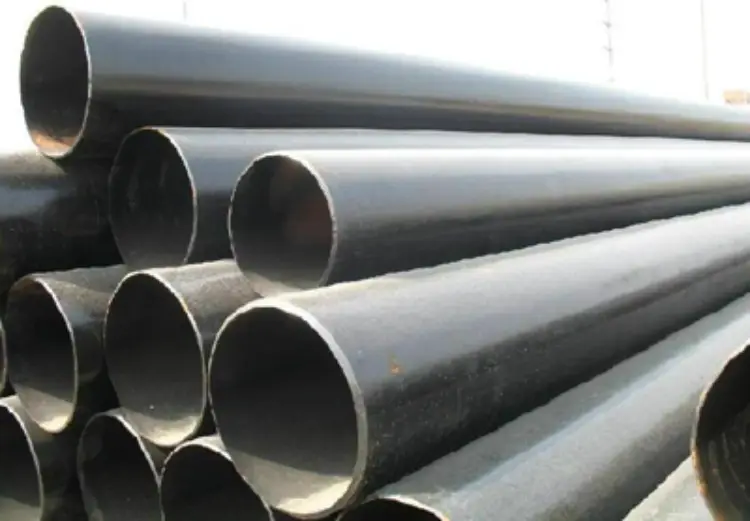
GB/T 9711-2011 PSL1 L415 LSAW Pipe Steel
GB/T 9711-2011 PSL1 L415 LSAW Pipe Steel: Data Sheet and Properties
Comprehensive material properties for L415 grade pipeline steel according to GB/T 9711-2011 PSL1, including chemical composition, mechanical, thermal and electrical properties, international equivalents, and application guidance.
LSAW (Longitudinal Submerged Arc Welding), ERW, seamless; controlled rolling, normalizing rolling, TMCP
- Phone : +8618037372205
- Email : [email protected]
- WhatsApp: Contact via Whtsapp
- WeChat: +8618037372205
GB/T 9711-2011 PSL1 L415 LSAW Pipe Steel Introduction
L415 (X60) is a microalloyed low-carbon steel grade specified in GB/T 9711-2011 for longitudinally submerged arc welded (LSAW) pipes used in petroleum and natural gas transportation. Under PSL1 (Product Specification Level 1), it guarantees a minimum yield strength of 415 MPa and offers a balanced combination of high strength, good weldability, and adequate toughness for ambient-temperature service. The steel is typically produced via thermomechanical controlled processing (TMCP) to refine grain structure and enhance performance. L415 pipes are widely utilized in onshore and offshore pipelines where reliable pressure containment is essential.
GB/T 9711-2011 PSL1 L415 LSAW Pipe Steel Chemical Composition
Element composition limits for PSL1 Grade L415 according to GB/T 9711-2011. All values are maximum unless a range is shown. Microalloying elements such as V, Nb, and Ti are added for grain refinement and precipitation hardening. Carbon equivalent (CEIIW) is often controlled to ensure weldability.
| Chemical Element | Standard Value | Remarks |
|---|---|---|
| C | 0.21 | Max, heat analysis |
| Mn | 1.30 | Max, for wall thickness ≤ 25 mm; 1.40% max for thicker pipes by agreement |
| P | 0.025 | Max |
| S | 0.015 | Max |
| Si | 0.45 | Max, if deoxidized |
| V | 0.10 | Max, often used as grain refiner |
| Nb | 0.05 | Max, individually |
| Ti | 0.04 | Max, individually |
| Cu | 0.50 | Max, if agreed |
| Ni | 0.30 | Max, if agreed |
| Cr | 0.30 | Max, if agreed |
| Mo | 0.15 | Max, if agreed |
| Al (total) | 0.015–0.060 | When used for grain refinement; Als ≥ 0.020% typical |
| N | 0.012 | Max, unless otherwise agreed |
| CEIIW | 0.43 | Carbon equivalent (IIW formula) when specified |
GB/T 9711-2011 PSL1 L415 LSAW Pipe Steel Thermal and Electrical Physical Properties
Representative physical properties for low-alloy steels of the L415 (X60) class. These data are not mandatory in GB/T 9711-2011 but serve as practical reference for design and engineering calculations. Actual properties can vary with processing history and exact composition.
| Property | Standard Requirement Value | Unit | Test Condition |
|---|---|---|---|
| Density (ρ) | 7.85 | g/cm³ | At 20°C |
| Elastic Modulus (E) | 207 | GPa | At 20°C, tension |
| Shear Modulus (G) | 80 | GPa | Calculated at 20°C |
| Poisson's Ratio (ν) | 0.30 | — | At 20°C |
| Thermal Expansion Coefficient (α) | 11.7 × 10⁻⁶ | K⁻¹ | From 20°C to 100°C |
| Thermal Conductivity (λ) | 45 | W/(m·K) | At 20°C |
| Specific Heat Capacity (cₚ) | 480 | J/(kg·K) | At 20°C |
| Electrical Resistivity (ρₑ) | 0.20 | µΩ·m | At 20°C |
GB/T 9711-2011 PSL1 L415 LSAW Pipe Steel Mechanical Properties
Typical tensile and toughness properties for L415 line pipe under GB/T 9711-2011 PSL1. For welded pipes, specimens are taken transverse to the weld seam. Charpy impact testing is not mandatory for PSL1 but is frequently required by supplementary agreement. Flattening or guided-bend tests are mandatory for welded pipe.
| Property | Standard Requirement Value | Unit | Test Condition |
|---|---|---|---|
| Yield Strength (ReH) | 415 – 565 | MPa | 0.5% total extension, transverse, room temperature |
| Tensile Strength (Rm) | 520 – 760 | MPa | Transverse, room temperature |
| Yield/Tensile Ratio | ≤ 0.92 (commonly agreed) | — | Not mandatory in PSL1; may be required for deformation control |
| Elongation after fracture (A) | ≥ 22 | % | Gauge length 50 mm, transverse; minimum based on formula in standard |
| Charpy Impact Energy (KV₂) | ≥ 27 (typical agreed) | J | At 0°C (or as agreed), 10×10 mm specimen, transverse; PSL1 does not require, but frequently specified |
| Shear Area (Charpy) | ≥ 70 (typical agreed) | % | At 0°C when Charpy test specified |
| Hardness | ≤ 250 HV10 | HV | Optional; may be imposed for sour service or by agreement |
| Guided Bend Test | No crack > 3.2 mm | — | For welded pipe, D = 4a, 180° bend, transverse weld |
GB/T 9711-2011 PSL1 L415 LSAW Pipe Steel Fully Equivalent Material Standards and Replacement Grades
| Country/Region | Standard | Grade | Remarks |
|---|---|---|---|
| International | ISO 3183:2012 | L415 | PSL1, identical technical requirements to GB/T 9711-2011 |
| USA | API Spec 5L (46th Ed.) | X60 | PSL1, equivalent strength and composition |
| European Union | EN 10208-2 | L415MB | For onshore and offshore pipeline; similar mechanical and chemical limits |
| Russia | GOST R 52079 (or GOST 20295) | K60 (X60) | Matches minimum yield strength 415 MPa; K60 is the closest equivalent grade |
| Brazil | ABNT NBR 14932 | X60 | Corresponds to API 5L X60 |
| India | IS 1567:2016 | Gr. X60 | Equivalent to API 5L X60 for line pipe |
GB/T 9711-2011 PSL1 L415 LSAW Pipe Steel Application Introduction
L415 (X60) steel is a backbone material for pipeline infrastructure. Its excellent strength–toughness balance and reliable field weldability make it suitable for large-diameter, high-pressure transmission systems. It can be fabricated into a wide range of pipe types and components.
Product Applications: Longitudinally submerged arc welded (LSAW) pipes (typically ≥ 16 inch OD), Spiral submerged arc welded (SSAW) pipes, Electric resistance welded (ERW) pipes (smaller diameters), Seamless pipes (for small diameters or special applications), Pipe fittings (elbows, tees, reducers, caps), Flanges and connectors
Processed into products: Mainline pipe sections for oil and gas trunklines, Offshore risers and flowlines (with optional corrosion-resistant cladding), Pumping station and compressor station piping, Structural supports in industrial plants, Foundation piling for bridges and buildings
Application industries: Oil and gas transmission (onshore/offshore), Petrochemical and refinery piping, High-pressure water and slurry transportation, Structural engineering (piles, hollow sections), CO₂ transport and potential hydrogen-ready pipelines
GB/T 9711-2011 PSL1 L415 LSAW Pipe Steel Similar / Alternative Materials
| Country/Region | Standard | Grade | Remarks |
|---|---|---|---|
| China | GB/T 9711-2011 | L450 (X65) | Higher strength (min YS 450 MPa) for higher pressure or weight reduction |
| China | GB/T 9711-2011 | L360 (X52) | Lower strength grade with improved formability, suitable for less demanding service |
| International | API 5L | X56 | Intermediate between X52 and X60; may be considered when full X60 is not required |
| European | EN 10208-2 | L360MB | Comparable to L360/X52; may substitute with thickness adjustment |
Notes:
Supplementary Testing: PSL1 does not mandate Charpy impact testing, but toughness at 0°C or -10°C is often specified by the purchaser (e.g., ≥27 J). Sour Service: When H₂S is present, stricter chemical limits (S ≤ 0.002%, CE ≤ 0.39, hardness ≤ 248 HV) and HIC/SSC tests per NACE MR0175/ISO 15156 are required. Coatings: Pipes are typically delivered bare, with temporary anti-corrosion, or factory-applied three-layer PE/PP coatings. Manufacturing: LSAW pipes are formed from plate using UOE or JCOE processes, resulting in outside diameters from 406 mm upward. The standard also covers seamless and ERW pipes of the same grade.
- Share



