
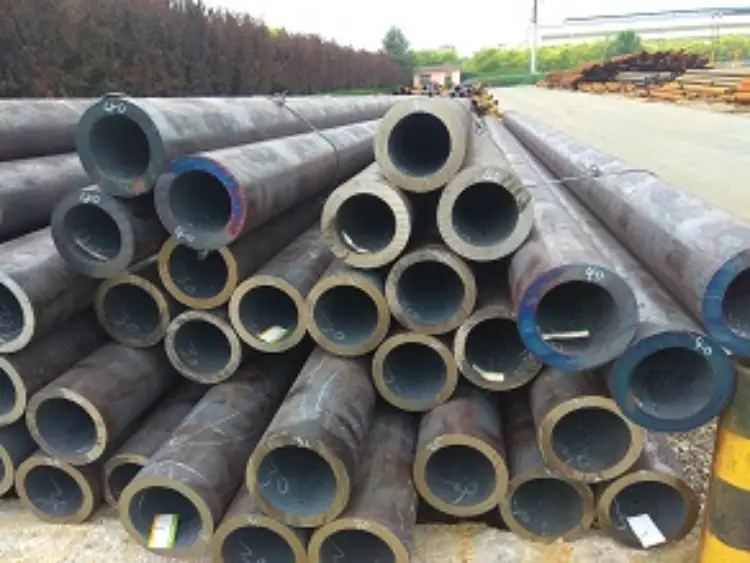
GB/T 9711-2011 PSL1 L390 LSAW Pipe
GB/T 9711-2011 PSL1 L390 LSAW Pipe: Material Properties and International Equivalents
Comprehensive material data for L390 grade longitudinal submerged arc welded (LSAW) pipe per GB/T 9711-2011 PSL1, including chemical composition, mechanical properties, thermal and electrical data, global equivalent standards, and application guidance for oil and gas transmission.
Thermo-mechanical controlled rolling (TMCP), cold forming, submerged arc welding, post-weld heat treatment if required
- Phone : +8618037372205
- Email : [email protected]
- WhatsApp: Contact via Whtsapp
- WeChat: +8618037372205
GB/T 9711-2011 PSL1 L390 LSAW Pipe Introduction
L390 is a microalloyed high-strength pipeline steel defined in GB/T 9711-2011 PSL1 for longitudinal submerged arc welded (LSAW) pipes. It provides a minimum yield strength of 390 MPa with excellent weldability and low-temperature toughness, making it suitable for large-diameter oil and gas transmission pipelines. Key characteristics include:
- Low carbon equivalent for field weldability
- Controlled microalloying (niobium, vanadium, titanium) for fine-grain strengthening
- Balanced mechanical properties for service under high pressure and varying temperatures
L390 LSAW pipe is manufactured from thermomechanically rolled plates and supplied with a mill test certificate confirming compliance to the standard.
GB/T 9711-2011 PSL1 L390 LSAW Pipe Chemical Composition
The chemical composition is controlled to ensure both the required strength and excellent field weldability. The following is based on the cast (heat) analysis limits for PSL1 L390 welded pipe (LSAW) in accordance with GB/T 9711-2011. Microalloying elements Nb, V, and Ti are used individually or in combination, with a strict cap on their total content to achieve fine grain refinement without compromising toughness. Carbon equivalent values are typically kept below 0.40% (IIW) for high weldability.
| Chemical Element | Standard Value (Wt.%) | Remarks |
|---|---|---|
| Carbon (C) | ≤ 0.22 | For welded pipe (LSAW); lower limit improves weldability |
| Manganese (Mn) | ≤ 1.40 | Provides strength and hardenability; balanced to avoid segregation |
| Phosphorus (P) | ≤ 0.030 | Restricted for toughness and resistance to temper embrittlement |
| Sulfur (S) | ≤ 0.030 | Controlled for improved ductility and cleanliness |
| Vanadium (V) | ≤ 0.15 | Permitted as a single addition; covered by the total microalloy limit |
| Niobium (Nb) | ≤ 0.15 | Typical grain refiner; covered by the total microalloy limit |
| Titanium (Ti) | ≤ 0.15 | Used for nitrogen binding; covered by the total microalloy limit |
| V+Nb+Ti | ≤ 0.15 | Maximum sum of microalloying elements |
GB/T 9711-2011 PSL1 L390 LSAW Pipe Thermal and Electrical Physical Properties
The physical properties listed below are typical for low‑alloy carbon steel of the L390 type. These values are not subject to product analysis but are essential for engineering design (heat transfer, thermal stress, electrical conductivity). Variations may occur depending on the exact heat treatment and chemical composition, but the numbers presented are widely accepted for pipeline steels.
| Property | Typical Value | Unit | Test Condition |
|---|---|---|---|
| Density (ρ) | 7.85 | g/cm³ | At 20 °C |
| Elastic Modulus (E) | 210 | GPa | At 20 °C, static tensile test |
| Shear Modulus (G) | 80 | GPa | Calculated from E and ν |
| Poisson's Ratio (ν) | 0.30 | — | At 20 °C, within elastic limit |
| Coefficient of Thermal Expansion (α) | 11.7 | 10⁻⁶/°C | 20–100 °C range |
| Thermal Conductivity (λ) | 50 | W/(m·K) | At 20 °C |
| Specific Heat Capacity (cp) | 490 | J/(kg·K) | At 20 °C |
| Electrical Resistivity (ρe) | 0.15 | μΩ·m | At 20 °C |
GB/T 9711-2011 PSL1 L390 LSAW Pipe Mechanical Properties
The mechanical properties are determined on transverse strip specimens taken from the pipe body (weld metal excluded) at room temperature. The yield and tensile strengths conform to the minimum requirements of GB/T 9711-2011 PSL1 for the L390 grade. Elongation is calculated according to the standard formula and is inversely related to wall thickness. For LSAW pipes a typical minimum elongation of 22% (2‑in gage) can be expected in wall thicknesses up to 19 mm. Impact toughness is not mandatory for PSL1 unless subject to supplementary agreement; typical project requirements specify Charpy energy of at least 27 J at 0°C.
| Property | Standard Requirement | Unit | Test Condition |
|---|---|---|---|
| Yield Strength (Rt0.5) | ≥ 390 | MPa | Transverse strip test, room temperature |
| Tensile Strength (Rm) | ≥ 490 | MPa | Transverse strip test, room temperature |
| Elongation (A) | By formula: A = 1940⋅A₀⁰·² / Rm⁰·⁹, typically ≥ 22% | % | Gage length 50 mm (2 in), wall thickness ≤ 19 mm |
GB/T 9711-2011 PSL1 L390 LSAW Pipe Fully Equivalent Material Standards and Replaceable Grades
| Country/Region | Standard | Grade | Remarks |
|---|---|---|---|
| China | GB/T 9711-2011 PSL1 | L390 (LSAW) | Base material; same chemical and mechanical requirements |
| USA | API Spec 5L (45th Ed.) PSL1 | X56 | Directly equivalent in yield and tensile strength; interchangeable for line pipe service |
| International | ISO 3183:2012 (PSL 1) | L390 | Technically identical to GB/T 9711-2011; often used for international project specifications |
| Europe | EN 10208-2 | L390MB | Equivalent strength level; note that EN 10208-2 does not have a PSL1/PSL2 split, but L390MB meets corresponding requirements |
GB/T 9711-2011 PSL1 L390 LSAW Pipe Application Introduction
L390 PSL1 LSAW pipe is designed for high‑volume transportation of fluids under high pressure across long distances. The longitudinal submerged arc welding process produces large‑diameter pipes (typically NPS 16 to NPS 64, wall thickness up to 40 mm) with consistent quality. Its balanced strength and toughness make it suitable for both onshore and offshore environments. The material can be shaped into various components and is compatible with standard welding procedures.
Product Applications: Long‑distance gas trunklines, Crude oil and refined product pipelines, Flowlines and gathering lines, Station piping (compressor stations, pump stations), Offshore risers and export lines
Processed into products: Line pipe segments (casing, tubing, and large‑diameter mains), Bends, elbows, reducers, and tees (made from pipe or plate), Flanges and connectors welded to LSAW pipe, Structural tubulars for jackets, decks, and bridges, Pressure-containing parts of manifolds and pig launchers/receivers
Application industries: Oil and gas (downstream and midstream), Petrochemical and chemical processing, Water injection and transport systems, Structural and pile applications (with supplementary toughness requirements)
GB/T 9711-2011 PSL1 L390 LSAW Pipe Similar/Closely Related Material Recommendations
| Country/Region | Standard | Grade | Remarks |
|---|---|---|---|
| China | GB/T 9711-2011 PSL1 / PSL2 | L360 (X52) | Lower yield strength (≥ 360 MPa); may be substituted when design pressure allows; often used in less demanding sections |
| USA | API Spec 5L PSL1 / PSL2 | X60 (L415) | Higher yield strength (≥ 415 MPa); suitable when increased pressure or reduced wall thickness is required; closely related metallurgy |
| International | ISO 3183 PSL 1 | L290 (X42) | Lower strength grade; may be used for low-pressure lines or structural applications where mechanical properties of L390 are not needed |
| China | GB/T 9711-2011 PSL1 | L245 (B) | Base carbon‑manganese steel; shares pipeline applications but at significantly lower strength; often selected for utility piping |
Notes:
- L390 LSAW pipes are typically ordered with a supplementary specification for Charpy V‑notch impact toughness (e.g., 27 J at 0 °C) even if not mandatory under PSL1, to ensure crack arrest capability.
- Full pipe body DWT (Drop Weight Tear) tests may be required for gas transmission pipelines per the supplementary requirements of the purchaser.
- Hydraulic pressure test, ultrasonic/radiography inspection of the weld, and mill test certificates are standard deliverables.
- When used in sour service, additional hardness control and HIC (Hydrogen Induced Cracking) tests per NACE MR0175 are often applied, though these are not part of the basic PSL1 specification.
- Share



