
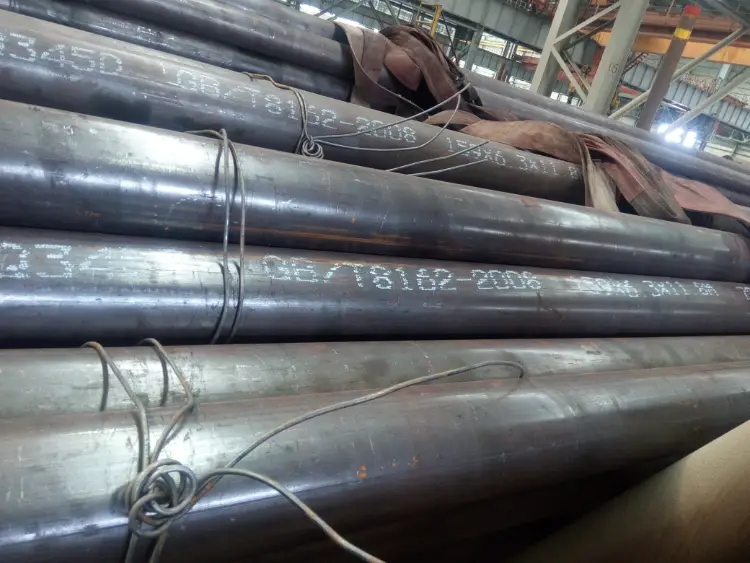
GB/T 8162 Q345 Seamless Structural Tube Material
GB/T 8162 Q345 Seamless Structural Tube: High-Strength Low-Alloy Steel for Critical Applications
Comprehensive analysis of Q345 seamless steel tubes per GB/T 8162 for structural purposes. Includes chemical composition, mechanical and physical properties, international equivalents, and application guidance.
Hot rolling, cold drawing, normalizing, tempering, stress relieving
- Phone : +8618037372205
- Email : [email protected]
- WhatsApp: Contact via Whtsapp
- WeChat: +8618037372205
GB/T 8162 Q345 Seamless Structural Tube Introduction
Q345 is a widely used Chinese low-alloy high-strength structural steel grade specified in GB/T 1591, adopted by GB/T 8162 for seamless steel tubes used in structural applications. It offers a minimum yield strength of 345 MPa, good weldability, and moderate toughness. The grade is available in various quality levels (A, B, C, D, E) with differing impact requirements. Q345 seamless tubes are typically delivered in hot-rolled or cold-drawn condition and may undergo normalizing or stress-relief heat treatment. The material is extensively used in construction, bridges, machinery, and offshore structures due to its balanced strength, ductility, and cost-effectiveness.
GB/T 8162 Q345 Seamless Structural Tube Chemical Composition
The chemical composition of Q345 steel for seamless tubes is specified in GB/T 1591-2018 (or the earlier GB/T 1591-2008 still referenced for Q345). Values represent typical limits for quality level B (Q345B). The steel is characterized by controlled carbon equivalent (CEV) to ensure weldability. Microalloying elements such as Nb, V, and Ti are added singly or in combination to achieve fine grain strengthening.
| Element | Standard Value (%) | Remarks |
|---|---|---|
| C | ≤ 0.20 | Carbon content limit |
| Si | ≤ 0.50 | Silicon |
| Mn | ≤ 1.70 | Manganese |
| P | ≤ 0.035 | Phosphorus |
| S | ≤ 0.035 | Sulfur |
| Nb | ≤ 0.07 | Niobium, optional grain refiner |
| V | ≤ 0.15 | Vanadium, optional strengthening element |
| Ti | ≤ 0.20 | Titanium, optional grain refiner |
| Cr | ≤ 0.30 | Chromium residual |
| Ni | ≤ 0.50 | Nickel residual |
| Cu | ≤ 0.20 | Copper residual |
| CEV | ≤ 0.45 (typical) | Carbon equivalent, depending on thickness |
GB/T 8162 Q345 Seamless Structural Tube Thermal and Electrical Physical Properties
The following physical properties are typical for Q345 steel and not mandatory per the tube standard. Data are valid at room temperature (20 °C) unless otherwise stated. Actual values may vary slightly with heat treatment and exact composition.
| Property | Standard / Typical Value | Unit | Test Condition |
|---|---|---|---|
| Density (ρ) | 7.85 | g/cm³ | 20 °C |
| Elastic Modulus (E) | 206 | GPa | 20 °C |
| Shear Modulus (G) | 79.4 | GPa | 20 °C |
| Poisson's Ratio (ν) | 0.3 | - | 20 °C |
| Thermal Expansion Coefficient (α) | 12.0 × 10⁻⁶ | K⁻¹ | 20–100 °C |
| Thermal Expansion Coefficient (α) | 13.2 × 10⁻⁶ | K⁻¹ | 20–200 °C |
| Thermal Expansion Coefficient (α) | 13.9 × 10⁻⁶ | K⁻¹ | 20–400 °C |
| Thermal Conductivity (λ) | 52.7 | W/(m·K) | 20 °C |
| Thermal Conductivity (λ) | 48.6 | W/(m·K) | 100 °C |
| Specific Heat Capacity | 470 | J/(kg·K) | 20–100 °C |
| Electrical Resistivity (ρ_e) | 0.23 | μΩ·m | 20 °C |
GB/T 8162 Q345 Seamless Structural Tube Mechanical Properties
Mechanical properties are specified according to GB/T 8162 and GB/T 1591. Values depend on wall thickness and heat treatment. Q345B is the most common quality for structural tubes. For thicknesses ≤ 16 mm, the minimum yield strength is 345 MPa. Impact energy is guaranteed only for quality levels B and above at specified test temperatures.
| Property | Standard Value | Unit | Test Condition |
|---|---|---|---|
| Yield Strength (ReH) | ≥ 345 | MPa | Wall thickness ≤ 16 mm |
| Yield Strength (ReH) | ≥ 335 | MPa | Wall thickness 16–40 mm |
| Yield Strength (ReH) | ≥ 325 | MPa | Wall thickness 40–63 mm |
| Tensile Strength (Rm) | 470–630 | MPa | Wall thickness ≤ 100 mm |
| Elongation (A) | ≥ 21 | % | Gauge length 5.65√S₀, thickness ≤ 16 mm |
| Elongation (A) | ≥ 20 | % | Gauge length 5.65√S₀, thickness 16–40 mm |
| Impact Energy (KV₂) | ≥ 34 | J | Q345B at +20 °C, longitudinal specimen |
| Impact Energy (KV₂) | ≥ 27 | J | Q345C at 0 °C |
| Impact Energy (KV₂) | ≥ 27 | J | Q345D at -20 °C |
| Bending Test | No cracks | - | Bend angle 180°, mandrel diameter 2a (a=specimen thickness) |
GB/T 8162 Q345 Seamless Structural Tube Equivalent Standards and Substitute Grades
| Country/Region | Standard | Grade | Remarks |
|---|---|---|---|
| China | GB/T 8162 | Q345 (Q345B, Q345C, etc.) | Original grade; quality level must match application |
| European Union | EN 10210-1 | S355J2H | Hot-finished structural hollow sections; minimum yield 355 MPa; J2 indicates 27 J at -20 °C |
| European Union | EN 10210-1 | S355J0H | If 0 °C impact is sufficient |
| International | ISO 630-2 | Fe 510 D | Structural steel plates; similar yield strength; D quality for low-temperature toughness |
| USA | ASTM A500 | Grade C | Cold-formed welded and seamless structural tubing; min yield 345 MPa; not identical impact requirements |
| Japan | JIS G 3106 | SM490A | Welded structural steel; min yield 325 MPa for thickness >16 mm; impact optional |
| Germany (historical) | DIN 17100 | St52-3 | Withdrawn; comparable to Q345 |
GB/T 8162 Q345 Seamless Structural Tube Application Introduction
Q345 seamless tubes per GB/T 8162 are designed for load-bearing structural applications where weight reduction and durability are critical. Their excellent weldability and machinability allow fabrication into complex trusses, frames, and mechanical components. The material performs reliably in ambient and low-temperature environments (depending on quality level) and can be galvanized or painted for corrosion protection.
Product Applications: Building columns and beams, Bridge arch ribs and truss members, Tower crane mast segments and jibs, Wind turbine towers (inner support structures), Hydraulic cylinder barrels, Scaffolding and support systems, Conveyor rollers and idlers, Offshore platform leg chords and braces
Processed into products: Tubular truss nodes, Spliced lattice girders, Cylindrical structural columns, Bracing pipes and cross arms, Bushings and spacers for heavy machinery, Telescopic boom sections for mobile cranes
Application industries: Civil engineering and construction, Bridge engineering, Machinery and equipment manufacturing, Offshore and marine structures, Energy transmission (towers and substations), Automotive and transportation (chassis, crane booms), Mining and heavy equipment
GB/T 8162 Q345 Seamless Structural Tube Similar and Alternative Materials
| Country/Region | Standard | Grade | Remarks |
|---|---|---|---|
| China | GB/T 1591 | Q355 (Q355B) | Current replacement for Q345; slightly higher yield strength; fully meets new design codes |
| USA | ASTM A572 | Grade 50 | High-strength low-alloy structural steel; yield 345 MPa; available in plates and shapes, not direct tube equivalent |
| USA | API 5L | X52 | Line pipe grade; yield 360 MPa; used for structural purpose when permitted |
| Europe | EN 10025-2 | S355JR | Hot-rolled structural steel; yield 355 MPa; suitable for welding; moderate toughness |
| Japan | JIS G 3444 | STK490 | Carbon steel tubes for general structural purposes; min tensile 490 MPa; yield around 325 MPa |
Notes:
- Q345 is being phased out in favor of Q355 (GB/T 1591-2018), but many projects still specify Q345; verify the required standard edition.
- For dynamic loading and fatigue-sensitive designs, ensure appropriate quality level (e.g., Q345D) to guarantee low-temperature toughness.
- Galvanizing of Q345 is possible but may require silicon-killed steel to avoid coating defects.
- The CEV should be limited to ≤0.43% if extensive welding is planned to avoid cold cracking.
- When substituting with EN S355J2H, confirm dimensional tolerances and delivery conditions as per EN 10210.
- Share



