
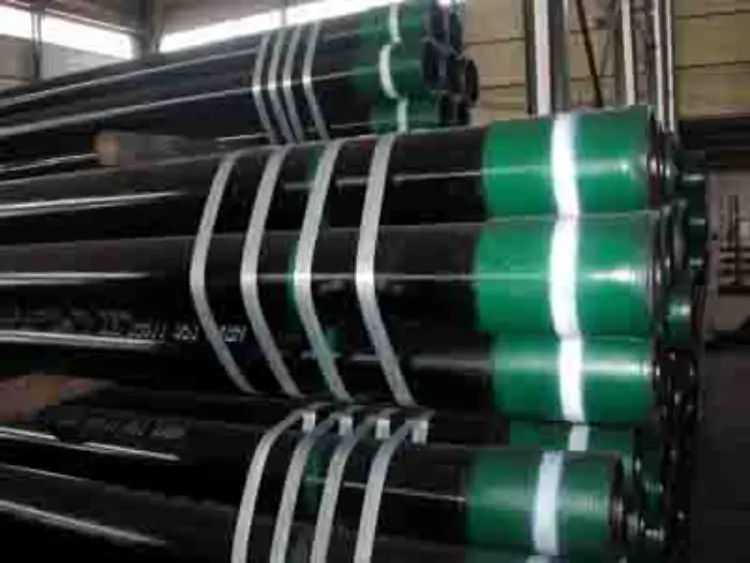
GB/T 8162 20CrMo Seamless Steel Pipes Material for Structural Purpose
GB/T 8162 20CrMo Seamless Steel Pipes for Structural Purpose - High-Strength Cr-Mo Alloy Steel Data
Comprehensive material data for 20CrMo structural seamless pipes under GB/T 8162, including chemical, mechanical, and physical properties with international equivalents and application guide.
Hot-rolled, cold-drawn, quenched and tempered, normalized, machined, welded
- Phone : +8618037372205
- Email : [email protected]
- WhatsApp: Contact via Whtsapp
- WeChat: +8618037372205
GB/T 8162 20CrMo Seamless Steel Pipes for Structural Purpose Introduction
20CrMo is a low-alloy chromium-molybdenum structural steel commonly supplied as seamless pipes per GB/T 8162 for general structural and mechanical engineering. It combines good hardenability with high strength and toughness after quenching and tempering. Key characteristics:
- Excellent high-temperature strength and creep resistance
- Good machinability in heat-treated condition
- Weldable with proper preheating and post-weld treatment
- Typical tensile strength ≥885 MPa after heat treatment
This steel is widely used for structural components, shafts, and pressure parts where moderate temperature performance is required.
GB/T 8162 20CrMo Seamless Steel Pipes for Structural Purpose Chemical Composition
Composition according to GB/T 3077 and applied in GB/T 8162 for seamless pipes. Trace elements are controlled to optimize mechanical properties and weldability. Phosphorus and sulfur are strictly limited to ensure toughness and avoid hot shortness.
| Element | Standard Value (%) | Remarks |
|---|---|---|
| Carbon (C) | 0.17 – 0.24 | Primary hardenability element |
| Silicon (Si) | 0.17 – 0.37 | Deoxidizer, enhances strength |
| Manganese (Mn) | 0.40 – 0.70 | Hardenability and deoxidizer |
| Phosphorus (P) | ≤ 0.030 | Maximum for toughness |
| Sulfur (S) | ≤ 0.030 | Maximum for machinability |
| Chromium (Cr) | 0.80 – 1.10 | Hardenability, oxidation resistance |
| Molybdenum (Mo) | 0.15 – 0.25 | High-temperature strength, creep resistance |
| Nickel (Ni) | ≤ 0.30 | Residual limit |
| Copper (Cu) | ≤ 0.20 | Residual limit |
GB/T 8162 20CrMo Seamless Steel Pipes for Structural Purpose Thermal and Electrical Physical Properties
Physical properties are typical for 20CrMo in the heat-treated condition and sourced from engineering handbooks. These values may vary with exact composition and microstructure. They are essential for design involving thermal loads, electrical resistance, and dimensional stability.
| Property | Typical Value | Unit | Test Condition |
|---|---|---|---|
| Density (ρ) | 7.85 | g/cm³ | At 20°C |
| Elastic Modulus (E) | 210 | GPa | At 20°C |
| Shear Modulus (G) | 80.8 | GPa | At 20°C (approximate) |
| Poisson's Ratio (ν) | 0.3 | — | At 20°C |
| Thermal Expansion Coefficient (α) | 11.5 | 10⁻⁶/K | 20 – 100°C |
| Thermal Expansion Coefficient (α) | 12.5 | 10⁻⁶/K | 20 – 200°C |
| Thermal Expansion Coefficient (α) | 13.0 | 10⁻⁶/K | 20 – 300°C |
| Thermal Expansion Coefficient (α) | 13.5 | 10⁻⁶/K | 20 – 400°C |
| Thermal Expansion Coefficient (α) | 14.0 | 10⁻⁶/K | 20 – 500°C |
| Thermal Conductivity (λ) | 44.0 | W/(m·K) | At 100°C |
| Thermal Conductivity (λ) | 42.0 | W/(m·K) | At 200°C |
| Thermal Conductivity (λ) | 39.0 | W/(m·K) | At 300°C |
| Thermal Conductivity (λ) | 36.0 | W/(m·K) | At 400°C |
| Thermal Conductivity (λ) | 33.0 | W/(m·K) | At 500°C |
| Specific Heat Capacity | 460 | J/(kg·K) | At 20°C |
| Specific Heat Capacity | 500 | J/(kg·K) | At 200°C |
| Specific Heat Capacity | 550 | J/(kg·K) | At 400°C |
| Electrical Resistivity (ρₑ) | 0.23 | µΩ·m | At 20°C |
GB/T 8162 20CrMo Seamless Steel Pipes for Structural Purpose Mechanical Properties
Properties per GB/T 8162 for 20CrMo seamless pipes after quenching and tempering. Impact values may be required by purchaser; typical data from GB/T 3077 is provided for reference. Note: Hardness is not a delivery requirement for pipes but is given for guidance.
| Property | Standard Required Value | Unit | Test Condition |
|---|---|---|---|
| Tensile Strength (Rm) | ≥ 885 | MPa | Longitudinal, room temperature |
| Yield Strength (ReH) | ≥ 685 | MPa | 0.2% offset, room temperature |
| Elongation (A) | ≥ 12 | % | Gauge length 5.65√So |
| Bend Test | Not required | — | Not specified for alloy steel pipes in GB/T 8162 |
| Impact Energy (KV₂) | ≥ 78 (reference from GB/T 3077; pipe may require ≥47 J if agreed) | J | Room temperature, Charpy V-notch |
| Hardness | ≤ 229 (reference from GB/T 3077 after Q&T) | HBW | After quench and temper |
GB/T 8162 20CrMo Seamless Steel Pipes for Structural Purpose Directly Equivalent Material Standards and Replacement Grades
| Country/Region | Standard | Grade | Remarks |
|---|---|---|---|
| China | GB/T 3077 | 20CrMo | Original alloy structural steel standard |
| ISO | ISO 683-2 | 20CrMo4 (1.7264) | Internationally equivalent Cr-Mo steel |
| EU | EN 10084 | 20CrMo4 (1.7264) | Identical composition; widely interchangeable |
| Japan | JIS G4105 | SCM420 | Close match; Mo 0.15–0.30 slightly wider |
| USA | ASTM A519 / ASTM A29 | 4118 (AISI/SAE 4118) | Approximate equivalent; carbon 0.18–0.23, Cr 0.80–1.10, Mo 0.15–0.25 |
| Germany | DIN 17200 / EN 10084 | 20CrMo4 (1.7264) | Same as EU grade |
GB/T 8162 20CrMo Seamless Steel Pipes for Structural Purpose Application Introduction
20CrMo seamless pipes are designed for structural and mechanical applications requiring high strength, good toughness, and moderate temperature performance. They are typically heat treated to achieve the required mechanical properties. Common industries and products:
Product Applications: Structural frameworks, High-pressure piping systems, Hydraulic cylinder tubes, Crankshafts and connecting rods, Gears and shafts, Bicycle frames (high-end) and motorcycle parts
Processed into products: Quenched and tempered tubes for crane booms, Drill pipe and tool joints (non-corrosive service), Bearing rings, Sprockets and rollers, Steam turbine stem parts (low temperature), Automotive half shafts and steering components
Application industries: Machinery manufacturing, Automotive and transportation, Pressure vessel and boiler construction, Oil and gas (structural supports, non-corrosive piping), Power generation, General engineering structures
GB/T 8162 20CrMo Seamless Steel Pipes for Structural Purpose Similar/Alternative Materials with Comparable Properties
| Country/Region | Standard | Grade | Remarks |
|---|---|---|---|
| China | GB/T 3077 | 20CrMnMo | Higher hardenability (added Mn); strength >20CrMo |
| China | GB/T 3077 | 15CrMo | Lower carbon (0.12–0.18), better weldability, heat-resistant |
| China | GB/T 3077 | 25CrMo | Higher carbon (0.22–0.29), higher strength, lower toughness |
| Japan | JIS G4105 | SCM415 | Case-hardening steel with lower carbon (0.13–0.18) |
| USA | ASTM A519 | 4130 | Higher C & Cr strength; widely used for similar structural tubes |
Notes:
- Recommended heat treatment: austenitize at 880°C (oil or water quench), temper at 500–550°C for optimum strength-toughness balance.
- Welding: preheat to 150–300°C, use low-hydrogen consumables, and apply post-weld heat treatment (500–650°C) to prevent cracking.
- Pipe ends: plain, beveled, or threaded per purchaser requirements.
- Surface protection: painting, galvanizing, or oil coating may be applied for corrosion resistance.
- Dimensional tolerances and lengths comply with GB/T 8162; additional testing (ultrasonic, eddy current) available on request.
- Share



