
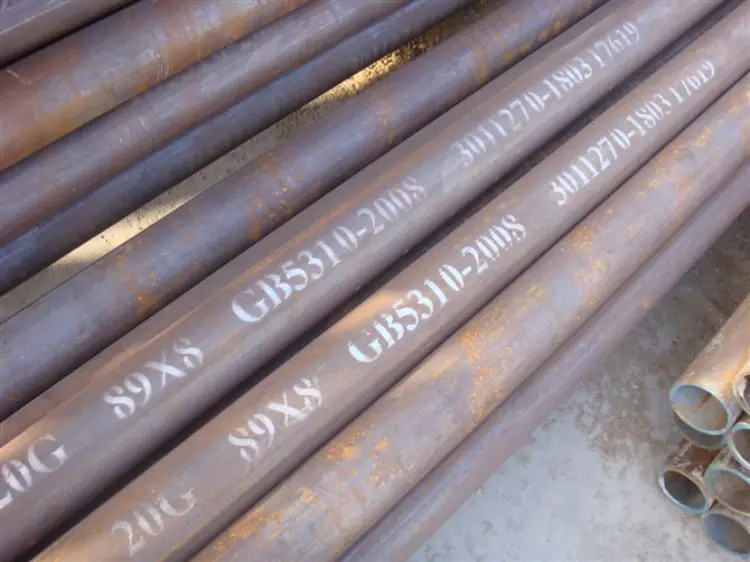
GB/T 8162 20Cr Seamless Steel Pipe Material for Structural Use
GB/T 8162 20Cr Seamless Steel Pipe for Structural Use - Expert Data & Equivalents
Comprehensive material data sheet for 20Cr seamless steel pipe manufactured to GB/T 8162 standard. Includes chemical composition, mechanical & physical properties, international equivalents, and application guidance for structural engineering.
Hot rolling, cold drawing, heat treatment (normalizing, quenching and tempering), machining, welding
- Phone : +8618037372205
- Email : [email protected]
- WhatsApp: Contact via Whtsapp
- WeChat: +8618037372205
GB/T 8162 20Cr Seamless Steel Pipe for Structural Use Introduction
GB/T 8162 20Cr is a Chinese standard seamless steel pipe made from alloy structural steel grade 20Cr (conforming to GB/T 3077). It is widely utilized for manufacturing structural parts and components in machinery, automotive, and general engineering. The steel offers a favorable combination of strength, toughness, and hardenability after appropriate heat treatment.
- Key features: Good balance of tensile strength (≥410 MPa after normalizing), moderate yield strength, and satisfactory elongation; capable of being hardened by quenching and tempering to achieve higher mechanical properties (Rm≥835 MPa).
- Delivery condition: Usually supplied in hot-rolled or normalized condition; can be ordered with specific heat treatment requirements.
- Weldability: Fair, requires preheating and post-weld heat treatment for thicker sections.
- Machinability: Acceptable in normalized or annealed condition.
GB/T 8162 20Cr Seamless Steel Pipe for Structural Use Chemical Composition
The chemical composition of 20Cr steel used for seamless pipes must adhere to GB/T 3077-2015 (Alloy Structural Steels). The limits below represent the ladle analysis as specified by the standard. Residual elements are controlled to maintain consistent hardenability and mechanical properties. Note: For pipe products, slight deviations in certain elements may be permitted by GB/T 8162 when agreed upon.
| Element | Standard Value (%) | Remarks |
|---|---|---|
| Carbon (C) | 0.18 – 0.24 | Key for hardenability and strength |
| Silicon (Si) | 0.17 – 0.37 | Deoxidizer, strengthens ferrite |
| Manganese (Mn) | 0.50 – 0.80 | Improves strength and hardenability |
| Chromium (Cr) | 0.70 – 1.00 | Primary alloying element for hardenability and wear resistance |
| Phosphorus (P) | ≤ 0.035 | Impurity, restricts ductility and toughness |
| Sulfur (S) | ≤ 0.035 | Impurity, affects machinability and hot workability |
| Nickel (Ni) | ≤ 0.30 (residual) | Not intentionally added; may appear as residual |
| Copper (Cu) | ≤ 0.25 (residual) | Residual element; higher levels may cause hot shortness |
| Iron (Fe) | Balance (approx. 97.0–98.0) | Remainder |
GB/T 8162 20Cr Seamless Steel Pipe for Structural Use Physical Properties
The physical properties listed below are typical for 20Cr alloy steel at ambient temperature or over specified temperature ranges, sourced from recognized engineering databases and literature. These values are not mandatory but serve as design references. Variations may occur due to exact chemical composition, heat treatment, and processing history. Properties are measured on wrought material with a density about 7.83 g/cm³.
| Property | Typical Value | Unit | Test Condition / Temperature |
|---|---|---|---|
| Density (ρ) | 7.83 | g/cm³ | At 20 °C |
| Modulus of elasticity (E) | 206 | GPa | At 20 °C |
| Shear modulus (G) | 79.4 | GPa | At 20 °C, calculated from E and ν |
| Poisson's ratio (ν) | 0.30 | – | At 20 °C |
| Coefficient of thermal expansion (α) | 11.5 | 10⁻⁶/K | Between 20 °C and 100 °C |
| Coefficient of thermal expansion (α) | 12.5 | 10⁻⁶/K | Between 20 °C and 400 °C |
| Thermal conductivity (λ) | 44.0 | W/(m·K) | At 100 °C |
| Thermal conductivity (λ) | 38.5 | W/(m·K) | At 400 °C |
| Specific heat capacity (cp) | 460 | J/(kg·K) | At 20 °C |
| Electrical resistivity (ρe) | 0.19 × 10⁻⁶ | Ω·m | At 20 °C |
GB/T 8162 20Cr Seamless Steel Pipe for Structural Use Mechanical Properties
Mechanical properties for 20Cr seamless steel pipe are defined in GB/T 8162-2018. Values depend on the delivery condition. Pipe in the normalized condition must meet the minimum values listed. For applications demanding higher strength, the steel can be quenched and tempered; the corresponding reference values from GB/T 3077 are provided for information. Testing conditions: room temperature, longitudinal test specimens taken from the pipe wall in accordance with the standard.
| Property | Required Value | Unit | Test Condition / Remarks |
|---|---|---|---|
| Tensile strength (Rm) | ≥ 410 | MPa | Delivery condition: normalized (or hot-rolled + normalized) |
| Lower yield strength (ReL) | ≥ 245 | MPa | Delivery condition: normalized |
| Elongation after fracture (A) | ≥ 20 | % | Gauge length 5.65√S₀; normalized condition |
| Impact absorbed energy (KV₂) | ≥ 39 | J | At room temperature (20 °C); normalized condition, V-notch |
| Tensile strength (Rm) – quenched & tempered | ≥ 835 | MPa | Reference: GB/T 3077 (after quenching from 880 °C, tempering 500 °C) |
| Yield strength (Rp0.2) – quenched & tempered | ≥ 540 | MPa | Reference: GB/T 3077 |
| Elongation (A) – quenched & tempered | ≥ 10 | % | Reference: GB/T 3077 |
| Reduction of area (Z) – quenched & tempered | ≥ 40 | % | Reference: GB/T 3077 |
| Impact absorbed energy (KU₂) – quenched & tempered | ≥ 47 | J | Reference: GB/T 3077 |
GB/T 8162 20Cr Seamless Steel Pipe for Structural Use Directly Equivalent Material Standards & Substitutable Grades
| Country / Region | Standard | Grade | Remarks |
|---|---|---|---|
| China | GB/T 8162 / GB/T 3077 | 20Cr | Original standard; structural seamless pipe in normalized or heat-treated condition |
| International (ISO) | ISO 683-2 | 20Cr4 | Equivalent alloy structural steel; similar hardenability and typical uses |
| European Union | EN 10084 | 20Cr4 (1.7027) | Case-hardening steel, chemically matching 20Cr; suitable for similar structural pipes |
| Japan | JIS G4051 | SCr420 | Mechanical structure steel, often used for seamless pipe and auto parts |
| USA | ASTM A29/A29M | 5120 | Alloy steel grade with overlapping composition; not a pipe standard but widely used for bars, can be adapted |
GB/T 8162 20Cr Seamless Steel Pipe for Structural Use Application Introduction
20Cr seamless steel pipes are specifically designed for structural purposes where a combination of moderate strength, good toughness, and cost-efficiency is required. After normalizing or quench-and-tempering, the material exhibits consistent performance in welded and mechanical structures. Key application areas:
- Automotive industry: tubular frames, drive shafts, axle components
- Machinery manufacturing: hydraulic cylinders, bushings, conveyor rollers
- Civil engineering: structural columns, scaffolding, handrails
- Energy sector: structural parts in oil & gas platforms, pipe supports
Product Applications: Structural hollow sections for frames and chassis, Hydraulic cylinder tubes, Bushings and sleeves, Drive shafts and propeller shafts, Conveyor and roller tubes, Scaffolding tubes and couplers, Heat exchanger structural components (non-pressure parts)
Processed into products: Automotive engine mounting brackets, Gear shift rails and selector forks, Bearing housings, Tube yokes and universal joint sleeves, Agricultural machine linkage tubes, Crane boom lattice members, Mechanical support legs and stand tubes, Coupling and flange connectors
Application industries: Automotive and transportation, Mechanical engineering, Construction and infrastructure, Oil & Gas (structural supports), Agricultural machinery, Industrial equipment manufacturing
GB/T 8162 20Cr Seamless Steel Pipe for Structural Use Similar / Analogous Materials for Possible Substitution
| Country / Region | Standard | Grade | Remarks |
|---|---|---|---|
| China | GB/T 3077 | 20CrMn | Slightly higher hardenability due to manganese addition; can replace 20Cr in many structural applications |
| China | GB/T 3077 | 20CrMnTi | Ti microalloyed variant with improved grain refinement; often used for gears, requires case-hardening |
| European Union | EN 10084 | 20MnCr5 (1.7147) | Better hardenability than 20Cr, widely used in Europe for structural pipes and powertrain components |
| USA | ASTM A29 | 5115 | Approximate alternative to 5120/20Cr with lower carbon; suitable for less demanding structural tubing |
Notes:
Additional information:
- For critical applications, ultrasonic testing or eddy current inspection may be specified to ensure internal soundness of the seamless pipe.
- Heat treatment details for achieving the quenched & tempered mechanical properties: austenitize at 880 °C, quench in oil or water, temper at 500–550 °C.
- Welding of 20Cr pipes: low-hydrogen electrodes and preheating (150–250 °C) are recommended; stress relief annealing at 600–650 °C after welding is beneficial.
- Corrosion resistance is limited; surface protection or painting is usually required for outdoor or corrosive environments.
- Standard dimensional tolerances and geometric requirements follow the provisions of GB/T 8162 and the applicable pipe dimension standard (e.g., GB/T 17395).
- Share



