
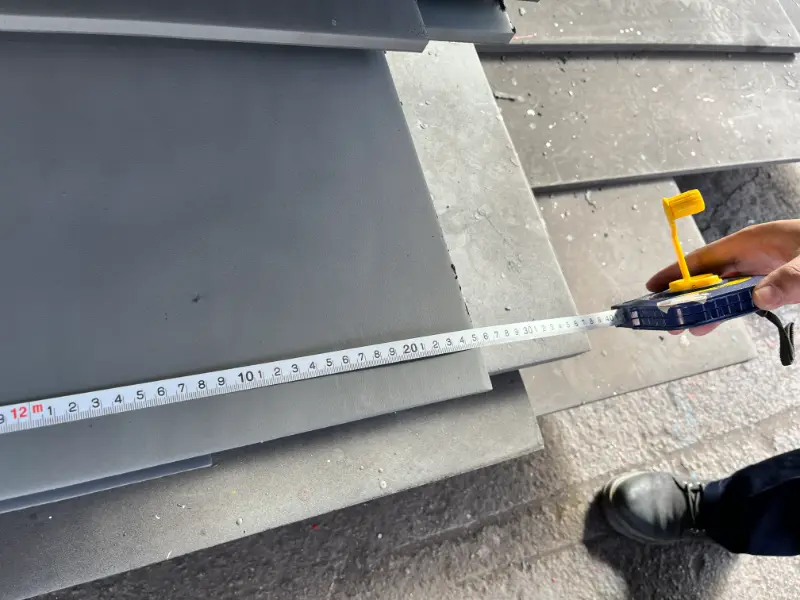
GB/T 3094 Q460C Cold Drawn Square & Rectangular Hollow Sections
GB/T 3094 Q460C Cold Drawn Square & Rectangular Hollow Sections - Material Data
Detailed material data for Q460C cold drawn square and rectangular hollow section pipes according to GB/T 3094, including chemical composition, mechanical properties, thermal properties, and international equivalents.
Cold drawing, hot rolling (for mother tube), welding (if welded tube used), normalizing, stress relieving, cutting, bending, welding, machining
- Phone : +8618037372205
- Email : [email protected]
- WhatsApp: Contact via Whtsapp
- WeChat: +8618037372205
GB/T 3094 Q460C Cold Drawn Square & Rectangular Hollow Sections Introduction
Q460C is a low-alloy high-strength structural steel designated in GB/T 1591, widely used as the raw material for cold-drawn special-shaped tubes conforming to GB/T 3094. This grade offers a minimum yield strength of 460 MPa with good weldability and toughness, suitable for heavy structural applications. The hollow sections are produced by cold drawing from hot-rolled or welded mother tubes, ensuring precise dimensions and smooth surface finish. Typical delivery condition is as-cold-drawn or with subsequent normalizing to relieve residual stresses. SHS and RHS profiles are preferred in architecture, machinery, and framework structures due to their high strength-to-weight ratio and torsional stiffness.
GB/T 3094 Q460C Cold Drawn Square & Rectangular Hollow Sections Chemical Composition
The chemical composition of Q460C steel is controlled to ensure the required high strength and good weldability. Microalloying elements such as Nb, V, Ti are added for grain refinement and precipitation strengthening. Maximum sulfur and phosphorus contents are restricted to improve toughness and formability. Carbon equivalent (CEV) is usually limited to ≤0.47 for thickness ≤16 mm to guarantee weldability without preheating under normal conditions.
| Chemical Element | Standard Value | Remarks |
|---|---|---|
| Carbon (C) | ≤0.20% | Max. 0.20 for thickness ≤16 mm; for larger thickness slightly higher may be agreed. |
| Silicon (Si) | ≤0.55% | Deoxidation effect. |
| Manganese (Mn) | 1.00 – 1.70% | Primary solid-solution strengthener. |
| Phosphorus (P) | ≤0.030% | Restricted for toughness. |
| Sulfur (S) | ≤0.030% | Restricted for ductility. |
| Niobium (Nb) | 0.015 – 0.060% | Grain refinement. |
| Vanadium (V) | 0.02 – 0.20% | Precipitation strengthening. |
| Titanium (Ti) | 0.02 – 0.20% | Grain refinement and deoxidation. |
| Chromium (Cr) | ≤0.30% | Residual element. |
| Nickel (Ni) | ≤0.30% | Residual element. |
| Copper (Cu) | ≤0.30% | Residual element. |
| Molybdenum (Mo) | ≤0.10% | Residual element. |
| Nitrogen (N) | ≤0.012% | Controlled to avoid embrittlement. |
| Aluminium (Al) | ≥0.015% | Grain refining and deoxidation. |
GB/T 3094 Q460C Cold Drawn Square & Rectangular Hollow Sections Thermal, Electrical and Physical Properties
Physical properties are typical for low-alloy structural steel and are applicable to Q460C in the as-delivered condition. These values are useful for design calculations involving thermal expansion, heat transfer, and electrical resistivity. Density slightly decreases with temperature, thermal conductivity and expansion are average for ferritic steels.
| Property | Typical Value | Unit | Test Condition |
|---|---|---|---|
| Density (ρ) | 7.85 | g/cm³ | 20°C |
| Elastic modulus (E) | 206 | GPa | 20°C, static tensile test |
| Shear modulus (G) | 79.3 | GPa | 20°C (calculated from E and ν) |
| Poisson's ratio (ν) | 0.3 | - | 20°C |
| Thermal expansion coefficient (α) | 12.0 | 10⁻⁶/K | 20°C to 100°C |
| Thermal expansion coefficient (α) | 12.5 | 10⁻⁶/K | 20°C to 200°C |
| Thermal expansion coefficient (α) | 13.0 | 10⁻⁶/K | 20°C to 300°C |
| Thermal conductivity (λ) | 45 | W/(m·K) | 20°C |
| Thermal conductivity (λ) | 43 | W/(m·K) | 100°C |
| Thermal conductivity (λ) | 40 | W/(m·K) | 200°C |
| Specific heat capacity (cₚ) | 460 | J/(kg·K) | 20°C |
| Specific heat capacity (cₚ) | 480 | J/(kg·K) | 100°C |
| Electrical resistivity (ρₑ) | 0.22 | μΩ·m | 20°C |
GB/T 3094 Q460C Cold Drawn Square & Rectangular Hollow Sections Mechanical Properties
The mechanical properties of cold-drawn Q460C hollow sections are based on the base metal properties from GB/T 1591 and the cold working effect. The values below are typical for the base steel in normalized condition; actual tube properties depend on cold drawing reduction and subsequent treatment. For welded tubes, the HAZ properties are also validated. Tensile testing is performed on samples taken from the tube or from a flattening strip according to GB/T 3094. Impact test temperature for Q460C is 0°C.
| Property | Standard Requirement | Unit | Test Condition |
|---|---|---|---|
| Upper yield strength (ReH) | ≥460 | MPa | Thickness ≤16 mm, transverse sample |
| Upper yield strength (ReH) | ≥450 | MPa | Thickness >16 mm and ≤40 mm |
| Tensile strength (Rm) | 550 – 720 | MPa | All thicknesses |
| Elongation after fracture (A) | ≥17 | % | Gauge length 5.65√S₀, longitudinal |
| Bend test (mandrel diameter) | Bend angle 180°, d=3a (a: thickness) | - | Tensile surface free from cracks |
| Impact absorbed energy (KV₂) | ≥34 | J | At 0°C, longitudinal sample |
| Vickers hardness | ~180 – 230 | HV10 | Typical value after normalizing (not mandatory) |
GB/T 3094 Q460C Cold Drawn Square & Rectangular Hollow Sections Exact Equivalent Material Standards and Replaceable Grades
| Country/Region | Standard | Grade | Remarks |
|---|---|---|---|
| China | GB/T 1591-2018 | Q460C | Base steel; also used for plates, strips, sections |
| International | ISO 630-3:2023 | S460N / S460M | S460N normalized, S460M TMCP; similar strength and toughness |
| European Union | EN 10025-3:2019 | S460N / S460NL | Hot rolled, normalized or normalized rolled; NL for low temperature toughness |
| European Union | EN 10025-4:2019 | S460M / S460ML | TMCP; comparable mechanical properties |
| USA | ASTM A572/A572M-21 | Grade 65 (450 MPa min) | Slightly lower yield strength; Q460C can substitute where design permits |
| Japan | JIS G 3106:2020 | SM570 | Tensile strength ≥570 MPa; similar weldable high strength steel |
GB/T 3094 Q460C Cold Drawn Square & Rectangular Hollow Sections Application Introduction
Q460C cold-drawn square and rectangular hollow sections offer a combination of high strength, good dimensional accuracy, and surface quality. They are suitable for both static and dynamic loading applications. The sections can be readily cut, drilled, welded (with low-hydrogen processes) and hot-dip galvanized. Typical industries and uses include:
Product Applications: Structural columns and beams for multi-story buildings, Trusses and space frames for large-span roofs, Crane booms and lattice masts, Chassis rails and sub-frames for trucks and trailers, Offshore platform walkways and handrails, Telecommunication towers and transmission line poles, Greenhouse frames and agricultural tunnel structures
Processed into products: Welded connections (end plates, gusset plates, stiffeners), Bolted joints with high-strength bolts, Machined pins and brackets attached to the sections, Bent or formed elbows from straight lengths (with spot heating if required), End caps and base plates for columns, Telescopic elements (male/female sliding members)
Application industries: Construction & infrastructure (steel structures, skyscrapers, stadiums, airports, railway stations, bridges), Special vehicles (trailer chassis, mobile crane booms, concrete pump truck booms, truck frames), Agricultural machinery (heavy harvesters, spraying booms, livestock equipment), Mining & material handling (conveyor gantries, crusher frames, hoppers), Machinery manufacturing (frames for heavy presses, injection molding machines, robotic arms), Energy sector (solar tracker supports, wind turbine towers internal platforms, oil & gas platforms)
GB/T 3094 Q460C Cold Drawn Square & Rectangular Hollow Sections Similar/Comparable Substitute Materials
| Country/Region | Standard | Grade | Remarks |
|---|---|---|---|
| China | GB/T 1591 | Q460D / Q460E | Higher toughness grades (D: -20°C, E: -40°C) for more severe conditions |
| China | GB/T 1591 | Q550C | Higher strength grade (550 MPa yield), may require redesign for weight savings |
| European | EN 10025-6 | S500Q | Quenched and tempered, higher yield, different product form |
| USA | ASTM A514 | Grade H | High yield quenched and tempered plate steel; similar strength but different production route |
| Worldwide | ISO 24314 | S460G1+M | Structural steel for offshore structures, comparable strength |
Notes:
- Dimensional tolerances for SHS/RHS are according to GB/T 3094, including side length, wall thickness, corner radius and straightness.
- For welded hollow sections, weld seam quality must comply with GB/T 3094; eddy current or ultrasonic testing may be specified.
- Cold-drawn tubes may exhibit residual stresses that can cause distortion during welding or machining; stress-relief annealing (580–620°C) is recommended for critical applications.
- Surface protection: as-drawn tubes can be protected with anti-rust oil, or hot-dip galvanized to EN ISO 1461 after fabrication.
- CEV typical: ≤0.47 for thickness ≤16 mm; for larger thickness consult supplier.
- Share



