
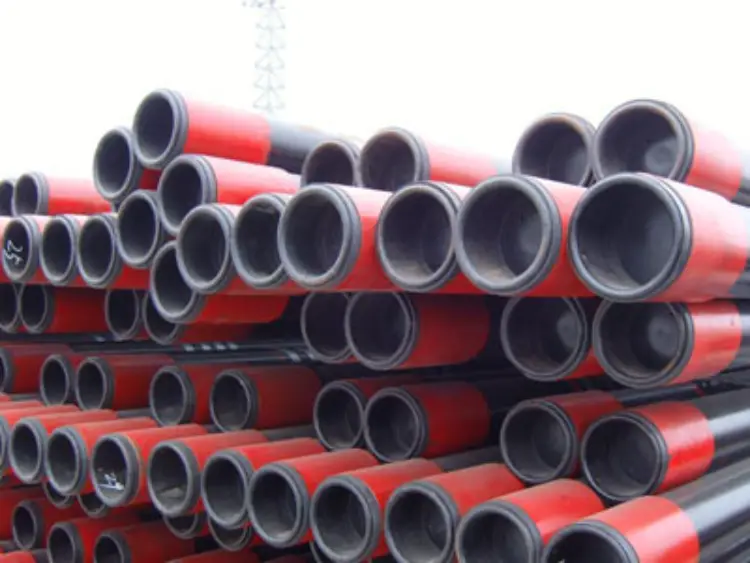
GB/T 1591 Q460E LSAW Steel Pipe
Q460E LSAW Steel Pipe - GB/T 1591 High-Strength Low-Alloy Steel Data
Complete material data for Q460E steel used in LSAW pipes, including chemical composition, mechanical properties at various thicknesses, thermal-physical properties, and international equivalent grades.
Welding (LSAW, SAW), hot rolling, normalizing, thermo-mechanical rolling (TMCP), cold forming
- Phone : +8618037372205
- Email : [email protected]
- WhatsApp: Contact via Whtsapp
- WeChat: +8618037372205
GB/T 1591 Q460E LSAW Steel Pipe Introduction
Q460E is a Chinese standard high-strength low-alloy (HSLA) structural steel defined in GB/T 1591-2018. It is commonly supplied as hot-rolled plates, strips, and welded pipes, including LSAW (Longitudinal Submerged Arc Welded) pipes. The grade offers a minimum yield strength of 460 MPa in thin sections and maintains good weldability, fine grain structure, and assured impact toughness down to -40°C (quality E). Typical applications include oil and gas transmission pipelines, heavy structural frames, bridges, pressure vessels, and offshore engineering. The steel can be delivered in normalized or thermo-mechanically rolled conditions, providing an excellent balance of strength, ductility, and low-temperature performance.
GB/T 1591 Q460E LSAW Steel Pipe Chemical Composition
Chemical composition according to GB/T 1591-2018 for Q460E. The grade is microalloyed with Nb, V, Ti, and optional Cr, Ni, Mo for grain refinement and strength. A minimum total aluminum content ensures deoxidation. The carbon equivalent (CEV) typically ≤0.45% is advised for welding.
| Chemical Element | Standard Value (%) | Remarks |
|---|---|---|
| Carbon (C) | ≤0.20 | Ladle analysis |
| Silicon (Si) | ≤0.60 | Ladle analysis |
| Manganese (Mn) | ≤1.80 | Ladle analysis |
| Phosphorus (P) | ≤0.025 | Ladle analysis |
| Sulfur (S) | ≤0.020 | Ladle analysis |
| Niobium (Nb) | ≤0.11 | Microalloy, optional |
| Vanadium (V) | ≤0.20 | Microalloy, optional |
| Titanium (Ti) | ≤0.20 | Microalloy, optional |
| Chromium (Cr) | ≤0.30 | Optional |
| Nickel (Ni) | ≤0.80 | Optional |
| Molybdenum (Mo) | ≤0.30 | Optional |
| Copper (Cu) | ≤0.55 | Optional |
| Nitrogen (N) | ≤0.015 | Ladle analysis |
| Boron (B) | ≤0.004 | Optional, may be added |
| Aluminium (Als) | ≥0.015 | Total aluminium, minimum |
GB/T 1591 Q460E LSAW Steel Pipe Thermal and Electrical Physical Properties
Representative physical properties of Q460E / HSLA steel at room temperature and elevated temperatures. Data are generic for low-alloy structural steels and serve as engineering reference. Actual values may vary slightly with specific heat treatment and composition.
| Property | Value | Unit | Test Condition / Remarks |
|---|---|---|---|
| Density (ρ) | 7.85 | g/cm³ | At 20°C |
| Modulus of Elasticity (E) | 206 | GPa | At 20°C |
| Shear Modulus (G) | 79.3 | GPa | At 20°C |
| Poisson's Ratio (ν) | 0.30 | — | At 20 °C |
| Thermal Expansion Coefficient (α) | 12.0 | 10⁻⁶/K | 20°C – 100°C |
| Thermal Expansion Coefficient (α) | 12.6 | 10⁻⁶/K | 20°C – 200°C |
| Thermal Expansion Coefficient (α) | 13.1 | 10⁻⁶/K | 20°C – 300°C |
| Thermal Conductivity (λ) | 45 | W/(m·K) | At 20°C |
| Specific Heat Capacity (c) | 460 | J/(kg·K) | At 20°C |
| Electrical Resistivity (ρ_e) | 0.15 | μΩ·m | At 20°C |
GB/T 1591 Q460E LSAW Steel Pipe Mechanical Properties
Mechanical properties of Q460E according to GB/T 1591-2018, valid for flat products (plates supplying LSAW pipes). Yield strength and elongation depend on thickness. Impact energy is guaranteed for -40°C (quality E). Bending requirements are for reference; actual manufacturing may employ different bend radii.
| Property | Value | Unit | Test Condition / Thickness |
|---|---|---|---|
| Yield Strength (ReH) | ≥460 | MPa | t ≤ 16 mm |
| Yield Strength (ReH) | ≥440 | MPa | 16 mm < t ≤ 40 mm |
| Yield Strength (ReH) | ≥420 | MPa | 40 mm < t ≤ 63 mm |
| Yield Strength (ReH) | ≥400 | MPa | 63 mm < t ≤ 80 mm |
| Yield Strength (ReH) | ≥380 | MPa | 80 mm < t ≤ 100 mm |
| Yield Strength (ReH) | ≥360 | MPa | 100 mm < t ≤ 150 mm |
| Tensile Strength (Rm) | 550 – 720 | MPa | All thicknesses |
| Elongation (A) | ≥17 | % | t ≤ 40 mm, gauge 5.65√So |
| Elongation (A) | ≥16 | % | 40 mm < t ≤ 63 mm |
| Elongation (A) | ≥15 | % | 63 mm < t ≤ 100 mm |
| Elongation (A) | ≥14 | % | 100 mm < t ≤ 150 mm |
| Impact Energy (KV2) | ≥31 | J | -40°C, longitudinal (E grade) |
| Bend Test | d=2a | — | 180°, t ≤ 16 mm |
| Bend Test | d=3a | — | 180°, t > 16 mm |
GB/T 1591 Q460E LSAW Steel Pipe Fully Equivalent Standards and Grades – Direct Replacements
| Country / Region | Standard | Grade | Remarks |
|---|---|---|---|
| China | GB/T 1591-2018 | Q460E | Original material, direct source |
| Europe | EN 10025-4:2004+A1:2019 | S460ML | Thermo-mechanically rolled, -50°C impact; chemistry slightly different but considered equivalent for structural applications. Impact test temperature lower than Q460E (ML guarantees -50°C). |
| International | ISO 630-3:2012 | E460DD | Delivery condition D: hot-rolled, normalised; impact values at -20°C or -50°C depending on quality; close match when -40°C impact is agreed. |
| International | ISO 4950-2:1995 | E460DD | High yield strength steel plates; similar strength and toughness; requires verification of delivery conditions. |
| USA | ASTM A572/A572M | Grade 65 [450] | Yield strength 450 MPa (65 ksi), lower than Q460E; not directly equivalent but often used as a substitute with thickness adjustment. |
GB/T 1591 Q460E LSAW Steel Pipe Application Introduction
Q460E steel, when formed into LSAW pipes, is widely utilised in large-diameter, high-pressure environments. The combination of high yield strength, excellent low-temperature toughness, and good weldability makes it suitable for critical infrastructure.
Product Applications: Longitudinal submerged arc welded (LSAW) pipes, Spiral submerged arc welded (SSAW) pipes (if steel strip is used), Heavy-wall structural hollow sections, Casing pipes for foundation and piling, High-pressure fluid transporting pipes
Processed into products: Pipeline segments for oil and gas trunklines, Offshore platform jacket legs and braces, Bridge main girders and arch ribs, Tower and mast components, Piling tubes for wharf and foundation construction, Pressure vessel cylindrical shells, Ventilation and process piping in industrial plants
Application industries: Oil & Gas (onshore and offshore pipeline networks), Water transmission and distribution, Structural engineering (buildings, bridges, tower structures), Heavy machinery and construction equipment, Shipbuilding and marine structures, Pressure vessel and storage tank fabrication
GB/T 1591 Q460E LSAW Steel Pipe Close/Similar Alternative Materials – Performance and Usage Comparison
| Country / Region | Standard | Grade | Remarks |
|---|---|---|---|
| USA | ASTM A633/A633M | Grade E (Type 2) | Normalized high-strength low-alloy structural steel; yield strength min. 290-415 MPa depending on thickness; impact tested at -40°C but strength range is lower, making it a candidate only for less demanding strength requirements. |
| Japan | JIS G3106 | SM570 | Yield strength ≥460 MPa for thickness ≤16 mm, tensile 570-720 MPa, impact energy at -5°C (typical). Good substitute if impact temperature is upgraded to -40°C by agreement. |
| Europe | EN 10025-6 | S460QL/S460QL1 | Quenched and tempered structural steel; guaranteed impact at -40°C or -60°C; very high strength and good weldability, but delivery condition differs from Q460E (QT vs. TMCP/normalized). |
| China | GB/T 714 | Q460qE | Bridge structural steel; similar strength and -40°C impact; specialised for bridges, may be used in pipe applications with additional approval. |
Notes:
Additional considerations for Q460E LSAW pipes:
- Pre-weld and post-weld heat treatment may be required depending on wall thickness and service conditions.
- Carbon equivalent (CEV) should be controlled to ≤0.45% to ensure cold cracking resistance.
- For sour service applications, hydrogen-induced cracking (HIC) and sulfide stress cracking (SSC) tests are typically required per NACE MR0175/ISO 15156.
- LSAW pipe dimensional standards often follow API 5L or GB/T 9711, depending on the project specification.
- Third-party certification (e.g., DNV, Lloyd's Register) is common for offshore and structural pipe.
- Typical delivery condition: hot-rolled plate, normalised or thermo-mechanically controlled processed (TMCP), and formed into pipe by JCOE or UOE process.
- Share



