
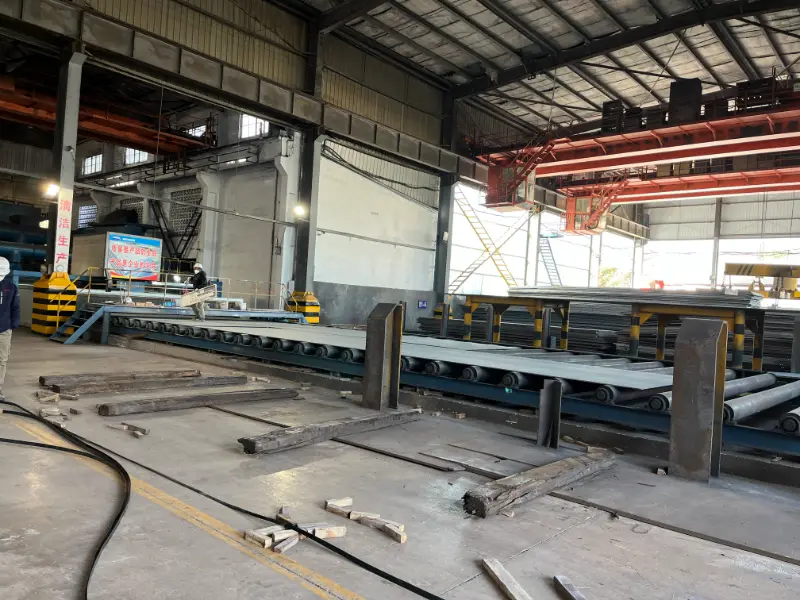
GB/T 1591 Q345A Steel
GB/T 1591 Q345A Steel - Low-Alloy High-Strength Structural Properties & Equivalents
Complete technical data for Q345A carbon and low-alloy high-strength steel according to GB/T 1591: chemical composition, mechanical and physical properties, international equivalents, and application guide.
Hot rolling, controlled rolling, normalizing, welding, cutting, bending, forming
- Phone : +8618037372205
- Email : [email protected]
- WhatsApp: Contact via Whtsapp
- WeChat: +8618037372205
GB/T 1591 Q345A Steel Introduction
Q345A is a Chinese low-alloy high-strength structural steel grade defined in GB/T 1591-2008. It belongs to the Q345 series, offering a minimum yield strength of 345 MPa for thicknesses ≤16 mm. With controlled carbon and manganese contents and optional microalloying elements (Nb, V, Ti), Q345A provides good strength, weldability, and formability. The 'A' suffix indicates that no impact test is required as standard; impact toughness may be agreed upon by the parties. This grade is widely used in welded structures, bridges, buildings, and general engineering applications in the as-rolled or normalized condition. Its balanced composition and reliable mechanical properties make it a cost-effective choice for medium-duty structural components.
GB/T 1591 Q345A Steel Chemical Composition
The chemical composition of Q345A is regulated by GB/T 1591-2008. Carbon and manganese primarily determine strength, while phosphorus and sulfur are limited for ductility and weldability. Microalloying elements such as Nb, V, and Ti may be added individually or in combination to refine grain size and improve strength. The sum of Nb+V+Ti is not strictly limited for grade A, but typical practice controls the total to ≤0.22%. Silicon is used as a deoxidizer, and Al is often added for grain refinement.
| Element | Standard Value (≤, unless range) | Remarks |
|---|---|---|
| C | 0.20 | Main strength element |
| Si | 0.50 | Deoxidizer |
| Mn | 1.70 | Improves strength & hardenability |
| P | 0.035 | Impurity, kept low for ductility |
| S | 0.035 | Impurity, kept low for toughness |
| Cr | 0.30 | Residual element, may improve corrosion resistance |
| Ni | 0.50 | Residual element |
| Cu | 0.30 | Residual element |
| Mo | 0.10 | Residual element |
| Nb | 0.07 | Grain refiner, optional microalloy |
| V | 0.15 | Grain refiner, optional microalloy |
| Ti | 0.20 | Grain refiner, optional microalloy |
| N | 0.012 | Limited to avoid strain aging |
| Als | ≥0.015 (if added) | Acid-soluble aluminum for deoxidation and grain refinement |
GB/T 1591 Q345A Steel Thermal and Electrical Physical Properties
The following data are typical for low-carbon and low-alloy structural steels at ambient temperature unless otherwise noted. These values are not specified in GB/T 1591-2008 but are widely accepted for engineering calculations. Thermal conductivity and specific heat capacity vary with temperature; given here are representative values at 20°C.
| Property | Typical Value | Unit | Test Conditions |
|---|---|---|---|
| Density (ρ) | 7.85 | g/cm³ | 20°C |
| Modulus of Elasticity (E) | 206 | GPa | Room temperature |
| Shear Modulus (G) | 79 | GPa | Room temperature |
| Poisson's Ratio (ν) | 0.3 | — | Room temperature |
| Thermal Expansion (α) | 12.0 | 10⁻⁶/K | 20–100°C |
| Thermal Conductivity (λ) | 45 | W/(m·K) | 20°C |
| Specific Heat Capacity (c) | 460 | J/(kg·K) | 20°C |
| Electrical Resistivity (ρₑ) | 0.15 | μΩ·m | 20°C |
GB/T 1591 Q345A Steel Mechanical Properties
The mechanical properties of Q345A are thickness-dependent. Yield strength decreases with increasing thickness. The specified values apply to hot-rolled plates and sections. Elongation is measured on a gauge length of 5.65√S0 (proportional test piece). Bend test requires a 180° bend without cracking. For Q345A, impact test (KV2) is not mandatory unless agreed upon; typical agreed values are 27–34 J at room temperature.
| Property | Standard Required Value | Unit | Test Conditions |
|---|---|---|---|
| ReH (Yield Strength) | ≥345 | MPa | Thickness ≤16 mm |
| ReH (Yield Strength) | ≥335 | MPa | Thickness >16–40 mm |
| ReH (Yield Strength) | ≥325 | MPa | Thickness >40–63 mm |
| ReH (Yield Strength) | ≥315 | MPa | Thickness >63–80 mm |
| ReH (Yield Strength) | ≥305 | MPa | Thickness >80–100 mm |
| Rm (Tensile Strength) | 470–630 | MPa | All thicknesses ≤100 mm |
| A (Elongation) | ≥21 | % | Thickness ≤16 mm, L₀=5.65√S₀ |
| A (Elongation) | ≥20 | % | Thickness >16–40 mm |
| A (Elongation) | ≥19 | % | Thickness >40–63 mm |
| A (Elongation) | ≥19 | % | Thickness >63–80 mm |
| A (Elongation) | ≥18 | % | Thickness >80–100 mm |
| Bend Test | d=2a (≤16 mm), d=3a (>16–100 mm) | — | 180° bend, a=thickness |
| KV₂ Impact Energy | Not required (optional) | J | Room temperature, if agreed |
GB/T 1591 Q345A Steel Fully Equivalent Standards and Replaceable Grades
| Country/Region | Standard | Grade | Remarks |
|---|---|---|---|
| International/ISO | ISO 630-2:2011 | E355A | Comparable yield strength, similar composition; quality A = no impact test |
| European Union | EN 10025-2:2004 | S355JR | Same minimum yield 355 MPa for ≤16 mm; JR = +20°C impact optional (27 J) |
| USA | ASTM A572/A572M-21 | Grade 50 | Yield 345 MPa, similar composition; no mandatory impact test; widely used |
| Japan | JIS G3106:2004 | SM490A | Min yield 325 MPa for ≤16 mm; equivalent weldable structural steel; 'A' no impact |
| Russia | GOST 19281-2014 | 17G1S | Approximate equivalent for rolled sections; min yield 345 MPa; similar chemistry |
GB/T 1591 Q345A Steel Application Introduction
Q345A steel offers a balance of strength, weldability, and cost-effectiveness, making it suitable for a wide range of structural and engineering applications. It is typically used in welded, bolted, and riveted constructions where moderate strength and excellent formability are required. The absence of mandatory impact testing limits its use only to ambient and moderately low temperatures.
Product Applications: Steel plates and coils for welding structures, Hot-rolled sections: H-beams, I-beams, channels, angles, Welded and seamless pipes, Structural hollow sections (SHS, RHS), Bridge decks and trusses, Container plates and boiler plates, Base materials for prefabricated buildings
Processed into products: Building columns, beams, and trusses, Bridge main girders, crossbeams, and stiffeners, Vehicle chassis frames and cross members, Offshore platform structural members, Storage tank shells and pressure vessel parts, Transmission tower legs and bracings, Excavator and crane booms, Welded pipe and tube for water and low-pressure services
Application industries: Civil engineering and construction, Bridge building, Shipbuilding and marine structures, Pressure vessel and storage tank fabrication, Power transmission towers, Heavy machinery and equipment manufacturing, Automotive and railway vehicle manufacturing, Water and oil pipeline engineering
GB/T 1591 Q345A Steel Similar or Alternative Materials
| Country/Region | Standard | Grade | Remarks |
|---|---|---|---|
| China | GB/T 1591-2018 (new version) | Q355B | Replaces Q345; min yield 355 MPa; B requires +20°C impact ≥34 J; improved purity |
| China | GB/T 1591-2008 | Q345B | Higher quality level; mandatory +20°C impact test (≥34 J); otherwise identical chemistry |
| China | GB/T 1591-2008 | Q345C | 0°C impact ≥34 J; better toughness; for colder service conditions |
| EU | EN 10025-2 | S355J0 | Better toughness than S355JR; 0°C impact 27 J; similar strength |
| EU | EN 10025-2 | S355J2 | -20°C impact 27 J; higher toughness; suitable for low-temperature structures |
Notes:
Additional Notes:
- Q345A is often supplied in the as-rolled (AR) condition; specific delivery condition should be agreed upon ordering.
- For improved toughness requirements, consider Q345B or Q345C instead.
- The new GB/T 1591-2018 standard has replaced Q345 with Q355; Q355B is the closest modern equivalent.
- When specifying equivalent S355JR, verify that the required impact properties are consistent with the design temperature.
- All data are based on the GB/T 1591-2008 standard; actual properties may vary by mill and thickness.
- Share



