
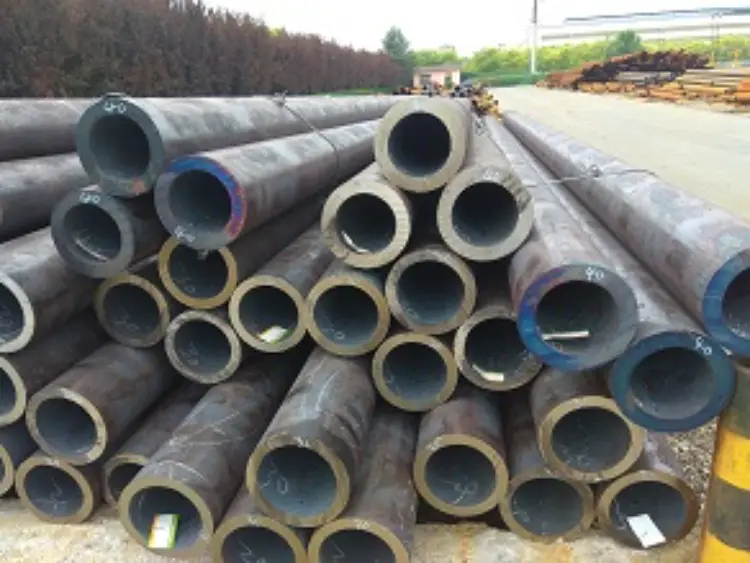
EN10219 S355K2H SSAW Pipe
EN10219 S355K2H SSAW Pipe: High-Strength Cold-Formed Hollow Section with -20°C Impact Toughness
Detailed material data for EN10219 S355K2H spiral submerged arc welded pipe: chemical composition, mechanical properties, thermal and electrical physical properties, international equivalents, similar grades, and application guide.
Cold forming, spiral welding, submerged arc welding, machining, cutting, bending, drilling, and coating
- Phone : +8618037372205
- Email : [email protected]
- WhatsApp: Contact via Whtsapp
- WeChat: +8618037372205
EN10219 S355K2H SSAW Pipe Introduction
EN10219 S355K2H is a weldable fine-grain structural steel grade for cold-formed welded structural hollow sections, supplied in the form of spiral submerged arc welded (SSAW) pipe. The designation 'S355' indicates a minimum yield strength of 355 MPa for thicknesses up to 16 mm, 'K2' guarantees a minimum impact energy of 40 J at -20°C, and 'H' denotes hollow section. This material combines high strength with excellent notch toughness at low temperatures, making it suitable for demanding structural applications such as offshore structures, bridges, towers, and piling. The SSAW manufacturing process allows production of large-diameter pipes with consistent wall thickness, providing cost-effective solutions for long-distance pipelines, foundation piles, and heavy structural columns. Typical delivery condition is as-welded or normalised, and the steel exhibits good weldability and formability.
EN10219 S355K2H SSAW Pipe Chemical Composition
Chemical composition limits as per EN 10219-1 for grade S355K2H. Elements not listed may be allowed in trace amounts or added for grain refinement (e.g., Nb, V, Ti) by agreement.
- Carbon equivalent (CEV) shall not exceed 0.45% for thicknesses ≤ 40 mm.
- Vanadium, niobium, and titanium may be added singly or in combination; their total content shall not exceed 0.22%.
| Element | Standard Value | Remarks |
|---|---|---|
| Carbon (C) | ≤ 0.22% | maximum |
| Silicon (Si) | ≤ 0.55% | maximum |
| Manganese (Mn) | ≤ 1.60% | maximum |
| Phosphorus (P) | ≤ 0.035% | maximum |
| Sulfur (S) | ≤ 0.035% | maximum |
| Nickel (Ni) | ≤ 0.50% | optional, maximum |
| Chromium (Cr) | ≤ 0.30% | optional, maximum |
| Molybdenum (Mo) | ≤ 0.10% | optional, maximum |
| Aluminium (Al) | ≥ 0.020% | total aluminium, minimum for grain refinement |
| Copper (Cu) | ≤ 0.35% | optional, maximum |
| Nitrogen (N) | ≤ 0.015% | maximum when not fixed by titanium or other elements |
EN10219 S355K2H SSAW Pipe Thermal and Electrical Physical Properties
Typical physical properties for S355K2H grade structural steel at room temperature unless otherwise indicated. Actual values may slightly vary depending on exact composition and processing conditions. These values are not mandatory in EN 10219 but are representative for design calculations.
| Property | Typical Value | Unit | Test Condition / Remarks |
|---|---|---|---|
| Density (ρ) | 7850 | kg/m³ | 20°C |
| Modulus of Elasticity (E) | 210 | GPa | 20°C, tension |
| Shear Modulus (G) | 81 | GPa | calculated from E and ν |
| Poisson's Ratio (ν) | 0.3 | – | elastic range |
| Thermal Expansion Coefficient (α) | 12.0 | 10⁻⁶/K | 20–100°C |
| Thermal Expansion Coefficient (α) | 12.5 | 10⁻⁶/K | 20–200°C |
| Thermal Expansion Coefficient (α) | 13.0 | 10⁻⁶/K | 20–300°C |
| Thermal Conductivity (λ) | 50 | W/(m·K) | 20°C |
| Specific Heat Capacity (c) | 460 | J/(kg·K) | 20°C |
| Electrical Resistivity (ρ_e) | 0.20 | 10⁻⁶ Ω·m | 20°C, approx. 0.2 μΩ·m |
EN10219 S355K2H SSAW Pipe Mechanical Properties
Mechanical properties specified in EN 10219-1 for S355K2H hollow sections. Tests are performed on longitudinal specimens. Impact energy values are based on 10×10 mm Charpy V-notch specimens; for sub-size specimens, minimum values are proportional to specimen width.
- Yield strength reduction applies for larger thicknesses.
- Bend test is carried out through 180° with the given mandrel diameter without cracks.
| Property | Standard Requirement | Unit | Test Condition / Thickness |
|---|---|---|---|
| Yield Strength (ReH) | ≥ 355 | MPa | t ≤ 16 mm |
| Yield Strength (ReH) | ≥ 345 | MPa | 16 mm < t ≤ 40 mm |
| Tensile Strength (Rm) | 470 – 630 | MPa | all thicknesses |
| Elongation after fracture (A) | ≥ 22 | % | t ≤ 40 mm, longitudinal, L₀=5.65√S₀ |
| Bend Test (Mandrel Diameter) | 1.5 t | – | t ≤ 16 mm, 180° bend |
| Bend Test (Mandrel Diameter) | 2.0 t | – | 16 mm < t ≤ 40 mm, 180° bend |
| Impact Energy (KV₂) | ≥ 40 | J | -20°C, longitudinal, 10×10 mm |
EN10219 S355K2H SSAW Pipe Fully Equivalent Material Standards and Replaceable Grades
| Country/Region | Standard | Grade | Remarks |
|---|---|---|---|
| EU | EN 10210-1 (hot-finished hollow sections) | S355K2H | Identical chemical and mechanical requirements including KV₂ ≥ 40J at -20°C; hot-finished variant |
| EU | EN 10219-1 (cold-formed hollow sections) | S355K2H | The original standard, fully applicable |
| International (ISO) | ISO 630-3 (structural steels) | S355K2 | Similar requirements for flat and long products; for hollow sections additional checks needed |
EN10219 S355K2H SSAW Pipe Application Introduction
S355K2H SSAW pipes are widely used where high strength, ductility, and toughness at sub-zero temperatures are required. Typical products include large-diameter spiral welded pipes for structural and line-pipe applications. The material offers good weldability with appropriate preheat and interpass temperature control. It can be further processed by cold bending, cutting, drilling, and welding, making it suitable for fabricating complex structural elements.
- Offshore & marine: wellhead conductor casings, boat landings, jacket structures, and caissons.
- Civil engineering: foundation piles, retaining wall piles, bridge piers, and columns.
- Energy sector: wind turbine towers, penstocks, and heavy-duty pipe racks.
Product Applications: Spiral submerged arc welded (SSAW) pipes for piling and pipelines, Structural hollow section members for buildings and bridges, Monopile foundations for offshore wind turbines, Large-diameter water transmission mains, Sheet pile connectors and section piles, Pressure piping for low- to medium-pressure services
Processed into products: Bearing piles and combined wall systems, Bridge arch ribs and struts, Wind tower shells and transition pieces, Columns and stanchions in industrial buildings, Conveyor gantries and support frames, Pipe truss nodes and fabricated connections
Application industries: Construction and infrastructure, Offshore oil & gas, Renewable energy (wind turbine foundations and towers), Water supply and sewage systems, Port and harbour engineering, Mechanical and heavy equipment manufacturing
EN10219 S355K2H SSAW Pipe Similar or Alternative Material Recommendations
| Country/Region | Standard | Grade | Remarks |
|---|---|---|---|
| EU | EN 10210-1 | S355J2H | Slightly lower impact requirement (KV₂ ≥ 27J at -20°C); otherwise similar strength and weldability |
| EU | EN 10025-2 (plates and sections) | S355J2 | Similar base material, but impact is 27J at -20°C; not a hollow section standard |
| USA | ASTM A572/A572M | Grade 50 [345] | Yield strength 345 MPa (50 ksi), no specified impact; CVN toughness may be ordered as supplementary requirement |
| USA | ASTM A500 | Grade C | Cold-formed welded/seamless tubing with 345 MPa yield; no mandatory low-temperature impact |
| China | GB/T 1591 | Q355D | High-strength low-alloy structural steel with impact at -20°C; equivalent properties but for plates and sections, not specifically welded hollow sections |
| Japan | JIS G 3466 | STKR490 | Square/rectangular carbon steel tubes with 490 N/mm² tensile strength; no specific low-temp impact requirement |
Notes:
- When ordering S355K2H hollow sections to EN 10219, the impact test temperature and minimum absorbed energy must be specified: 'K2' ensures 40 J at -20°C on longitudinal specimens.
- For thicknesses above 40 mm, consult the standard for adjusted yield strength and elongation values.
- Weldability: general fabrication welding is possible without preheat up to approximately 30 mm thickness; for thicker sections or lower ambient temperatures, preheating to 100–150°C may be advisable. Filler metals with matching strength and toughness should be used.
- Corrosion protection: painting, galvanizing, or other coating systems are recommended for atmospheric or buried service.
- Tolerances on diameter, wall thickness, and straightness should be agreed per the standard; SSAW pipes typically have tighter straightness than seamless alternatives.
- Share



