
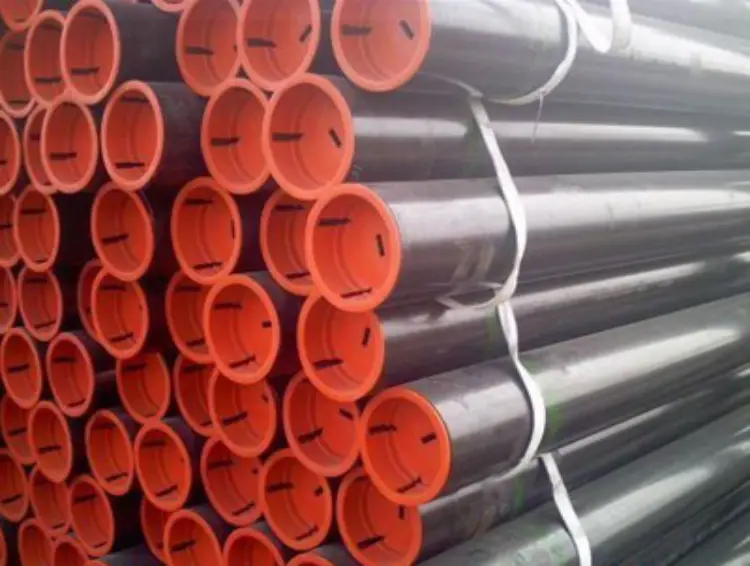
EN10219 S275NLH ERW Pipe
EN10219 S275NLH ERW Pipe: High-Strength Low-Temperature Structural Hollow Sections
Comprehensive material property data for S275NLH electric resistance welded (ERW) pipe according to EN 10219, including chemical composition, mechanical and physical properties, equivalent grades, and application guidelines.
Cold forming, welding (ERW), machining, hot-dip galvanizing, painting
- Phone : +8618037372205
- Email : [email protected]
- WhatsApp: Contact via Whtsapp
- WeChat: +8618037372205
EN10219 S275NLH ERW Pipe Introduction
S275NLH is a weldable fine-grain structural steel grade specified in EN 10219-1 for cold-formed welded structural hollow sections. The designation 'S' indicates structural steel, '275' denotes the minimum yield strength of 275 MPa for thicknesses ≤16 mm, 'N' stands for normalized or normalized rolled delivery condition, 'L' specifies low-temperature impact properties verified at -50°C, and 'H' refers to hollow sections. Supplied as electric resistance welded (ERW) pipe, it offers a balanced combination of strength, excellent toughness at sub-zero temperatures, and good weldability. Typical applications include offshore structures, bridges, cranes, and heavy machinery operating in cold climates.
EN10219 S275NLH ERW Pipe Chemical Composition
The chemical composition of S275NLH is designed to ensure fine grain structure and low-temperature toughness. Maximum limits are specified for carbon, phosphorus, and sulfur, with controlled additions of manganese and micro-alloying elements such as niobium, vanadium, and titanium. Carbon equivalent value (CEV) is typically limited to guarantee good weldability. The values below represent the ladle analysis according to EN 10219-1 for product thickness ≤40 mm.
| Element | Standard Value (max %) | Remarks |
|---|---|---|
| Carbon (C) | ≤0.18 | For thickness ≤16 mm; ≤0.20 for thickness >16 ≤40 mm |
| Silicon (Si) | ≤0.50 | Typical range 0.10–0.50 |
| Manganese (Mn) | ≤1.75 | Depending on thickness; typical range 0.90–1.75 |
| Phosphorus (P) | ≤0.025 | Low phosphorus for improved toughness |
| Sulfur (S) | ≤0.020 | Low sulfur for enhanced ductility |
| Niobium (Nb) | ≤0.05 | Micro-alloying for grain refinement |
| Vanadium (V) | ≤0.12 | Optional; combined with Nb or Ti |
| Titanium (Ti) | ≤0.05 | Grain refinement and nitrogen fixation |
| Aluminium (Al total) | ≥0.020 | Minimum for fine grain practice |
| Nitrogen (N) | ≤0.015 | Controlled for aging properties |
| Copper (Cu) | ≤0.55 | When copper is specified (optional) |
| Molybdenum (Mo) | ≤0.10 | Residual element |
| Nickel (Ni) | ≤0.30 | Residual element |
| Chromium (Cr) | ≤0.30 | Residual element; may be higher in some casts |
| CEV (max) | ≤0.40 | Carbon equivalent value for thickness ≤16 mm, based on ladle analysis |
EN10219 S275NLH ERW Pipe Physical and Thermal Properties
The following physical property values are typical for S275NLH structural steel at room temperature, unless otherwise stated. These values are derived from general structural steel data and EN 1993-1-1 recommendations. Slight variations may occur depending on the exact chemical composition and manufacturing process.
| Property | Standard Value | Unit | Test Condition |
|---|---|---|---|
| Density (ρ) | 7850 | kg/m³ | At 20°C |
| Modulus of Elasticity (E) | 210 | GPa | At 20°C |
| Shear Modulus (G) | ≈81 | GPa | At 20°C |
| Poisson's Ratio (ν) | 0.3 | - | Elastic range |
| Thermal Expansion Coefficient (α) | 12 × 10⁻⁶ | K⁻¹ | Between 20°C and 100°C |
| Thermal Conductivity (λ) | 50 | W/(m·K) | At 20°C |
| Specific Heat Capacity (c) | 460 | J/(kg·K) | At 20°C |
| Electrical Resistivity (ρe) | 0.22 × 10⁻⁶ | Ω·m | At 20°C, typical for carbon steel |
EN10219 S275NLH ERW Pipe Mechanical Properties
Mechanical properties of S275NLH ERW pipe are guaranteed in the normalized delivery condition. Values vary with wall thickness. The minimum yield strength, tensile strength, and elongation are specified in EN 10219-1. Impact toughness is tested on longitudinal Charpy-V specimens at -50°C, with minimum average energy of 27 J. Bending tests on hollow sections are normally performed by flattening or drift expansion for ERW pipe.
| Property | Standard Required Value | Unit | Test Condition / Remarks |
|---|---|---|---|
| Yield Strength (ReH) | ≥275 | MPa | For wall thickness ≤16 mm |
| Yield Strength (ReH) | ≥265 | MPa | For wall thickness >16 mm ≤40 mm |
| Tensile Strength (Rm) | 370–530 | MPa | For wall thickness ≤16 mm |
| Tensile Strength (Rm) | 360–520 | MPa | For wall thickness >16 mm ≤40 mm |
| Elongation (A) | ≥24 | % | Longitudinal, proportional test piece, L0=5.65√S0 |
| Elongation (A) | ≥22 | % | For thickness >16 mm ≤40 mm |
| Impact Energy (KV) | ≥27 (average) | J | Charpy-V, longitudinal, at -50°C; single minimum 19 J |
| Bend Test | Flattening without cracks | - | Flattening test according to EN 10219-1 for round hollow sections; alternative drift expansion |
EN10219 S275NLH ERW Pipe Direct Equivalent Material Standards and Replaceable Grades
| Country/Region | Standard | Grade | Remarks |
|---|---|---|---|
| Europe | EN 10219-1 | S275NLH | Original designation; fine-grain structural hollow section for low-temperature service |
| Germany | DIN EN 10219-1 | S275NLH | Adopted European standard; identical requirements |
| United Kingdom | BS EN 10219-1 | S275NLH | British adoption; fully equivalent |
| France | NF EN 10219-1 | S275NLH | French adoption; same properties |
| Italy | UNI EN 10219-1 | S275NLH | Italian adoption; identical |
| International | ISO 630-3 | S275NL | ISO standard for fine grain structural steel plates (not hollow sections). Similar chemical and mechanical properties but delivery form differs. |
EN10219 S275NLH ERW Pipe Application Introduction
S275NLH ERW pipes are specifically designed for welded structures operating in low-temperature environments. Their fine grain structure and guaranteed toughness at -50°C make them ideal for Arctic and offshore applications. With good formability and weldability, these hollow sections can be cut, joined, and coated using standard fabrication methods. Below are typical application industries, products, and specific components.
Product Applications: Offshore platform legs and braces, Crane and excavator booms, Pedestrian and road bridge trusses, Wind turbine towers (foundation and transition pieces), Railway wagon underframes, Pressure vessel shells (with additional certification)
Processed into products: Joints and nodes of space frames, Chords and diagonals of trusses, Pile sleeves and connectors in offshore substructures, Hydraulic cylinder bodies (machined from pipe), Structural bollards and mooring posts, Heavy-duty rollers and shafts (when machined)
Application industries: Offshore oil & gas, Shipbuilding, Bridge construction, Renewable energy (wind power), Heavy lifting and transport equipment, Mining machinery
EN10219 S275NLH ERW Pipe Similar / Comparable Material Recommendations
| Country/Region | Standard | Grade | Remarks |
|---|---|---|---|
| Europe | EN 10219-1 | S275NH | Normalized fine-grain structural hollow section; lower low-temperature toughness (tested at -20°C instead of -50°C). Similar strength and chemistry. |
| Europe | EN 10219-1 | S275J2H | Structural hollow section with impact properties tested at -20°C (J2); not fine-grain treated. May substitute where L-grade toughness is not required. |
| Europe | EN 10210-1 | S275NH / S275NLH | Hot-finished structural hollow sections with similar grades; S275NLH available for low temperature. Mechanical properties comparable but tolerances differ. |
| USA/International | ASTM A500 / A501 | Grade C, or ASTM A572 Grade 50 with supplementary low-temperature requirement | Not direct equivalents. For structural tubing, similar strength levels (~345 MPa yield). But low-temperature impact properties must be specified separately, e.g., Charpy at -50°C per ASTM A6 supplementary requirements. |
| China | GB/T 1591 | Q345D or Q345E | Low alloy structural steel with 345 MPa yield; Q345E offers -40°C impact energy. Not a hollow section grade but plates used to fabricate pipes. Closest Chinese equivalent for low-temperature structural applications. |
Notes:
Welding recommendations: Preheat and interpass temperature control may be required for thicker sections to avoid cold cracking. Corrosion protection: When used in marine environments, hot-dip galvanizing or painting systems according to ISO 12944 are recommended. Inspection: ERW weld seam integrity should be verified by non-destructive testing (NDT) per EN 10246 or equivalent. For critical applications, a through-thickness tensile test (Z-quality) may be specified per EN 10164. Note on dimensions: Typical sizes range from outside diameters 21.3 mm to 2500 mm and wall thicknesses up to 40 mm, depending on the manufacturer's capabilities.
- Share



