
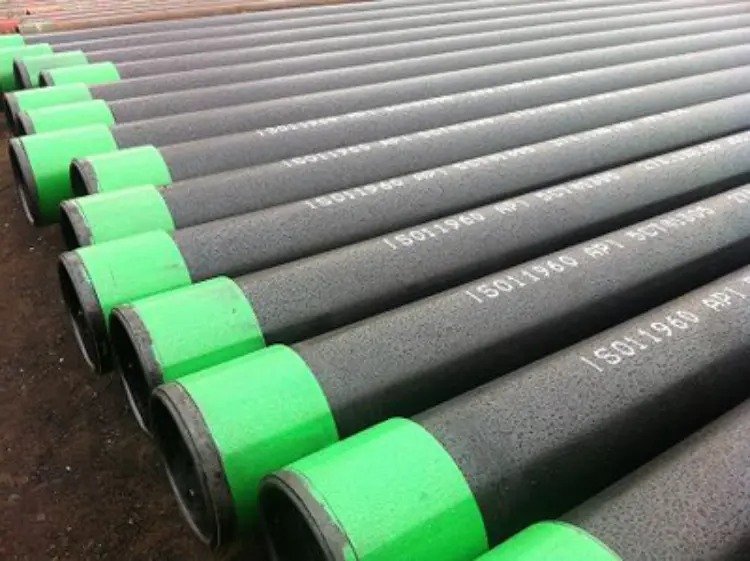
EN 10219 S275NH ERW Pipe
EN 10219 S275NH ERW Pipe: Fine Grain Structural Hollow Section Properties & Equivalents
Comprehensive material data sheet for EN 10219 S275NH ERW pipe: chemical composition, mechanical properties, thermal & electrical physical properties, international equivalents, and application recommendations.
Cold forming, electric resistance welding, normalized or normalized rolled
- Phone : +8618037372205
- Email : [email protected]
- WhatsApp: Contact via Whtsapp
- WeChat: +8618037372205
EN 10219 S275NH ERW Pipe Introduction
S275NH is a normalized fine grain structural steel grade specified in EN 10219-1 for cold-formed welded structural hollow sections. The 'N' designates a normalized or normalized rolled delivery condition, while 'H' indicates hollow section products. As an ERW (Electric Resistance Welded) pipe, it is produced by cold forming and high‑frequency welding followed by normalizing. The grade provides a minimum yield strength of 275 MPa (for thickness ≤16 mm), good weldability, and guaranteed impact toughness of 27 J at -20°C (for thickness ≤60 mm). S275NH is widely used in structural engineering, construction, and mechanical applications where a combination of strength, toughness, and formability is required. It is suitable for circular, square and rectangular hollow profiles and is often employed in frameworks, columns, bridges, and heavy‑duty machinery.
EN 10219 S275NH ERW Pipe Chemical composition
The chemical composition of S275NH according to EN 10219-1, Table A.1 (fine grain steels). The grade is aluminium‑killed fine grain steel with controlled micro‑alloying elements (Nb, V, Ti). The maximum carbon equivalent (CEV) ensures good weldability.
- Single values are maximum unless otherwise stated.
- Aluminium total (Altot) is minimum 0.020%.
- CEV = C + Mn/6 + (Cr+Mo+V)/5 + (Ni+Cu)/15 (max 0.40 for t ≤ 40 mm).
| Chemical Element | Standard Requirement Value | Remarks |
|---|---|---|
| Carbon (C) | ≤0.16 | max |
| Silicon (Si) | ≤0.50 | max |
| Manganese (Mn) | ≤1.50 | max |
| Phosphorus (P) | ≤0.030 | max |
| Sulfur (S) | ≤0.025 | max |
| Aluminium (Altot) | ≥0.020 | total aluminium |
| Niobium (Nb) | ≤0.05 | max |
| Vanadium (V) | ≤0.12 | max |
| Titanium (Ti) | ≤0.05 | max |
| Chromium (Cr) | ≤0.30 | max |
| Nickel (Ni) | ≤0.30 | max |
| Molybdenum (Mo) | ≤0.10 | max |
| Copper (Cu) | ≤0.35 | max |
| Nitrogen (N) | ≤0.020 | max |
| Carbon equivalent (CEV) | ≤0.40 (t ≤ 40 mm) | welding suitability indicator |
EN 10219 S275NH ERW Pipe Thermal & electrical physical properties
Typical physical properties for S275NH fine grain structural steel. These values are representative for carbon‑manganese structural steels in the normalized condition and can be used for design calculations. Actual values may slightly vary depending on exact composition and temper.
| Property | Standard Requirement Value | Unit | Test Condition |
|---|---|---|---|
| Density (ρ) | ~ 7850 | kg/m³ | at 20°C |
| Elastic modulus (E) | ~ 210 | GPa | at room temperature |
| Shear modulus (G) | ~ 80 | GPa | at room temperature |
| Poisson's ratio (ν) | ~ 0.3 | — | elastic range |
| Thermal expansion coefficient (α) | ~ 12 × 10⁻⁶ | K⁻¹ | 20 – 100°C |
| Thermal conductivity (λ) | ~ 50 | W/(m·K) | at 20°C |
| Specific heat capacity (cp) | ~ 460 | J/(kg·K) | at 20°C |
| Electrical resistivity (ρe) | ~ 0.20 × 10⁻⁶ | Ω·m | at 20°C |
EN 10219 S275NH ERW Pipe Mechanical properties
Mechanical properties of S275NH hollow sections as per EN 10219-1, Table A.2. The yield strength (ReH) and tensile strength (Rm) vary with nominal thickness t. Elongation after fracture A is measured on a gauge length L0 = 5.65√S0. Impact energy KV is determined on Charpy‑V specimens (longitudinal) at -20°C for thickness ≤60 mm.
- All values are minimum unless a range is given.
- Test pieces are taken from the finished hollow section in the delivery condition.
| Property | Standard Requirement Value | Unit | Test Condition |
|---|---|---|---|
| Yield strength (ReH) | 275 | MPa | thickness t ≤ 16 mm |
| Yield strength (ReH) | 265 | MPa | 16 < t ≤ 40 mm |
| Yield strength (ReH) | 255 | MPa | 40 < t ≤ 63 mm |
| Yield strength (ReH) | 245 | MPa | 63 < t ≤ 80 mm |
| Yield strength (ReH) | 235 | MPa | 80 < t ≤ 100 mm |
| Yield strength (ReH) | 225 | MPa | 100 < t ≤ 120 mm |
| Tensile strength (Rm) | 370 – 510 | MPa | t ≤ 40 mm |
| Tensile strength (Rm) | 370 – 510 | MPa | 40 < t ≤ 63 mm |
| Tensile strength (Rm) | 370 – 510 | MPa | 63 < t ≤ 80 mm |
| Tensile strength (Rm) | 360 – 500 | MPa | 80 < t ≤ 100 mm |
| Tensile strength (Rm) | 350 – 490 | MPa | 100 < t ≤ 120 mm |
| Elongation after fracture (A) | 24 | % | t ≤ 40 mm, L0 = 5.65√S0 |
| Elongation after fracture (A) | 24 | % | 40 < t ≤ 63 mm, L0 = 5.65√S0 |
| Elongation after fracture (A) | 23 | % | 63 < t ≤ 80 mm, L0 = 5.65√S0 |
| Elongation after fracture (A) | 22 | % | 80 < t ≤ 100 mm, L0 = 5.65√S0 |
| Elongation after fracture (A) | 22 | % | 100 < t ≤ 120 mm, L0 = 5.65√S0 |
| Impact energy (KV) | 27 | J | longitudinal, -20°C, t ≤ 60 mm |
EN 10219 S275NH ERW Pipe Identical material standards & directly replaceable grades
| Country/Region | Standard | Grade | Remarks |
|---|---|---|---|
| International (ISO) | ISO 10799-1 | S275NH | Identical to EN 10219-1 S275NH for cold‑formed welded structural hollow sections |
| United Kingdom (BS) | BS EN 10219-1 | S275NH | Direct adoption of EN 10219-1 |
EN 10219 S275NH ERW Pipe Application Introduction
S275NH ERW pipe is designed for welded, bolted and riveted structures where reliability and good low‑temperature toughness are required. Its normalized fine grain microstructure provides uniform mechanical properties and excellent formability. The grade is particularly suitable for dynamically loaded components and can be used at service temperatures down to -20°C. Common processing includes cutting, cold forming, welding (all common methods), and hot‑dip galvanizing.
Product Applications: Structural frameworks and trusses, Columns and beams in steel buildings, Pedestrian and road bridge girders, Offshore platform legs and braces, Telescopic crane booms, Scaffolding tubes and fittings, Roll cages and protective structures
Processed into products: Circular, square and rectangular hollow sections, Welded tube‑to‑tube connections (nodes), Pre‑fabricated welded beams and columns, Lattice mast segments, Structural end plates and brackets, Steel pipe piles
Application industries: Construction and civil engineering, Bridge building, Offshore and marine structures, Mechanical engineering, Crane and lifting equipment, Industrial scaffolding and falsework, Agricultural machinery
EN 10219 S275NH ERW Pipe Similar / comparable material alternatives
| Country/Region | Standard | Grade | Remarks |
|---|---|---|---|
| Europe | EN 10219-1 | S275J2H | Non‑alloy structural hollow section; same yield strength and impact toughness (27 J at -20°C) but different chemistry; slightly lower cost |
| Europe | EN 10025-3 | S275N | Hot‑rolled fine grain steel plate; same normalized condition and chemical limits; not a hollow section, suitable for welded structures |
| USA | ASTM A572 / A572M | Grade 50 [345] | Higher yield strength (≥345 MPa); comparable carbon‑manganese steel with good weldability; impact properties optional |
| China | GB/T 1591 | Q345D | Higher yield (345 MPa) and guaranteed impact at -20°C; fine grain killed steel, suitable as alternative with strength up‑grade |
| Japan | JIS G 3106 | SM490A | Higher tensile strength (490‑610 MPa); weldable structural steel; impact properties on agreement; often used in similar structural applications |
Notes:
Weldability: S275NH has a controlled CEV (≤0.40 for t ≤40 mm) which ensures good weldability without preheating for moderate thicknesses. Standard welding processes (MAG, TIG, SAW) are applicable.
Corrosion protection: For outdoor or aggressive environments, hot‑dip galvanizing or painting is recommended. The steel's silicon content (≤0.50) supports good zinc adhesion.
Certification: Products are supplied with inspection certificate 3.1 per EN 10204. Impact tests at -20°C are mandatory for thickness ≤60 mm.
- Share



