
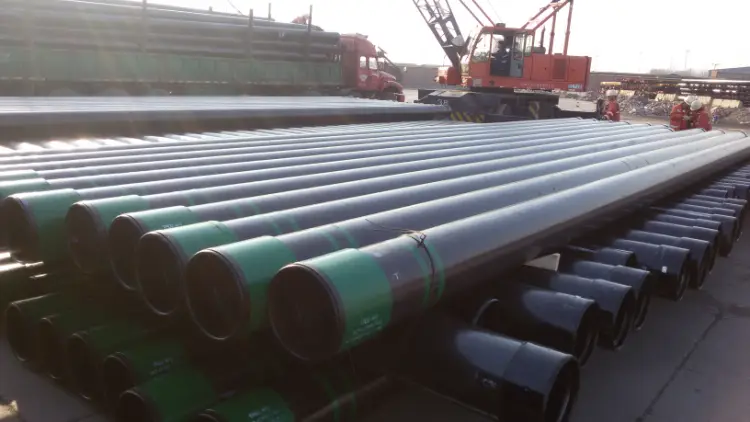
EN10219 S235JRH ERW Pipe
EN10219 S235JRH ERW Pipe - Chemical, Mechanical & Physical Properties
Complete material specifications for S235JRH electric resistance welded structural hollow sections according to EN 10219-1:2006, including chemistry, tensile, impact, bend test and physical properties.
Cold forming, electric resistance welding (ERW), cutting, bending, welding, drilling, coating
- Phone : +8618037372205
- Email : [email protected]
- WhatsApp: Contact via Whtsapp
- WeChat: +8618037372205
EN10219 S235JRH ERW Pipe Introduction
EN10219 S235JRH ERW pipe is a cold-formed, electric resistance welded structural hollow section made from fully killed, non-alloy fine grain steel. The designation S235JRH denotes:
- S – structural steel
- 235 – minimum yield strength 235 MPa for thickness ≤16 mm
- JR – minimum impact energy 27 J at +20 °C
- H – hollow section
It offers good weldability, uniform mechanical properties and reliable low-temperature toughness. Primarily used in structural engineering, construction, machinery and general fabrication, it is delivered in the as-welded condition and can be further processed by cutting, bending, welding and coating.
EN10219 S235JRH ERW Pipe Chemical Composition
The chemical requirements conform to EN 10219-1:2006 Table 2 for grade S235JRH. The steel is fully killed and fine grain treated. Elements not listed shall not be intentionally added.
- Maximum carbon content ensures weldability.
- Manganese provides strength and toughness.
- Limits on phosphorus, sulfur and nitrogen guarantee good forming and impact properties.
| Element | Standard Value (max %) | Remarks |
|---|---|---|
| C | 0.17 | Carbon |
| Mn | 1.40 | Manganese |
| P | 0.040 | Phosphorus |
| S | 0.040 | Sulfur |
| N | 0.009 | Nitrogen |
EN10219 S235JRH ERW Pipe Thermal and Electrical Physical Properties
Physical properties are typical for non-alloy structural steel at room temperature. These values are not specified in EN 10219 but are widely accepted for design calculations.
- Density is standard for carbon steel.
- Moduli and Poisson's ratio are typical for ferritic steels.
- Thermal expansion and conductivity are essential for structures exposed to temperature variations.
| Property | Standard Value (typical) | Unit | Test condition |
|---|---|---|---|
| Density (ρ) | 7850 | kg/m³ | 20 °C |
| Elastic modulus (E) | 210 | GPa | 20 °C |
| Shear modulus (G) | 81 | GPa | 20 °C |
| Poisson's ratio (ν) | 0.3 | — | 20 °C |
| Thermal expansion (α) | 12 × 10⁻⁶ | K⁻¹ | 20–100 °C |
| Thermal conductivity (λ) | 52 | W/(m·K) | 20 °C |
| Specific heat capacity | 460 | J/(kg·K) | 20 °C |
| Electrical resistivity (ρₑ) | 0.16 × 10⁻⁶ | Ω·m | 20 °C |
EN10219 S235JRH ERW Pipe Mechanical Properties
Mechanical properties are extracted from EN 10219-1:2006 Table 3 for S235JRH. Values apply to wall thickness ≤ 16 mm unless otherwise indicated.
- Yield strength is specified as ReH (upper yield strength).
- Charpy impact test is performed on longitudinal specimens at +20 °C.
- Bend test uses a mandrel of 1.5 × thickness without cracking.
| Property | Standard Requirement | Unit | Test condition |
|---|---|---|---|
| Yield strength (ReH) | ≥235 | MPa | Thickness ≤16 mm |
| Tensile strength (Rm) | 360 – 510 | MPa | Thickness ≤16 mm |
| Elongation (A) | ≥24 | % | L₀=5.65√S₀, t≤40 mm |
| Bend test | 1.5 t | — | Bend angle 180°, mandrel diameter = 1.5× wall thickness |
| Impact energy (KV₂) | ≥27 | J | Longitudinal, +20 °C |
EN10219 S235JRH ERW Pipe Fully Equivalent Standards & Replaceable Grades
The following international grades are regarded as identical or interchangeable with EN10219 S235JRH due to equivalent chemistry, mechanical properties and delivery condition.
| Country/Region | Standard | Grade | Remarks |
|---|---|---|---|
| International (ISO) | ISO 630-2 | S235JRH | Identical designation, cold-formed welded hollow sections |
| Europe | EN 10210-1 | S235JRH | Hot finished hollow section; same mechanical limits, often interchangeable |
| China | GB/T 6728 | Q235B | Cold-formed hollow section; similar yield and impact, verify Cu/P limits |
| Japan | JIS G 3466 | STKR400 | Carbon steel square/rectangular tubes; comparable strength |
EN10219 S235JRH ERW Pipe Application Introduction
EN10219 S235JRH ERW pipes are designed for lightweight and medium-duty structural applications. Excellent formability and weldability allow efficient fabrication. Typical uses include civil engineering, mechanical supports, agricultural frames and architectural metalwork. The grade is suitable for galvanizing and other corrosion protection systems.
Product Applications: Columns and roof trusses, Building frameworks, Scaffolding and formwork, Greenhouse structures, Handrails and guardrails, Machinery frames and supports, Pipe racks and structural hollow profiles
Processed into products: Welded box beams and columns, Bent tubular parts for machinery arms, Cut-to-length spacers and sleeves, Flattened-end connectors, Punched and drilled hollow section braces, Fabricated node joints
Application industries: Construction & civil engineering, Agricultural machinery, General metal fabrication, Transportation & fencing, Mechanical engineering
EN10219 S235JRH ERW Pipe Similar / Near-Equivalent Alternative Materials
These materials exhibit comparable strength and toughness but belong to flat or long products or different manufacturing processes. They can be considered when hollow sections are not mandatory.
| Country/Region | Standard | Grade | Remarks |
|---|---|---|---|
| Europe | EN 10025-2 | S235JR | Structural plate and sections; same yield and impact class, not hollow |
| Germany | DIN 17100 (withdrawn) | St37-2 | Predecessor grade, widely comparable |
| USA | ASTM A500/A500M | Grade B | Higher yield (315 MPa), but often substituted for structural tubes |
| Russia | GOST 8732-78 | 10 (St10) | Seamless pipe, similar carbon steel |
Notes:
- The material is delivered in the as-welded condition; the weld seam is not heat treated, but the base metal is of normalized rolled quality.
- For wall thicknesses >16 mm the minimum yield strength reduces to 225 MPa; elongation requirements are proportionally adjusted.
- Optional impact test at -20°C can be agreed (designation S235J2H). Cu content is typically limited to 0.55% to avoid hot shortness.
- In design calculations use the nominal values for modulus and density; for precise physical data refer to the actual material certificate.
- Share



