
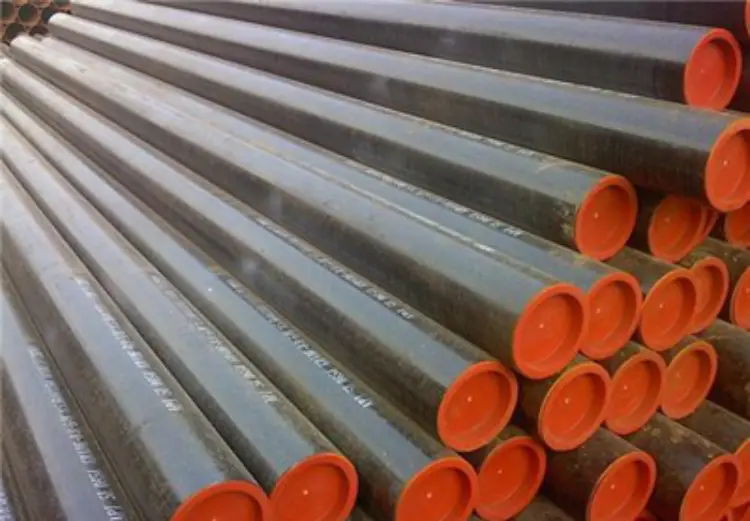
EN10025-6 S960QL1 SSAW Pipe
EN10025-6 S960QL1 SSAW Pipe: High-Strength Quenched & Tempered Steel Properties
Complete material data for S960QL1 steel according to EN 10025-6, covering chemical composition, mechanical and physical properties, equivalent grades, and application guidelines specifically for spiral submerged arc welded (SSAW) pipes.
Welding (SAW, GMAW, SMAW), cold and hot forming, bending, machining, cutting (plasma, laser, oxy-fuel)
- Phone : +8618037372205
- Email : [email protected]
- WhatsApp: Contact via Whtsapp
- WeChat: +8618037372205
EN10025-6 S960QL1 SSAW Pipe Introduction
S960QL1 is a high-strength quenched and tempered fine-grain structural steel specified in EN 10025-6. With a minimum yield strength of 960 MPa and guaranteed impact toughness down to -40°C, it belongs to the premium category of weldable high-strength steels for heavy-duty structures. The material offers a favourable combination of strength, toughness, and formability, making it suitable for demanding applications such as offshore platforms, pressure pipelines, and mobile cranes. In the context of SSAW (spiral submerged arc welded) pipes, S960QL1 is typically supplied as hot-rolled plate or strip that is subsequently formed and welded into large-diameter line pipes. Its fine-grained microstructure and low carbon equivalent facilitate good weldability when proper procedures are followed, while the tempered martensitic/bainitic structure provides excellent resistance to brittle fracture even under harsh service conditions.
EN10025-6 S960QL1 SSAW Pipe Chemical Composition
The chemical composition of S960QL1 is carefully controlled to achieve high strength and excellent low-temperature toughness. The limits below are based on the cast (heat) analysis per EN 10025-6:2019. Fine grain practice is assured by a minimum total aluminium content or by the addition of other grain-refining elements such as niobium, vanadium, or titanium. The low carbon content and microalloying improve weldability while maintaining the required mechanical properties.
| Element | Standard Value (max unless noted) | Remarks |
|---|---|---|
| Carbon (C) | ≤0.20 | For t ≤ 50 mm |
| Silicon (Si) | ≤0.80 | |
| Manganese (Mn) | ≤1.70 | |
| Phosphorus (P) | ≤0.020 | |
| Sulfur (S) | ≤0.010 | |
| Chromium (Cr) | ≤1.50 | |
| Nickel (Ni) | ≤2.00 | |
| Molybdenum (Mo) | ≤0.70 | |
| Boron (B) | ≤0.005 | |
| Vanadium (V) | ≤0.12 | |
| Niobium (Nb) | ≤0.06 | |
| Titanium (Ti) | ≤0.05 | |
| Copper (Cu) | ≤0.50 | |
| Aluminium (Al total) | ≥0.015 | Minimum for fine grain practice |
| Nitrogen (N) | ≤0.015 |
EN10025-6 S960QL1 SSAW Pipe Thermal and Electrical Physical Properties
The physical properties listed below are typical for high-strength quenched and tempered steels of the S960QL1 type. They serve as engineering references and are not mandatory requirements of EN 10025-6. Values may vary slightly depending on the exact chemical composition and heat treatment condition. These data are essential for design calculations involving heat transfer, thermal expansion, and electrical conductivity.
| Property | Standard Value | Unit | Test Condition / Remarks |
|---|---|---|---|
| Density (ρ) | 7.85 × 10³ | kg/m³ | At 20°C |
| Modulus of elasticity (E) | 210 | GPa | At 20°C |
| Shear modulus (G) | 81 | GPa | Calculated from E and ν |
| Poisson's ratio (ν) | 0.3 | - | At 20°C |
| Thermal expansion coefficient (α) | 11.1 × 10⁻⁶ | K⁻¹ | Between 20°C and 100°C |
| Thermal conductivity (λ) | 30 | W/(m·K) | At 20°C |
| Specific heat capacity (c) | 460 | J/(kg·K) | At 20°C |
| Electrical resistivity (ρₑ) | 2.5 × 10⁻⁷ | Ω·m | At 20°C |
EN10025-6 S960QL1 SSAW Pipe Mechanical Properties
The mechanical properties of S960QL1 are determined by the quenching and tempering heat treatment. Values below represent the minimum requirements in the delivery condition (+QT) for product thicknesses up to 50 mm, as specified in EN 10025-6. For SSAW pipes, properties near the weld seam may be influenced by the welding thermal cycle; the base material values are guaranteed. Charpy impact tests are performed at -40°C to verify toughness.
| Property | Requirement | Unit | Test Condition |
|---|---|---|---|
| Yield strength (ReH or Rp0.2) | ≥960 | MPa | Thickness t ≤ 50 mm; transverse specimen |
| Tensile strength (Rm) | 980 – 1150 | MPa | Thickness t ≤ 50 mm; transverse specimen |
| Elongation after fracture (A) | ≥10 | % | Proportional gauge length L₀ = 5.65√S₀; transverse, t ≤ 50 mm |
| Bend test (mandrel diameter) | No cracks | - | Mandrel diameter: 3t for t ≤ 16 mm; 4t for 16 < t ≤ 50 mm; 180° bend |
| Charpy impact energy (KV₂) | ≥27 | J | At -40°C; transverse specimen; full-size 10×10 mm |
EN10025-6 S960QL1 SSAW Pipe Fully Equivalent Material Standards and Substitutable Grades
| Country/Region | Standard | Grade | Remarks |
|---|---|---|---|
| European Union | EN 10025-6 | S960QL1 | Base specification; -40°C impact |
| International | ISO 630-6 | S960QL1 | Direct equivalent within the ISO structural steel system |
| Germany | DIN EN 10025-6 | S960QL1 | Identical to EN standard |
| China | GB/T 16270-2009 | Q960E | Closest Chinese grade with -40°C impact; check thickness-dependent properties |
EN10025-6 S960QL1 SSAW Pipe Application Introduction
S960QL1 is specifically designed for heavily loaded welded structures operating under extreme conditions. Its high strength-to-weight ratio enables significant material savings and lighter constructions. The steel is used predominantly in the form of plates, which are subsequently fabricated into SSAW (spiral submerged arc welded) pipes for the following industries and products. Excellent formability and weldability allow the production of large-diameter pipes without loss of mechanical performance, provided that appropriate welding consumables and procedures are employed.
Product Applications: Spiral submerged arc welded (SSAW) pipes for high-pressure fluids, Structural tubular columns and masts, Foundation and piling pipes, Conductor pipes for offshore platforms, Boom sections for heavy-lift cranes, Jack-up rig legs and spudcans
Processed into products: Pipe joints, flanges, and connectors, Welded pipe bends and elbows, Tubular node elements for jacket structures, Reinforcing saddles and stiffening rings, Transition pieces and pup pipes, Threaded or welded end connectors
Application industries: Oil & gas transmission (onshore and offshore), Offshore engineering and subsea structures, Heavy civil construction and bridge building, Mining and earth-moving equipment, Wind energy towers and foundations, Industrial pressure vessels and storage tanks
EN10025-6 S960QL1 SSAW Pipe Similar or Closely Related Alternative Materials
| Country/Region | Standard | Grade | Remarks |
|---|---|---|---|
| EU | EN 10025-6 | S960Q | Same strength, impact test at 0°C (higher temperature) |
| EU | EN 10025-6 | S960QL | Same strength, impact test at -20°C; slightly less tough than QL1 |
| EU | EN 10025-6 | S1100QL1 | Higher strength (1100 MPa) with -40°C impact; requires more welding control |
| China | GB/T 16270 | Q960D | Same strength, impact at -20°C; suitable for less severe cold environments |
| USA | ASTM A514/A514M | Grade S | Lower minimum yield (≥690 MPa); only comparable in toughness concept |
Notes:
S960QL1 requires strict welding procedure control because of its high strength and tempered microstructure. Recommended precautions include:
- Preheating (typically 100–175°C) depending on plate thickness and hydrogen control.
- Use of low-hydrogen welding consumables matching the base material strength.
- Post-weld heat treatment is generally avoided; if necessary, it must be carefully verified not to degrade tempered properties.
- For SSAW pipe production, the forming strain and welding process parameters must be optimized to maintain the toughness of the heat-affected zone (HAZ).
- Third-party certification to EN 10204 Type 3.1 or 3.2 is commonly required for quality assurance.
- Share



