
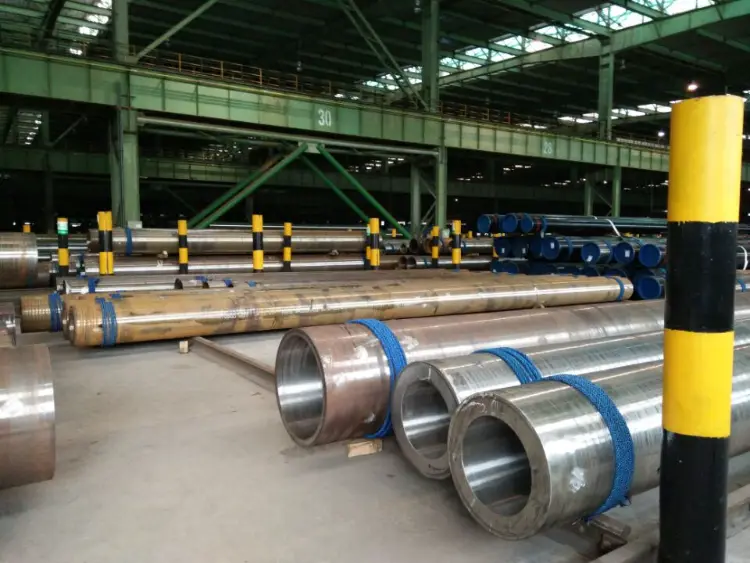
EN10025-2 S235JR ERW Pipe Steel
EN10025-2 S235JR ERW Pipe Steel Grade Technical Data
Complete technical data for non-alloy structural steel S235JR according to EN10025-2, commonly used in ERW pipe manufacturing. Includes chemistry, mechanical and physical properties, international equivalents, and application guidance.
Welding, bending, cutting, drilling, machining, cold forming, galvanizing, painting
- Phone : +8618037372205
- Email : [email protected]
- WhatsApp: Contact via Whtsapp
- WeChat: +8618037372205
EN10025-2 S235JR ERW Pipe Steel Introduction
S235JR is a non-alloy structural steel grade defined in EN 10025-2. It is the most commonly used mild steel in Europe, offering a minimum yield strength of 235 MPa at room thickness. The designation JR guarantees a minimum impact energy of 27 J at +20°C. This steel is widely supplied as ERW (Electric Resistance Welded) pipe for structural and general engineering applications. It exhibits good weldability, formability, and machinability. Typical delivery conditions include hot-rolled, normalized, or as-welded (for pipes).
EN10025-2 S235JR ERW Pipe Steel Chemical Composition
The ladle analysis limits as per EN 10025-2:2019 for grade S235JR. Elements not listed may be present as residuals. For product analysis, permissible deviations apply.
| Element | Standard Value (max %) | Remarks |
|---|---|---|
| Carbon (C) | 0.17 | Max for thickness ≤ 40 mm |
| Manganese (Mn) | 1.40 | Max |
| Silicon (Si) | Not specified | May be added for deoxidation; typically 0.15–0.35 % if killed |
| Phosphorus (P) | 0.035 | Max |
| Sulfur (S) | 0.035 | Max |
| Nitrogen (N) | 0.012 | Max |
| Copper (Cu) | 0.55 | Max |
| Other residual elements (Cr, Ni, Mo) | Residual, typically each ≤ 0.30 | Not required but controlled for CEV |
EN10025-2 S235JR ERW Pipe Steel Thermal and Electrical Physical Properties
These values are indicative for non-alloy structural steel at room temperature (20 °C) unless stated otherwise. They are not specified in EN 10025-2 but are based on published data for similar mild steels.
| Property | Typical Value | Unit | Test Condition |
|---|---|---|---|
| Density (ρ) | 7.85 | g/cm³ | At 20 °C |
| Elastic modulus (E) | 200 – 210 | GPa | At 20 °C, static loading |
| Shear modulus (G) | ~80 | GPa | At 20 °C |
| Poisson's ratio (ν) | 0.27 – 0.30 | – | At 20 °C |
| Thermal expansion coefficient (α) | 11.7 – 13.0 | ×10⁻⁶ /K | Between 20 °C and 100 °C |
| Thermal expansion coefficient (α) | 12.4 – 13.8 | ×10⁻⁶ /K | Between 20 °C and 200 °C |
| Thermal conductivity (λ) | ~50 – 55 | W/(m·K) | At 20 °C |
| Specific heat capacity (c) | ~470 – 480 | J/(kg·K) | At 20 °C |
| Electrical resistivity (ρ_e) | ~0.16 – 0.22 | ×10⁻⁶ Ω·m | At 20 °C, depending on composition |
EN10025-2 S235JR ERW Pipe Steel Mechanical Properties
Minimum values based on transverse test pieces (longitudinal for pipes can show slightly better values). Impact test temperature: +20 °C. For ERW pipe to EN 10219/EN 10210, additional flattening or bending tests apply.
| Property | Standard Requirement | Unit | Test Condition / Thickness Range |
|---|---|---|---|
| Yield strength (ReH) | ≥ 235 | MPa | Nominal thickness ≤ 16 mm |
| Yield strength (ReH) | ≥ 225 | MPa | Nominal thickness >16 mm ≤ 40 mm |
| Yield strength (ReH) | ≥ 215 | MPa | Nominal thickness >40 mm ≤ 100 mm |
| Tensile strength (Rm) | 360 – 510 | MPa | Nominal thickness ≤ 40 mm |
| Tensile strength (Rm) | 350 – 500 | MPa | Nominal thickness >40 mm ≤ 100 mm |
| Elongation (A5) | ≥ 26 | % | Nominal thickness ≤ 40 mm, gauge length 5.65√S₀ |
| Elongation (A5) | ≥ 24 | % | Nominal thickness >40 mm ≤ 63 mm |
| Elongation (A5) | ≥ 22 | % | Nominal thickness >63 mm ≤ 100 mm |
| Impact energy (KV, Charpy-V) | ≥ 27 | J | at +20 °C (JR quality), longitudinal or transverse depend on standard |
| Bend test (mandrel diameter) | No cracks | Mandrel diameter = 0.5 × thickness (t ≤ 16 mm); often performed for plates |
EN10025-2 S235JR ERW Pipe Steel Full Equivalent Material Standards and Replaceable Grades
| Country / Region | Standard | Grade | Remarks |
|---|---|---|---|
| European Union | EN 10025-2 | S235JR | Original designation, fully equivalent |
| International | ISO 630-2 | S235B | Close match; also JR quality |
| Germany (former) | DIN 17100 | St37-2 / S235JR | Replaced by EN standard; identical properties |
| United Kingdom | BS EN 10025-2 | S235JR | British adoption of EN |
| United States | ASTM A283/A283M | Grade C or D | Similar strength range; verify impact properties |
| Japan | JIS G3101 | SS400 | Similar structural steel; no guaranteed impact energy |
| China | GB/T 700 | Q235B | Includes 27 J at +20 °C impact requirement |
| Russia | GOST 380 | St3ps / St3sp | Comparable carbon steel with yield ~235 MPa |
EN10025-2 S235JR ERW Pipe Steel Application Introduction
S235JR ERW pipes are versatile and cost-effective for general structural applications. They are readily weldable and can be galvanized for corrosion protection. Below are typical industries, products, and components where this material is used.
Product Applications: ERW structural hollow sections (square, rectangular, round), Transmission line poles, Scaffolding tubes, Greenhouse structures, Fence posts and gates, Low-pressure fluid conveyance pipes, Handrails and guardrails, Fabricated steel frames and trusses
Processed into products: Pipe couplings and flanges, Pipe elbows and tees (formed from pipe), Support brackets, Roller conveyor frames, Bicycle racks, Street sign posts, Base plates for columns, Light-duty rollers and idlers
Application industries: Construction & civil engineering, Machinery manufacturing, Automotive (chassis, frames), Agricultural equipment, Material handling, Water and gas supply (low-pressure), Furniture & storage systems, Shipbuilding (secondary structures)
EN10025-2 S235JR ERW Pipe Steel Similar / Alternative Material Recommendations
| Country / Region | Standard | Grade | Remarks |
|---|---|---|---|
| European Union | EN 10025-2 | S275JR | Higher strength (275 MPa yield), similar toughness |
| European Union | EN 10025-2 | S355JR | Even higher strength for weight reduction |
| European Union | EN 10025-2 | S235J0 | Same strength but impact tested at 0 °C |
| European Union | EN 10025-2 | S235J2 | Impact tested at -20 °C, better low-temperature performance |
| European Union | EN 10025-3 | S235J2C | Improved corrosion resistance (weathering steel) |
| United States | ASTM A36 | A36 | Structural steel with yield ~250 MPa, no mandatory impact |
| China | GB/T 1591 | Q345B | Higher strength (345 MPa) structural steel |
Notes:
ERW pipe specifics: The base metal must meet S235JR chemistry; welding seam integrity is tested by flattening, flaring, or eddy current. Corrosion protection: Frequently hot-dip galvanized or painted. Design codes: Eurocode 3 (EN 1993) applies when used in structural design. Availability: Thickness range typically 1.5 – 16 mm for ERW tubes; larger diameters up to 610 mm. Note: Always verify the specific pipe manufacturing standard (e.g., EN 10219, EN 10210, ASTM A500) as mechanical properties may be adjusted for hollow sections.
- Share



