
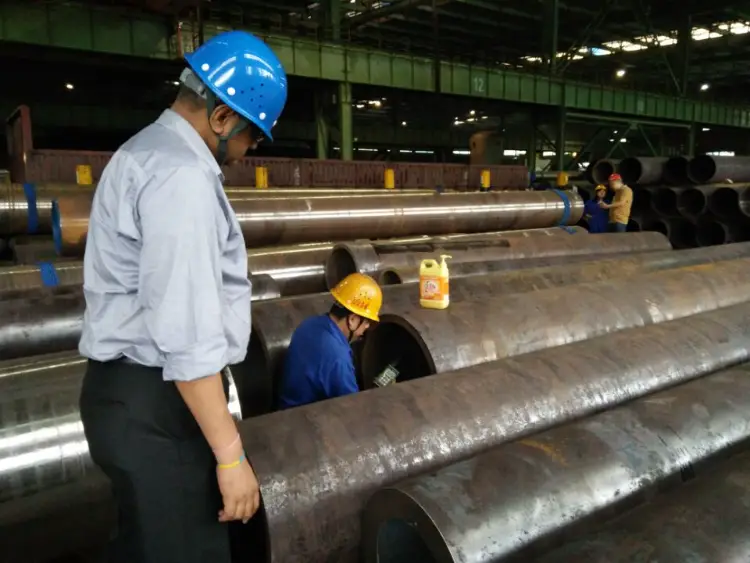
EN10025-2 S235J0 ERW Pipe
EN10025-2 S235J0 ERW Pipe: Properties, Equivalent Grades and Applications
Comprehensive material data for S235J0 steel grade according to EN 10025-2, typically used for electric resistance welded (ERW) pipes. Includes chemical composition, mechanical properties, physical performance, international equivalents, and application guidance.
Cold forming, electric resistance welding (ERW), cutting, bending, machining, galvanizing, painting
- Phone : +8618037372205
- Email : [email protected]
- WhatsApp: Contact via Whtsapp
- WeChat: +8618037372205
EN10025-2 S235J0 ERW Pipe Introduction
S235J0 is a non-alloy structural steel grade defined in EN 10025-2, designed for welded, bolted and riveted structures. The 'J0' designation indicates guaranteed Charpy impact energy of at least 27 J at 0°C. When processed into ERW (Electric Resistance Welded) pipes, it provides a cost-effective solution for structural hollow sections, fluid conveyance and general fabrication. Key characteristics include good weldability, moderate strength (yield strength ≥235 MPa for thickness ≤16 mm), and reliable notch toughness at low ambient temperatures. Typical delivery condition is hot-rolled strip or plate subsequently cold-formed and welded, often supplied as normalized or as-rolled for pipe production. The material is widely used in construction, machinery, and piping systems where ambient temperature toughness is required.
EN10025-2 S235J0 ERW Pipe Chemical composition according to EN 10025-2 for S235J0
The chemical composition of S235J0 is controlled to ensure adequate strength, weldability and toughness. Maximum limits are strictly defined for phosphorus and sulfur to meet the 0°C impact requirement. Nitrogen and copper are optionally specified. The carbon equivalent value (CEV) is typically limited for weldability.
| Element | Standard value (max % unless range) | Remarks |
|---|---|---|
| Carbon (C) | ≤0.17 | For product thickness ≤40 mm |
| Manganese (Mn) | ≤1.40 | For long products; for flat products ≤1.40 as well |
| Silicon (Si) | — | Not specified, typically 0.15–0.35 |
| Phosphorus (P) | ≤0.030 | Restricted for J0 quality |
| Sulfur (S) | ≤0.030 | Restricted for J0 quality |
| Nitrogen (N) | ≤0.012 | Only required for J0 and J2 qualities |
| Copper (Cu) | ≤0.55 | Optional; if required by the purchaser |
| Carbon equivalent (CEV) | ≤0.35 | Typical maximum for thickness ≤30 mm, based on formula CEV = C + Mn/6 + (Cr+Mo+V)/5 + (Ni+Cu)/15 |
EN10025-2 S235J0 ERW Pipe Thermal and electrical physical properties
The following physical properties are representative for carbon structural steel of similar composition. They are not guaranteed by the standard but are widely accepted in engineering design. Values may vary slightly depending on exact composition and manufacturing history.
| Property | Standard value | Unit | Condition / note |
|---|---|---|---|
| Density (ρ) | 7.85 | g/cm³ | At 20°C |
| Modulus of elasticity (E) | 210 | GPa | At 20°C, tension |
| Shear modulus (G) | ≈80.8 | GPa | At 20°C, calculated from E and ν |
| Poisson's ratio (ν) | 0.3 | — | At 20°C, elastic range |
| Thermal expansion coefficient (α) | 11.1 | 10⁻⁶/K | 20–100°C |
| Thermal expansion coefficient (α) | 11.9 | 10⁻⁶/K | 20–200°C |
| Thermal expansion coefficient (α) | 12.5 | 10⁻⁶/K | 20–300°C |
| Thermal expansion coefficient (α) | 13.0 | 10⁻⁶/K | 20–400°C |
| Thermal conductivity (λ) | 53 | W/(m·K) | At 20°C |
| Thermal conductivity (λ) | 51 | W/(m·K) | At 100°C |
| Thermal conductivity (λ) | 48 | W/(m·K) | At 200°C |
| Specific heat capacity (c) | 460 | J/(kg·K) | At 20°C |
| Electrical resistivity (ρ_e) | 0.15 – 0.20 | µΩ·m | At 20°C, typical range |
EN10025-2 S235J0 ERW Pipe Mechanical properties
Mechanical properties depend on the nominal thickness (t) of the original hot-rolled material. The values below are the minimum specified for longitudinal test pieces unless otherwise noted. ERW pipes manufactured from such strip inherit comparable strength in the longitudinal direction; however, the weld zone may exhibit slightly different properties. Transverse properties are typically lower for elongation.
| Property | Standard requirement | Unit | Condition / note |
|---|---|---|---|
| Yield strength (ReH) | ≥235 | MPa | t ≤16 mm |
| Yield strength (ReH) | ≥225 | MPa | 16 < t ≤40 mm |
| Yield strength (ReH) | ≥215 | MPa | 40 < t ≤63 mm |
| Yield strength (ReH) | ≥215 | MPa | 63 < t ≤80 mm |
| Yield strength (ReH) | ≥215 | MPa | 80 < t ≤100 mm |
| Yield strength (ReH) | ≥195 | MPa | 100 < t ≤150 mm |
| Tensile strength (Rm) | 360 – 510 | MPa | t < 3 mm |
| Tensile strength (Rm) | 360 – 510 | MPa | 3 ≤ t ≤100 mm |
| Tensile strength (Rm) | 350 – 500 | MPa | 100 < t ≤150 mm |
| Elongation after fracture (A80) | ≥17 | % | t ≤1 mm, longitudinal, gauge length 80 mm |
| Elongation after fracture (A80) | ≥18 | % | 1 < t ≤1.5 mm, longitudinal |
| Elongation after fracture (A80) | ≥19 | % | 1.5 < t ≤2 mm, longitudinal |
| Elongation after fracture (A80) | ≥20 | % | 2 < t ≤2.5 mm, longitudinal |
| Elongation after fracture (A80) | ≥21 | % | 2.5 < t <3 mm, longitudinal |
| Elongation after fracture (A5) | ≥26 | % | t ≥3 mm, longitudinal, proportional gauge length |
| Elongation after fracture (A5) | ≥24 | % | t ≥3 mm, transverse, proportional gauge length |
| Charpy impact energy (KV) | ≥27 (longitudinal) | J | At 0°C, standard V-notch specimen |
| Charpy impact energy (KV) | ≥20 (transverse) | J | At 0°C, standard V-notch specimen |
| Bend test (mandrel diameter) | No cracks | — | Cold bend test according to EN ISO 7438; mandrel diameter depends on thickness and grade, typically 0.5a to 2a (a = thickness) for S235 |
EN10025-2 S235J0 ERW Pipe Completely equivalent standards and replaceable grade designations
| Country / Region | Standard | Grade | Remarks |
|---|---|---|---|
| European Union | EN 10025-2 | S235J0 | Original specification; base material for ERW pipe |
| International (ISO) | ISO 630-2 | S235J0 | Identical technical delivery conditions |
| Germany | DIN EN 10025-2 | S235J0 | Adopted European standard, designation unchanged |
| United Kingdom | BS EN 10025-2 | S235J0 | Adopted European standard |
| France | NF EN 10025-2 | S235J0 | Adopted European standard |
| Italy | UNI EN 10025-2 | S235J0 | Adopted European standard |
| Spain | UNE EN 10025-2 | S235J0 | Adopted European standard |
| China | GB/T 700 | Q235D | Similar strength, impact test at -20°C (more demanding); can be used with approval |
EN10025-2 S235J0 ERW Pipe Application Introduction
S235J0 ERW pipes are extensively employed in applications that demand moderate strength, good weldability, and guaranteed notch toughness at 0°C. Their cost-effectiveness and availability in a wide range of sizes make them a preferred choice for structural and mechanical engineering projects. Typical industries and products are listed below.
Product Applications: Structural hollow sections (circular, square, rectangular ERW tubes), Scaffolding tubes and couplers, Fence posts and handrails, Greenhouse frames and agricultural constructions, Conveyor rollers and idler frames, Piping for low-pressure fluid transport, Prefabricated building modules, Bicycle racks and street furniture
Processed into products: Pipe clamps and brackets, Flanges and pipe fittings (welded type), Adjustable base jacks for scaffolding, Hinge pins and bushings, Angle connectors and gusset plates, Tube end caps and inserts, Bolted connections using steel plates cut from ERW tubes
Application industries: Building and construction (columns, beams, trusses), Infrastructure (bridges, sign posts, guardrails), Mechanical engineering (frames, supports, conveyor systems), Agricultural equipment (greenhouses, storage racks, irrigation), Automotive and transportation (trailer components, chassis parts), Fluid and gas distribution (water pipes, compressed air lines, fire protection systems), Furniture and storage systems (shelving, lockers, racking)
EN10025-2 S235J0 ERW Pipe Closely related or similar alternative materials
| Country / Region | Standard | Grade | Remarks |
|---|---|---|---|
| European Union | EN 10025-2 | S235JR | Similar strength but impact test at +20°C; lower toughness requirement |
| European Union | EN 10025-2 | S235J2 | Higher toughness, impact test at -20°C; often interchangeable with S235J0 with better low-temperature performance |
| European Union | EN 10025-2 | S275J0 | Higher yield strength (≥275 MPa) with same 0°C impact requirement; substitution may require redesign |
| USA | ASTM A283/A283M | Grade D | Similar tensile strength but no mandatory impact test; extra verification needed for 0°C toughness |
| Japan | JIS G3101 | SS400 | Comparable tensile strength; impact test not specified; use only if toughness not critical |
| China | GB/T 700 | Q235C | 0°C impact test required, similar to S235J0; can be a good alternative |
Notes:
- The chemical composition and mechanical properties refer to the base material according to EN 10025-2. For ERW pipes, additional requirements of the pipe standard (e.g., EN 10219-1 for cold-formed welded structural hollow sections) may apply, such as flattening or drift expanding tests.
- For pipe dimensions, typical thicknesses range from 1.0 mm to 12.5 mm (depending on diameter), and the above thickness-dependent properties should be matched to the original strip thickness.
- In welded structures, consideration of the heat-affected zone (HAZ) and possible reduction in toughness near the weld is recommended; post-weld heat treatment may be required for critical applications.
- The carbon equivalent (CEV) is typically ≤0.35, ensuring good weldability without preheating for moderate thicknesses.
- For corrosive environments, galvanizing or painting is recommended.
- Share



