
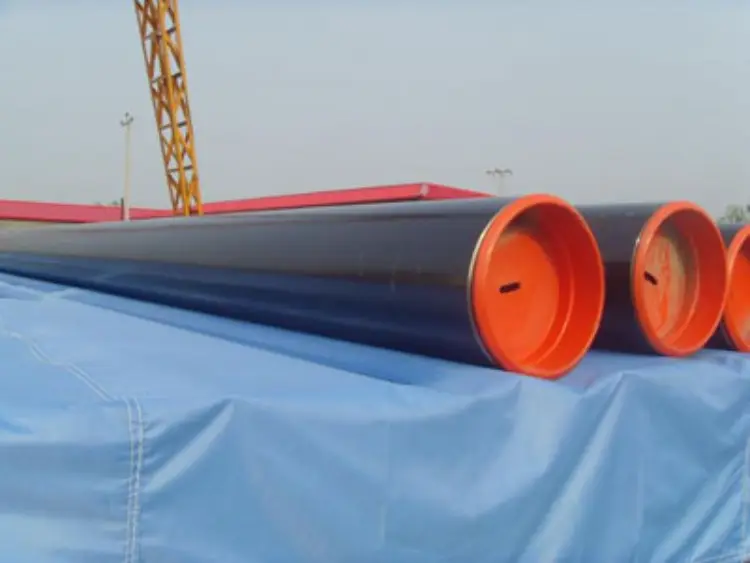
EN10025-2 S235J2 ERW Pipe
S235J2 ERW Pipe Steel – EN 10025-2 Carbon Structural Steel for Welded Tubes
Comprehensive material data for S235J2 according to EN 10025-2, widely used as base metal for electric resistance welded (ERW) pipes. Includes chemical composition, mechanical and physical properties, international equivalents, and application guidance.
Hot rolling, pickling and oiling, cold forming, electric resistance welding (ERW), cold bending, punching, drilling, welding (all standard arc and resistance methods)
- Phone : +8618037372205
- Email : [email protected]
- WhatsApp: Contact via Whtsapp
- WeChat: +8618037372205
EN10025-2 S235J2 ERW Pipe Introduction
S235J2 is a non-alloy structural steel grade defined by EN 10025-2:2019, intended for hot-rolled long and flat products. It is characterized by a minimum yield strength of 235 MPa for thickness ≤16 mm, combined with good weldability and guaranteed Charpy impact energy at -20 °C (J2 quality). When supplied as coil or strip, it is frequently processed into ERW (electric resistance welded) pipes for structural and general engineering purposes. The steel exhibits excellent cold formability and consistent mechanical properties, making it suitable for
- building frameworks
- mechanical tubing
- fluid transport lines
- furniture and agricultural equipment
.
EN10025-2 S235J2 ERW Pipe Chemical Composition
The ladle analysis of S235J2 according to EN 10025-2:2019, Table 2 and Table 3. Elements not listed are not intentionally added but may be present as residuals. Maximum values apply unless a range is given. Note: Silicon content is not mandated by the standard and may be reported for reference; the steel is aluminium-killed or fully killed when required for impact properties.
| Element | Standard Value (max. or range, wt%) | Remarks |
|---|---|---|
| C (Carbon) | ≤ 0.17 | For product thickness ≤ 16 mm; thickness dependent (≤ 0.17% up to 40 mm, ≤ 0.20% > 40 mm) |
| Mn (Manganese) | ≤ 1.40 | |
| Si (Silicon) | Not specified | Typical 0.15 – 0.35 for fully killed Al-killed practice; not a requirement |
| P (Phosphorus) | ≤ 0.025 | Low P to enhance toughness |
| S (Sulfur) | ≤ 0.025 | Low S for good weldability and ductility |
| N (Nitrogen) | ≤ 0.012 | Al-killed or equivalent binding treatment required for nitrogen control |
| Cu (Copper) | ≤ 0.55 | Optional; if specified, helps atmospheric corrosion resistance |
| Al (total Aluminium) | Typically ≥ 0.020 | Required for fine-grain practice and impact property guarantee; not a mandatory element in standard, but necessary to achieve J2 quality |
EN10025-2 S235J2 ERW Pipe Physical Properties
Physical properties representative of non-alloy structural steels at room temperature (20 °C) unless otherwise noted. Values are typical for carbon-manganese steels with approx. 0.17 % C and may vary slightly with exact composition and microstructure. These values are for reference only and are not part of EN 10025-2 specification.
| Property | Typical Value | Unit | Test Condition / Temperature Range |
|---|---|---|---|
| Density (ρ) | 7.85 | g/cm³ | at 20 °C |
| Modulus of Elasticity (E) | 210 | GPa | at 20 °C, static loading |
| Shear Modulus (G) | 81 | GPa | at 20 °C |
| Poisson's Ratio (ν) | 0.30 | - | at 20 °C, elastic range |
| Thermal Expansion Coefficient (α) | 11.1 | 10⁻⁶/K | 20–100 °C |
| Thermal Expansion Coefficient (α) | 11.9 | 10⁻⁶/K | 20–200 °C |
| Thermal Expansion Coefficient (α) | 12.5 | 10⁻⁶/K | 20–300 °C |
| Thermal Conductivity (λ) | 53 | W/(m·K) | at 20 °C |
| Specific Heat Capacity (c) | 461 | J/(kg·K) | at 20 °C |
| Electrical Resistivity (ρ_e) | 0.15 | µΩ·m | at 20 °C |
EN10025-2 S235J2 ERW Pipe Mechanical Properties
Mechanical properties according to EN 10025-2:2019, valid for products in as-delivered condition (+N or +AR). For ERW pipe, the properties of the base metal are the baseline; the pipe properties may be modified by cold forming (see EN 10219-1 for design values in hollow sections). Test pieces taken in longitudinal direction (L) unless noted.
- ReH – upper yield strength or 0.2% proof strength if no yield phenomenon.
- Rm – tensile strength.
- A – percentage elongation after fracture. Gauge length L₀ = 5.65√S₀ (proportional test piece).
- Bend test – transverse test piece, bending angle 180°, no cracks.
- KV – Charpy V-notch impact energy, average of three tests, minimum individual value 70% of specified average.
| Property | Standard Requirement (min. unless stated) | Unit | Test Condition / Thickness Range |
|---|---|---|---|
| Yield Strength ReH | ≥ 235 | MPa | t ≤ 16 mm |
| Yield Strength ReH | ≥ 225 | MPa | 16 mm < t ≤ 40 mm |
| Yield Strength ReH | ≥ 215 | MPa | 40 mm < t ≤ 100 mm |
| Tensile Strength Rm | 360 – 510 | MPa | t ≤ 100 mm |
| Tensile Strength Rm | 350 – 500 | MPa | 100 mm < t ≤ 150 mm |
| Elongation A (longitudinal) | ≥ 26 | % | t ≤ 40 mm (L₀ = 5.65√S₀) |
| Elongation A (longitudinal) | ≥ 25 | % | 40 mm < t ≤ 63 mm |
| Elongation A (longitudinal) | ≥ 24 | % | 63 mm < t ≤ 100 mm |
| Bend Test (transverse, d = mandrel diameter, a = specimen thickness) | d = 0.5a (no cracks) | – | t ≤ 16 mm; 180° bend |
| Bend Test (transverse) | d = 1a (no cracks) | – | 16 mm < t ≤ 100 mm; 180° bend |
| Impact Energy KV² (longitudinal) | ≥ 27 | J | Test temperature -20 °C (J2); average of 3 tests |
EN10025-2 S235J2 ERW Pipe Equivalent Material Standards & Replaceable Grades
| Country / Region | Standard & Grade | Designation | Remarks |
|---|---|---|---|
| European Union | EN 10219-1 (cold-formed welded structural hollow sections) | S235J2H | Direct equivalent for ERW pipe; same base chemistry and similar mechanical properties; -20°C impact test required. |
| European Union | EN 10210-1 (hot-finished structural hollow sections) | S235J2H | Hot-finished alternative; properties comparable but delivered in hot-finished condition. |
| International (ISO) | ISO 630-2: High yield strength structural steels | S235B | Close chemical and strength match; impact test at +20°C (B) versus -20°C (J2). Not fully equivalent to J2 quality. |
EN10025-2 S235J2 ERW Pipe Application Introduction
S235J2 ERW pipes are employed wherever moderate strength, excellent weldability, and reliable low-temperature toughness (-20°C impact guaranteed) are required. The ERW manufacturing process ensures uniform wall thickness and a smooth surface finish, making the pipes ideal for structural frameworks, mechanical components, and low to medium pressure fluid conveyance. Typical applications include
- building columns and beams (structural hollow sections)
- scaffolding and support structures
- handrails, guardrails, and fencing
- agricultural machinery frames
- bus and truck body construction
- industrial conveying lines
- furniture tubing
- compressed air and water piping (non-potable)
.
Product Applications: Welded structural hollow sections (rectangular, square, circular), ERW line pipe for low-pressure fluid service, Pre-galvanized and black steel tubes for scaffolding, Greenhouse frames and irrigation systems, Sports equipment (pole structures), Signage and lighting columns
Processed into products: Building columns and truss members, Machine frames and bases, Handrail and balustrade posts, Automotive sub-frames and roll cages, Conveyor rollers and idlers, Couplings and connectors, Cold-formed brackets and mounting plates, Telescopic poles and adjustable props
Application industries: Construction and civil engineering, Automotive and transportation (chassis and bodies), Agricultural machinery, General mechanical engineering, Furniture manufacturing, Warehouse and storage equipment, Pipe and tube fabrication
EN10025-2 S235J2 ERW Pipe Similar / Alternative Material Recommendations
| Country / Region | Standard & Grade | Designation | Remarks |
|---|---|---|---|
| United States | ASTM A36 / A36M | A36 | Widely used carbon structural steel; yield strength ~250 MPa (≤50 mm), tensile 400-550 MPa; but no guaranteed low-temperature impact. Good alternative for non-critical structural applications without J2 requirements. |
| Japan | JIS G 3101 | SS400 | General structural steel; tensile strength 400-510 MPa, yield ≈235–245 MPa for thin sections. No impact requirement; comparable strength but less stringent quality. |
| China | GB/T 700 | Q235B | Carbon structural steel with min. yield 235 MPa and impact at +20°C; widely used in construction and general engineering. Not suitable for -20°C applications without additional testing. |
| United States | ASTM A500 (cold-formed welded carbon steel structural tubing) | Grade B | Tubing standard with 315 MPa min yield (46 ksi) and 400 MPa min tensile (58 ksi). Higher strength than S235J2; may replace S235J2H in structural tubes where slightly increased strength is acceptable and impact requirements align. |
Notes:
When specifying S235J2 ERW pipe, the applicable pipe standard (e.g. EN 10219-1 for cold-formed hollow sections) must be invoked. The pipe-forming process may alter mechanical properties; EN 10219-1 allows reduced strength values after welding if not subsequently stress-relieved. Welding filler materials should be selected according to the steel category (non-alloy, C≤0.17%, CEV≤0.35) – typical options include ER70S-6 (GMAW) or E7018 (SMAW). For galvanizing, S235J2's low silicon content is beneficial for zinc coating adhesion. Inspection documents 3.1 according to EN 10204 are standard for J2 quality. No specific Corrosion resistance is implied; atmospheric corrosion proceeds similarly to plain carbon steel; protective coatings are required for durability.
- Share



