
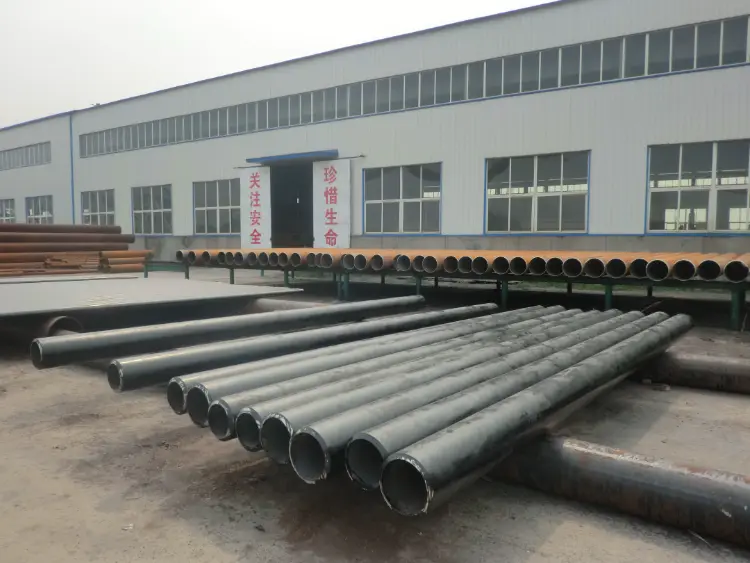
EN 10219 S420MLH LSAW Pipe
EN 10219 S420MLH LSAW Pipe: High-Strength Low-Temperature Structural Steel Hollow Section
Comprehensive material data sheet for EN 10219 S420MLH thermomechanically rolled fine-grain structural steel used for LSAW (Longitudinally Submerged Arc Welded) pipes, including chemical composition, mechanical properties, physical properties, equivalent grades, and application guidance.
Cold forming, welding (LSAW, SAW), bending, cutting, machining
- Phone : +8618037372205
- Email : [email protected]
- WhatsApp: Contact via Whtsapp
- WeChat: +8618037372205
EN 10219 S420MLH LSAW Pipe Introduction
EN 10219 S420MLH is a weldable fine-grain structural steel grade intended for cold-formed welded structural hollow sections. The designation 'MLH' indicates thermomechanical rolling with guaranteed impact toughness at -50 °C (M = thermomechanical rolled, L = low temperature, H = hollow section). It delivers a minimum yield strength of 420 MPa (for sections up to 16 mm thickness) with excellent formability and weldability. The LSAW (Longitudinally Submerged Arc Welded) pipe produced from this grade is widely used in demanding structural applications where high strength and low-temperature toughness are required, such as offshore structures, bridges, heavy machinery, and building frames. The fine-grain microstructure achieved by controlled rolling eliminates the need for normalizing or stress-relief heat treatment in most cases.
EN 10219 S420MLH LSAW Pipe Chemical Composition
The chemical composition of S420MLH is designed to achieve a fine-grain microstructure through thermomechanical rolling, ensuring high strength and excellent toughness at low temperatures. Microalloying elements such as niobium, vanadium, and titanium are added for grain refinement and precipitation strengthening. The carbon equivalent value (CEV) is controlled to guarantee good weldability.
| Element | Standard Value (max or range, mass%) | Remarks |
|---|---|---|
| Carbon (C) | ≤ 0.16 | Max |
| Silicon (Si) | ≤ 0.50 | Max |
| Manganese (Mn) | ≤ 1.70 | Max |
| Phosphorus (P) | ≤ 0.030 | Max |
| Sulfur (S) | ≤ 0.025 | Max |
| Aluminium (Al total) | ≥ 0.020 | Min; used for deoxidation and grain refinement |
| Niobium (Nb) | ≤ 0.05 | Max |
| Vanadium (V) | ≤ 0.12 | Max |
| Titanium (Ti) | ≤ 0.05 | Max |
| Nickel (Ni) | ≤ 0.30 | Max |
| Molybdenum (Mo) | ≤ 0.20 | Max |
| Copper (Cu) | ≤ 0.35 | Max |
| Chromium (Cr) | ≤ 0.30 | Max |
| Nitrogen (N) | ≤ 0.020 | Max |
| Carbon Equivalent (CEV) | ≤ 0.45 | Based on ladle analysis, CEV = C + Mn/6 + (Cr+Mo+V)/5 + (Ni+Cu)/15 |
EN 10219 S420MLH LSAW Pipe Thermal and Electrical Physical Properties
Physical properties are not specified in EN 10219; the values below are typical for low-alloy structural steels of the S420 grade family at ambient temperature. They are suitable for engineering calculations and are based on general structural steel data (EN 1993-1-1, EN 10025 documentation).
| Property | Typical Value | Unit | Test Condition |
|---|---|---|---|
| Density (ρ) | 7850 | kg/m³ | At 20 °C |
| Modulus of Elasticity (E) | 210 | GPa | At 20 °C |
| Shear Modulus (G) | 81 | GPa | At 20 °C |
| Poisson's Ratio (ν) | 0.3 | — | At 20 °C |
| Thermal Expansion Coefficient (α) | 12 × 10⁻⁶ | K⁻¹ | 20 – 100 °C |
| Thermal Conductivity (λ) | 50 | W/(m·K) | At 20 °C |
| Specific Heat Capacity (cₚ) | 460 | J/(kg·K) | At 20 °C |
| Electrical Resistivity (ρₑ) | 0.20 – 0.25 | μΩ·m | At 20 °C |
EN 10219 S420MLH LSAW Pipe Mechanical Properties
The mechanical properties depend on the wall thickness of the hollow section. The values below are minimum or range values for longitudinal test pieces (transverse values may be slightly lower). Impact toughness is guaranteed at -50 °C with a minimum absorbed energy of 27 J for all thicknesses. The delivery condition for LSAW pipe is as-welded, and the specified properties reflect the base metal (parent metal) away from the weld.
| Property | Standard Requirement | Unit | Test Condition |
|---|---|---|---|
| Yield Strength (ReH) | ≥ 420 | MPa | Wall thickness t ≤ 16 mm |
| Yield Strength (ReH) | ≥ 400 | MPa | 16 mm < t ≤ 40 mm |
| Yield Strength (ReH) | ≥ 390 | MPa | 40 mm < t ≤ 63 mm |
| Yield Strength (ReH) | — | MPa | 63 mm < t ≤ 100 mm (to be agreed) |
| Tensile Strength (Rm) | 520 - 680 | MPa | t ≤ 40 mm |
| Tensile Strength (Rm) | 500 - 660 | MPa | 40 mm < t ≤ 63 mm |
| Tensile Strength (Rm) | 480 - 630 | MPa | 63 mm < t ≤ 80 mm |
| Tensile Strength (Rm) | 470 - 620 | MPa | 80 mm < t ≤ 100 mm |
| Elongation (A5, L₀=5.65√S₀) | ≥ 19 | % | t ≤ 40 mm, longitudinal |
| Elongation (A80, L₀=80 mm) | ≥ 17 | % | t > 40 mm, longitudinal |
| Impact Energy (KV₂) | ≥ 27 | J | At -50 °C, Charpy V-notch, longitudinal, all thicknesses |
EN 10219 S420MLH LSAW Pipe Fully Equivalent Material Standards and Substitute Grades
| Country/Region | Standard | Grade | Remarks |
|---|---|---|---|
| Europe | EN 10219-1 | S420MLH | Original grade for welded hollow sections |
| Europe | EN 10025-4 | S420M | Base material (plates/coils) for hollow sections; same thermomechanical treatment |
| International | ISO 4951-1 | S420M | High yield strength steel bars and sections, thermomechanically rolled |
| USA | ASTM A1011 | HSLAS Grade 420 | High-strength low-alloy steel with minimum yield 420 MPa (comparable, but impact temperature may differ) |
EN 10219 S420MLH LSAW Pipe Application Introduction
EN 10219 S420MLH LSAW pipes are specifically designed for heavy structural applications that demand high strength, good weldability, and guaranteed toughness at temperatures as low as -50 °C. Thermomechanical rolling refines the grain structure, providing both strength and ductility without additional heat treatment. The longitudinal submerged arc welding (LSAW) process ensures a high-quality, uniform weld seam. These pipes are suitable for use in fatigue-loaded structures and in corrosive environments when combined with protective coatings.
Product Applications: Circular hollow sections (CHS), Square hollow sections (SHS), Rectangular hollow sections (RHS), LSAW steel pipes for structural purposes, Cold-formed welded hollow profiles for construction
Processed into products: Bracing elements and struts in offshore structures, Main chords and diagonals of heavy truss bridges, Tubular columns and beams for high-rise buildings, Wind turbine tower sections, Dragline and excavator booms, Penstock pipes for hydroelectric power plants, Jack-up legs and spudcans for offshore support vessels
Application industries: Offshore oil and gas (platforms, jackets, topsides), Bridge construction (main girders, arch ribs), Wind energy (tower structures, foundation piles), Heavy machinery and cranes (booms, chassis), Shipbuilding (deck girders, hull reinforcement), Building and construction (columns, trusses, space frames), Pipeline infrastructure (high-strength penstocks, water mains)
EN 10219 S420MLH LSAW Pipe Similar / Alternative Materials with Close Performance
| Country/Region | Standard | Grade | Remarks |
|---|---|---|---|
| Europe | EN 10219-1 | S420MH | Same strength, impact temperature -20 °C instead of -50 °C |
| Europe | EN 10025-3 | S420N / S420NL | Normalized or normalized rolled structural steels; slightly different chemical composition, good low-temperature toughness |
| USA | ASTM A572 | Grade 60 | Yield 415 MPa, similar strength; not specifically for hollow sections; impact properties by agreement |
| Japan | JIS G3106 | SM490YA | Yield ≥ 365 MPa, lower strength but often used in welded structures; toughness class depends on suffix |
| China | GB/T 1591 | Q420D | Minimum yield 420 MPa, -20 °C impact; comparable for plate and sections, but not specifically hollow sections |
Notes:
- EN 10219-1 specifies that S420MLH hollow sections may be supplied with optional improved surface quality or dimensional tolerances as agreed at the time of enquiry and order.
- For LSAW pipes, the weld joint efficiency is typically 100% when fully welded and inspected, but fatigue and fracture assessments should consider the weld joints.
- Post-weld heat treatment (PWHT) is not mandatory, but if required, the properties after PWHT must be agreed between the purchaser and manufacturer, because thermomechanically rolled steel can lose some strength when reheated.
- Properties given are for base metal; welding consumables should match the strength and toughness requirements.
- Share



