
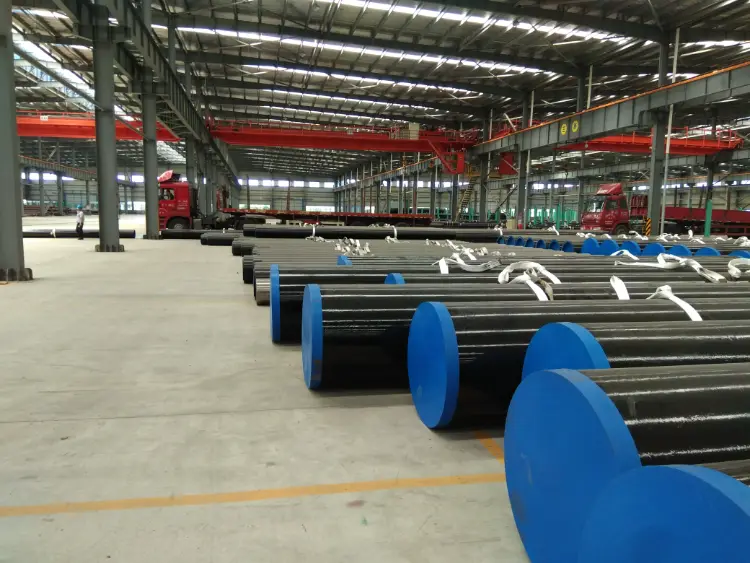
EN 10219 S355MH SSAW Pipe
EN 10219 S355MH SSAW Pipe: High-Strength Cold-Formed Structural Hollow Section with Fine Grain
Comprehensive material data for S355MH spiral submerged arc welded (SSAW) pipe under EN 10219, including chemical composition, mechanical and physical properties, equivalent grades, and application guidance for structural engineering.
Cold forming, spiral welding, submerged arc welding, cutting, beveling, coating
- Phone : +8618037372205
- Email : [email protected]
- WhatsApp: Contact via Whtsapp
- WeChat: +8618037372205
EN 10219 S355MH SSAW Pipe Introduction
S355MH is a weldable fine-grain structural steel grade intended for cold-formed welded structural hollow sections, manufactured by spiral submerged arc welding (SSAW) under the European standard EN 10219-1. This thermomechanically rolled low-carbon manganese steel offers a minimum yield strength of 355 MPa and excellent toughness down to -20°C, making it suitable for demanding static and dynamic loads in construction, offshore, and infrastructure projects.
The material is available in rounds, squares, and rectangles, with wall thicknesses up to 40 mm. Typical delivery condition is thermomechanical rolled, and the product is often supplied with test certificates 3.1 or 3.2 according to EN 10204.
EN 10219 S355MH SSAW Pipe Chemical Composition
The chemical composition of S355MH according to EN 10219-1:2006. Values are maximum unless otherwise stated. The fine-grain practice ensures sufficient aluminum content and limits on microalloying elements.
- For wall thicknesses >30 mm the carbon equivalent CEV is ≤0.45% (optionally ≤0.43%).
- Nitrogen binding elements such as Nb, V, and Ti are controlled to ensure toughness.
| Element | Content (%) | Remarks |
|---|---|---|
| Carbon (C) | ≤0.16 | Heat analysis |
| Silicon (Si) | ≤0.50 | Heat analysis |
| Manganese (Mn) | ≤1.70 | Heat analysis |
| Phosphorus (P) | ≤0.030 | Heat analysis |
| Sulfur (S) | ≤0.025 | Heat analysis |
| Niobium (Nb) | ≤0.05 | Heat analysis |
| Vanadium (V) | ≤0.12 | Heat analysis |
| Aluminum (Al) total | ≥0.020 | Minimum for fine-grain practice |
| Titanium (Ti) | ≤0.05 | Heat analysis |
| Nitrogen (N) | ≤0.015 | Heat analysis |
| Molybdenum (Mo) | ≤0.10 | Optional; not required by standard but may be present |
| Copper (Cu) | ≤0.55 | May appear from scrap; not specified |
| CEV (Carbon Equivalent) | ≤0.43/0.45 | Depending on thickness (≤30mm/ >30mm); CEV = C + Mn/6 + (Cr+Mo+V)/5 + (Ni+Cu)/15 |
EN 10219 S355MH SSAW Pipe Thermal and Electrical Physical Properties
Physical properties for low-carbon manganese structural steel, applicable to S355MH. These values are nominal and may vary slightly with composition and processing.
- Thermal expansion coefficient is averaged between 20°C and 100°C.
- Thermal conductivity decreases with increasing temperature.
- Specific heat increases with temperature.
- Electrical resistivity is for DC current.
| Property | Value | Unit | Test conditions |
|---|---|---|---|
| Density (ρ) | 7.85 | kg/dm³ | At 20°C |
| Elastic modulus (E) | 210 | GPa | At 20°C, static modulus |
| Shear modulus (G) | 81 | GPa | Calculated from E and ν = 0.3 |
| Poisson ratio (ν) | 0.3 | In elastic range | |
| Thermal expansion coefficient (α) | 12.0 × 10⁻⁶ | K⁻¹ | Between 20°C and 100°C |
| Thermal conductivity (λ) | 50 | W/(m·K) | At 20°C |
| Specific heat capacity | 460 | J/(kg·K) | At 20°C |
| Electrical resistivity (ρ_e) | 0.18 | µΩ·m | At 20°C, typical for carbon steel |
EN 10219 S355MH SSAW Pipe Mechanical Properties
Mechanical properties for S355MH hollow sections with wall thickness ≤40 mm as per EN 10219-1. Tensile test specimens are taken transverse to the weld, in the longitudinal direction for impact tests.
- Yield strength is the upper yield point (ReH).
- Impact energy (KV) is verified at -20°C on longitudinal Charpy V-notch specimens; 40 J min required for standard grades, may be higher for specific thicknesses.
- Bend test: mandrel diameter = 3 × thickness, bend angle 180°.
| Property | Value | Unit | Test conditions |
|---|---|---|---|
| Yield strength (ReH) | ≥355 | MPa | Wall thickness ≤40 mm, room temperature |
| Tensile strength (Rm) | 470 - 630 | MPa | Wall thickness ≤40 mm |
| Elongation after fracture (A) | ≥20 (longitudinal) | % | Proportional gauge length L₀ = 5.65√S₀ |
| Elongation after fracture (A) | ≥16 (transverse) | % | Proportional gauge length L₀ = 5.65√S₀ |
| Impact energy (KV) | ≥40 | J | At -20°C, longitudinal Charpy V-notch, average of 3 tests |
| Bend test (mandrel diameter) | 3 × t | Bend angle 180°; t = specimen thickness, no cracks |
EN 10219 S355MH SSAW Pipe Fully Equivalent Material Standards and Substitutable Grades
| Region/Country | Standard | Grade | Remarks |
|---|---|---|---|
| European Union | EN 10219-1 | S355MH | Identical; the base specification for cold-formed welded structural hollow sections |
| United Kingdom | BS EN 10219-1 | S355MH | British adoption of EN standard |
| Germany | DIN EN 10219-1 | S355MH | German adoption, formerly DIN 17119 S355MH |
| France | NF EN 10219-1 | S355MH | French adoption |
| Italy | UNI EN 10219-1 | S355MH | Italian adoption |
| Spain | UNE EN 10219-1 | S355MH | Spanish adoption |
| Sweden | SS-EN 10219-1 | S355MH | Swedish adoption |
| Poland | PN-EN 10219-1 | S355MH | Polish adoption |
EN 10219 S355MH SSAW Pipe Application Introduction
S355MH SSAW pipes are primarily used for structural applications requiring high strength-to-weight ratio and reliable toughness. Their fine-grain microstructure ensures good weldability and ductility even at low service temperatures.
The material is prevalent in:
- Construction of high-rise buildings and large-span roofs
- Infrastructure projects such as bridges, flyovers, and pedestrian decks
- Offshore oil and gas platforms, wind turbine towers and foundations
- Piling and foundation engineering
- Portal frames, towers, and masts for telecommunication
Product Applications: Bridge girders and arches, Structural columns and trusses, Piling pipes for deep foundations, Wind turbine monopiles and transition pieces, Platform legs and jacket structures, Telescopic and lattice crane booms
Processed into products: Welded pipe-to-pipe connections with end plates, Clamped and bolted flanges, Stub ends and butt-welded joints, Cut-to-length sections for fabrication, Bent and formed structural elements (e.g., curved beams), Welded assemblies with stiffeners and gussets
Application industries: Civil and structural engineering, Offshore and marine construction, Renewable energy (wind, solar support structures), Industrial machinery and crane manufacturing, Infrastructure and transport
EN 10219 S355MH SSAW Pipe Similar or Reasonable Alternative Materials
| Region/Country | Standard | Grade | Remarks |
|---|---|---|---|
| European Union | EN 10210-1 | S355J2H | Hot-finished structural hollow section; same yield strength but different processing; toughness guaranteed at -20°C |
| United States | ASTM A500/A500M | Grade C | Cold-formed welded carbon steel structural tubing; min yield 345 MPa; not a direct equivalent but widely used in similar applications |
| United States | ASTM A501/A501M | Grade A | Hot-formed structural tubing; yield 250 MPa, lower strength alternative |
| Canada | CSA G40.20/G40.21 | 350W | Structural steel hollow sections; yield 350 MPa, comparable but not identical in fine-grain practice |
| Japan | JIS G 3466 | STKR490 | Carbon steel square and rectangular tubes for general structure; tensile strength min 490 MPa, yield 325 MPa |
| China | GB/T 3091 | Q355B | Welded steel pipe for low pressure liquid delivery and structural purposes; yield 355 MPa, similar but not fine-grain |
Notes:
Additional notes:
- Delivery is normally in +M condition; surface condition may be black, shot blasted, or with shop primer.
- Weldability: S355MH is readily weldable with all common arc welding processes. Low CEV reduces cold cracking risk. Preheating is generally not required for thicknesses ≤30 mm.
- Optional testing: ultrasonic or radiographic inspection of welds, fracture toughness CTOD, corrosion resistance testing.
- Dimensional tolerance and straightness are according to EN 10219-2 for cold-formed hollow sections.
- For seismic or fatigue-loaded structures, it is recommended to specify additional testing of impact toughness and through-thickness properties.
- Share



