
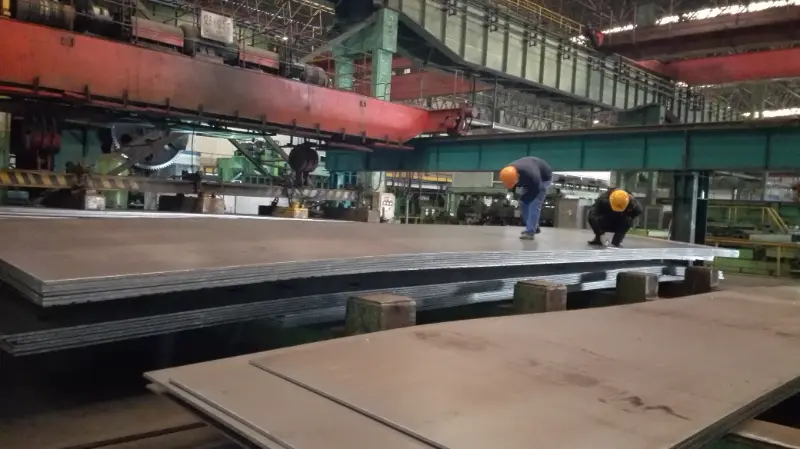
EN 10025-6 S500QL1
EN 10025-6 S500QL1 High-Strength Quenched & Tempered Steel for Low-Temperature Service
S500QL1 under EN 10025-6 is a weldable fine-grain structural steel with minimum yield strength of 500 MPa, supplied in quenched and tempered condition, offering excellent toughness down to -50°C. Suitable for heavy-duty structures in cryogenic environments.
Hot rolling, quenching and tempering; suitable for cold forming (limited), machining, and welding with appropriate procedures.
- Phone : +8618037372205
- Email : [email protected]
- WhatsApp: Contact via Whtsapp
- WeChat: +8618037372205
EN 10025-6 S500QL1 Introduction
S500QL1 is a high-strength structural steel grade defined in EN 10025-6, produced via quenching and tempering (Q+T). It belongs to the family of weldable fine-grain steels with improved low-temperature toughness. The designation: S – structural steel, 500 – minimum yield strength (MPa) for thicknesses ≤ 50 mm, Q – quenched and tempered, L1 – minimum impact energy of 27 J at -50 °C. Typical applications include mobile cranes, offshore structures, bridges, and heavy machinery subjected to low ambient temperatures. The material provides an excellent combination of high strength, good weldability, and reliable notch toughness.
EN 10025-6 S500QL1 Chemical Composition
The chemical composition complies with EN 10025-6:2019. Values are maximum unless a range is given. Fine grain practice is achieved through additions of Al, V, Nb, Ti, etc. Carbon equivalent (CEV) is controlled for weldability.
| Element | Standard Value | Remarks |
|---|---|---|
| C | ≤0.20 | max |
| Si | ≤0.80 | max |
| Mn | ≤1.70 | max |
| P | ≤0.020 | max |
| S | ≤0.010 | max |
| N | ≤0.015 | max |
| Al (total) | ≥0.015 | min, for fine grain control |
| Cr | ≤1.50 | max |
| Ni | ≤2.0 | max |
| Mo | ≤0.70 | max |
| Cu | ≤0.50 | max |
| V | ≤0.12 | max |
| Ti | ≤0.05 | max |
| Nb | ≤0.06 | max |
| B | ≤0.005 | max |
| Zr | ≤0.15 | max |
| Cr+Mo+Ni+Cu | ≤3.0 | sum of elements |
EN 10025-6 S500QL1 Thermal and Electrical Physical Properties
Physical properties are typical for quenched and tempered low-alloy steel at room temperature unless otherwise noted. These values serve as engineering reference and may vary slightly with actual heat treatment and exact composition.
| Property | Standard Required Value | Unit | Test Condition |
|---|---|---|---|
| Density (ρ) | ~7850 | kg/m³ | 20 °C |
| Modulus of elasticity (E) | ~210 | GPa | 20 °C |
| Shear modulus (G) | ~81 | GPa | 20 °C |
| Poisson's ratio (ν) | ~0.30 | – | 20 °C |
| Thermal expansion coefficient (α) | ~12 | 10⁻⁶/K | 20–100 °C |
| Thermal conductivity (λ) | ~50 | W/(m·K) | 20 °C |
| Specific heat capacity (c) | ~460 | J/(kg·K) | 20 °C |
| Electrical resistivity (ρ_e) | ~0.16 – 0.25 | μΩ·m | 20 °C |
EN 10025-6 S500QL1 Mechanical Properties
Mechanical properties are based on EN 10025-6:2019, valid for quenched and tempered condition. Impact tests are performed on Charpy-V specimens (10×10 mm) at -50 °C in longitudinal direction. Bend test requires a minimum bending angle of 180° around a mandrel without cracking.
| Property | Standard Required Value | Unit | Test Condition |
|---|---|---|---|
| Yield strength (ReH) | ≥500 | MPa | Thickness ≤16 mm |
| Yield strength (ReH) | ≥500 | MPa | Thickness >16 mm to ≤50 mm |
| Yield strength (ReH) | ≥480 | MPa | Thickness >50 mm to ≤100 mm |
| Yield strength (ReH) | ≥440 | MPa | Thickness >100 mm to ≤150 mm |
| Tensile strength (Rm) | 590 – 770 | MPa | Thickness ≤50 mm |
| Tensile strength (Rm) | 590 – 770 | MPa | Thickness >50 mm to ≤100 mm |
| Tensile strength (Rm) | 570 – 750 | MPa | Thickness >100 mm to ≤150 mm |
| Elongation (A5) | ≥17 | % | Thickness ≤16 mm, gauge L₀=5.65√S₀ |
| Elongation (A) | ≥17 | % | Thickness >16 mm to ≤50 mm, proportional test piece |
| Elongation (A) | ≥15 | % | Thickness >50 mm to ≤100 mm |
| Elongation (A) | ≥14 | % | Thickness >100 mm to ≤150 mm |
| Impact energy (KV) | ≥27 | J | at -50 °C, longitudinal, 10×10 mm specimen, thickness 10–150 mm |
| Bend test (180°) – mandrel diameter | 2t | – | Thickness ≤16 mm |
| Bend test (180°) – mandrel diameter | 3t | – | Thickness >16 mm to ≤50 mm |
| Bend test (180°) – mandrel diameter | 4t | – | Thickness >50 mm to ≤100 mm |
| Bend test (180°) – mandrel diameter | 6t | – | Thickness >100 mm to ≤150 mm |
EN 10025-6 S500QL1 Exactly Equivalent Material Standards and Substitute Grades
| Country/Region | Standard | Grade | Remarks |
|---|---|---|---|
| European Union | EN 10025-6 | S500QL1 (1.8984) | Original specification |
| International | ISO 4950-2 | E500DD | High yield strength flat products, quenched and tempered, fine grain, impact at -50°C |
EN 10025-6 S500QL1 Application Introduction
S500QL1 is used in applications requiring high strength and guaranteed toughness at sub-zero temperatures. The following sectors and typical products illustrate common usage.
Product Applications: Crane booms and lattice structures, Jack-up rig legs and offshore platform components, Welded steel bridge girders and trusses, Cryogenic pressure vessels and LPG/LNG storage tanks, Excavator and loader arms, bulldozer frames
Processed into products: Welded structural sections (beams, columns), Boom chords and lacing plates, Fatigue-critical welded junctions, Flanges, stiffeners, and end plates, Machined pins and sleeves for heavy joints
Application industries: Mobile crane manufacturing, Offshore and marine engineering, Bridge construction (especially in cold climates), Pressure vessel and storage tank fabrication, Heavy machinery and mining equipment, Renewable energy structures (wind turbine towers, Arctic infrastructure)
EN 10025-6 S500QL1 Similar/Comparable Substitute Materials
| Country/Region | Standard | Grade | Remarks |
|---|---|---|---|
| European Union | EN 10025-6 | S500Q (1.8924) | Same yield class but impact at -20°C; less demanding low-temperature toughness |
| European Union | EN 10025-6 | S500QL (1.8909) | Same yield class with impact at -40°C; slightly higher transition temperature |
| European Union | EN 10025-6 | S550QL1 (1.8987) | Higher yield class (550 MPa) with -50°C impact; increased strength, similar toughness |
Notes:
Welding must follow established procedures (preheat, interpass temperature control, post-weld heat treatment if required) to avoid hydrogen cracking and to maintain toughness. Cold forming should observe minimum bending radii to prevent strain aging and cracking. The CEV of S500QL1 is typically ≤0.65, ensuring good weldability with suitable consumables.
- Share



