
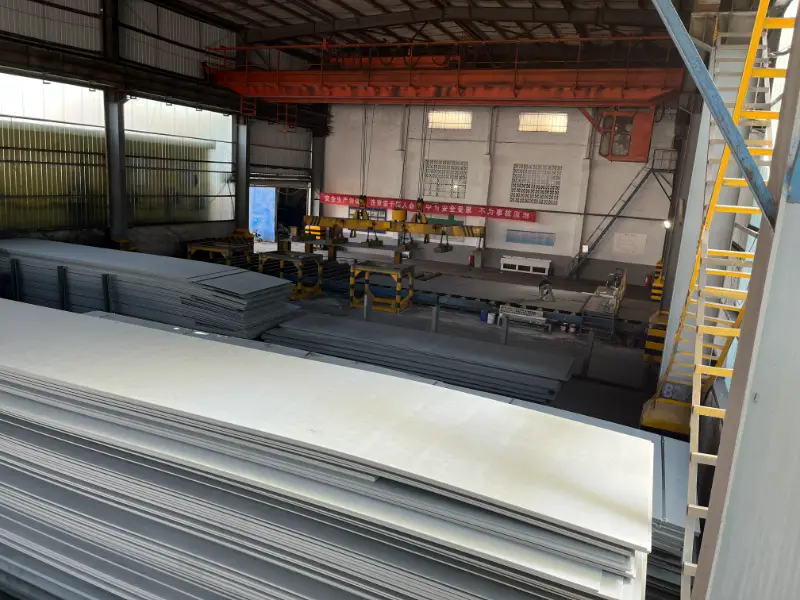
EN 10025-4 S420M Steel
S420M Steel – Thermomechanical Rolled High-Strength Structural Coil per EN 10025-4
Explore the technical data of S420M carbon and low-alloy high-strength steel coil under EN 10025-4. Chemical composition, mechanical properties, thermal and electrical data, international equivalents and application insights.
Welding, cold forming, hot forming, bending, cutting, drilling, punching
- Phone : +8618037372205
- Email : [email protected]
- WhatsApp: Contact via Whtsapp
- WeChat: +8618037372205
EN 10025-4 S420M Steel Introduction
S420M is a thermomechanically rolled weldable fine-grain structural steel defined in EN 10025-4. It offers a minimum yield strength of 420 MPa for thicknesses ≤ 16 mm, combined with excellent toughness and weldability. The thermomechanical rolling process refines the grain structure, providing high strength without excessive alloying, reducing carbon equivalent and improving formability. Typical delivery condition is 'M' (thermomechanically rolled), allowing direct use in heavy fabrication with reduced preheating requirements. S420M is widely used in bridges, offshore structures, crane booms and high-rise buildings where high strength and reliable low-temperature impact toughness are required.
EN 10025-4 S420M Steel Chemical Composition
The chemical composition of S420M meets the requirements of EN 10025-4:2019. Maximum values are given unless a range or minimum is indicated. The carbon equivalent (CEV) is controlled to ensure good weldability.
| Element | Content (mass %) | Remarks |
|---|---|---|
| C | ≤0.16 | For all thicknesses; CEV ≤0.41 typical |
| Si | ≤0.50 | |
| Mn | ≤1.70 | Higher Mn permissible for increased thickness |
| P | ≤0.030 | |
| S | ≤0.025 | |
| Nb | ≤0.05 | |
| V | ≤0.12 | |
| Al (total) | ≥0.015 | Minimum for fine grain practice |
| Ti | ≤0.05 | |
| Mo | ≤0.20 | |
| Ni | ≤0.80 | |
| Cr | ≤0.30 | |
| Cu | ≤0.55 | |
| N | ≤0.015 |
EN 10025-4 S420M Steel Thermal and Electrical Physical Properties
Physical properties are typical for low-alloy thermomechanically rolled steels. Exact values may vary slightly depending on actual composition and thickness.
| Property | Value | Unit | Test condition |
|---|---|---|---|
| Density (ρ) | 7850 | kg/m³ | Room temperature |
| Modulus of elasticity (E) | 210 | GPa | Room temperature |
| Shear modulus (G) | ≈81 | GPa | Room temperature |
| Poisson's ratio (ν) | 0.3 | — | Room temperature |
| Thermal expansion coefficient (α) | 12 × 10⁻⁶ | K⁻¹ | 20–100 °C |
| Thermal expansion coefficient (α) | 13 × 10⁻⁶ | K⁻¹ | 20–200 °C |
| Thermal conductivity (λ) | 53 | W/(m·K) | Room temperature |
| Thermal conductivity (λ) | 51 | W/(m·K) | At 100 °C |
| Specific heat capacity (c) | 460 | J/(kg·K) | Room temperature |
| Electrical resistivity (ρₑ) | 0.18 | Ω·mm²/m | Room temperature (typical 0.15–0.20) |
EN 10025-4 S420M Steel Mechanical Properties
Mechanical properties according to EN 10025-4 for S420M, based on test pieces taken in the transverse direction. Impact energy values are for longitudinal Charpy-V specimens.
| Property | Value | Unit | Test condition / thickness (mm) |
|---|---|---|---|
| Yield strength ReH | ≥420 | MPa | t ≤ 16 |
| Yield strength ReH | ≥400 | MPa | 16 < t ≤ 40 |
| Yield strength ReH | ≥390 | MPa | 40 < t ≤ 63 |
| Yield strength ReH | ≥370 | MPa | 63 < t ≤ 80 |
| Yield strength ReH | ≥360 | MPa | 80 < t ≤ 100 |
| Yield strength ReH | ≥340 | MPa | 100 < t ≤ 120 |
| Tensile strength Rm | 500–660 | MPa | t ≤ 40 |
| Tensile strength Rm | 500–660 | MPa | 40 < t ≤ 63 |
| Tensile strength Rm | 480–640 | MPa | 63 < t ≤ 80 |
| Tensile strength Rm | 470–630 | MPa | 80 < t ≤ 100 |
| Tensile strength Rm | 460–620 | MPa | 100 < t ≤ 120 |
| Elongation A (L₀=5.65√S₀) | ≥19 | % | t ≤ 40 |
| Elongation A | ≥19 | % | 40 < t ≤ 63 |
| Elongation A | ≥19 | % | 63 < t ≤ 80 |
| Elongation A | ≥18 | % | 80 < t ≤ 100 |
| Elongation A | ≥18 | % | 100 < t ≤ 120 |
| Impact energy KV (longitudinal) | ≥40 | J | at -20 °C, t ≤ 120 |
| Bend test (mandrel diameter) | 2t | — | t ≤ 16 (180° bend) |
| Bend test (mandrel diameter) | 2.5t | — | 16 < t ≤ 40 (180° bend) |
| Bend test (mandrel diameter) | 3t | — | 40 < t ≤ 63 (180° bend) |
| Bend test (mandrel diameter) | 3t | — | 63 < t ≤ 80 (180° bend) |
| Bend test (mandrel diameter) | 4t | — | 80 < t ≤ 100 (180° bend) |
| Bend test (mandrel diameter) | 4t | — | 100 < t ≤ 120 (180° bend) |
EN 10025-4 S420M Steel Fully Equivalent Standards and Replaceable Grades
| Country/Region | Standard | Grade | Remarks |
|---|---|---|---|
| European Union | EN 10025-4 | S420M | Original specification |
| Germany | DIN EN 10025-4 | S420M | Identical adoption |
| United Kingdom | BS EN 10025-4 | S420M | Identical adoption |
| France | NF EN 10025-4 | S420M | Identical adoption |
| Italy | UNI EN 10025-4 | S420M | Identical adoption |
| Spain | UNE EN 10025-4 | S420M | Identical adoption |
| International | ISO 4950-2 | S420M | Equivalent thermomechanically rolled grade |
EN 10025-4 S420M Steel Application Introduction
S420M is specifically designed for heavy welded structures where high strength and resistance to brittle fracture are essential. The thermomechanical rolling process allows the steel to be used directly in the as-delivered condition, reducing fabrication costs. It is suitable for all common welding techniques, provided a suitable consumable and preheat (if required) are used based on the carbon equivalent and thickness.
Product Applications: Welded bridge girders and box sections, Offshore platform topside structures and jacket legs, Tower crane booms and luffing jibs, Heavy-duty truck chassis and trailer frames, Industrial pressure vessels and penstocks
Processed into products: Welded I‑beams, H‑columns and box columns, Flanges and webs for crane girders, Brackets, stiffeners and gusset plates, Structural nodes and cast-welded joints, Bearing supports and connection plates
Application industries: Civil engineering and construction, Bridge fabrication, Offshore and marine engineering, Crane and heavy lifting equipment, Mining and earthmoving machinery, Transport vehicle manufacturing
EN 10025-4 S420M Steel Similar / Alternative Material Recommendations
These materials offer comparable strength and are sometimes used as alternatives, though process route and supplementary requirements may differ. Always verify welding and toughness requirements before substitution.
| Country/Region | Standard | Grade | Remarks |
|---|---|---|---|
| European Union | EN 10025-4 | S420ML | Same strength, improved low-temperature impact (down to -50 °C) |
| European Union | EN 10025-3 | S420N | Normalized rolling, similar strength but different delivery condition |
| European Union | EN 10025-4 | S460M | Higher minimum yield strength (460 MPa) |
| USA | ASTM A572 | Grade 60 | Yield strength 415 MPa; similar strength level but produced via different metallurgical route |
| USA | ASTM A709 | Grade 50T | Structural steel for bridges; 345 MPa yield but may be comparable in some designs |
| China | GB/T 1591 | Q420D | High-strength low-alloy structural steel, impact at -20 °C, 420 MPa yield |
| Japan | JIS G 3106 | SM490B | Lower yield but widely used for welded structures |
Notes:
- CEV (carbon equivalent) is typically ≤0.41% for S420M, ensuring good weldability without preheating for moderate thicknesses.
- The steel is fully killed and fine-grain treated with Al, and optionally with Nb, V or Ti for grain refinement.
- Ultrasonic testing to EN 10160 or equivalent may be specified for critical applications.
- Surface condition and tolerances comply with EN 10029 for plates and EN 10051 for coils and cut lengths.
- For improved resistance to lamellar tearing, Z-quality (Z15, Z25, Z35) can be ordered according to EN 10164.
- Share



