
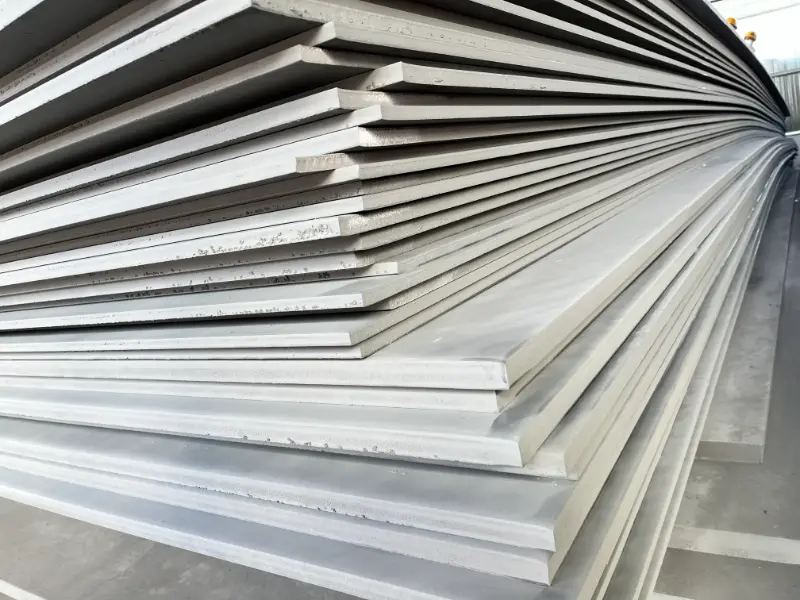
DIN 17102 TStE315 Steel
DIN 17102 TStE315 Steel: Comprehensive Data on Chemical, Mechanical, and Thermal Properties
Explore detailed technical specifications for TStE315 steel under DIN 17102, including exact chemical composition, mechanical and thermal properties, international equivalents, and application guidance for welded structures.
Welding, Cold forming, Bending, Cutting, Machining
- Phone : +8618037372205
- Email : [email protected]
- WhatsApp: Contact via Whtsapp
- WeChat: +8618037372205
DIN 17102 TStE315 Steel Introduction
TStE315 is a weldable fine-grain structural steel grade specified in the historical German standard DIN 17102, now largely superseded by EN 10025-3 and EN 10025-4. It belongs to the carbon and low-alloy high-strength steel category, specifically designed for cold-forming and welding applications. This steel offers a minimum yield strength of 315 MPa for thicknesses up to 16 mm, with guaranteed impact toughness at temperatures down to -20°C. It is characterized by its fine-grain microstructure achieved through controlled rolling or normalizing, which provides a good combination of strength, ductility, and weldability. Typical applications include welded constructions, bridge building, crane manufacturing, and vehicle components where structural integrity and low-temperature toughness are critical. The steel is commonly supplied in the form of coils and sheets.
DIN 17102 TStE315 Steel Chemical Composition
The chemical composition for TStE315 as per DIN 17102 establishes limits to ensure reliable weldability and toughness. Key elements like Carbon (C), Silicon (Si), and Manganese (Mn) are controlled for strength, while micro-alloying elements such as Niobium (Nb) and Vanadium (V) are used for grain refinement. Strict control over Phosphorus (P) and Sulfur (S) is essential for maintaining ductility and impact toughness. The Carbon Equivalent Value (CEV) is typically limited to guarantee weldability.
| Element | Standard Value (max %) | Remarks |
|---|---|---|
| Carbon (C) | 0.16 | For thickness ≤ 16 mm |
| Silicon (Si) | 0.50 | Typical maximum |
| Manganese (Mn) | 1.60 | Typical maximum |
| Phosphorus (P) | 0.030 | Maximum |
| Sulfur (S) | 0.025 | Maximum |
| Nitrogen (N) | 0.020 | Maximum, typically fixed by Al or other N-binding elements |
| Aluminum (Al) total | ≥ 0.020 | Minimum for grain refinement and nitrogen binding |
| Niobium (Nb) | 0.05 | Typical maximum for micro-alloying |
| Vanadium (V) | 0.10 | Typical maximum for micro-alloying |
| Titanium (Ti) | 0.05 | Maximum (if added for grain refinement) |
| Chromium (Cr) | 0.30 | Residual element limit |
| Nickel (Ni) | 0.30 | Residual element limit |
| Copper (Cu) | 0.35 | Residual element limit |
| Molybdenum (Mo) | 0.08 | Residual element limit |
DIN 17102 TStE315 Steel Thermal and Electrical Physical Properties
Physical properties are provided as typical reference values for low-alloy structural steel at room temperature (20°C), unless otherwise specified. Thermal conductivity and specific heat capacity are critical for calculating heat input during welding, while thermal expansion coefficient is essential for design consideration under thermal cycling.
| Property | Typical Reference Value | Unit | Test Condition |
|---|---|---|---|
| Density (ρ) | 7.85 | kg/dm³ | At 20°C |
| Modulus of Elasticity (E) | 210 | GPa | At 20°C |
| Shear Modulus (G) | 81 | GPa | At 20°C |
| Poisson's Ratio (ν) | 0.3 | — | At 20°C |
| Thermal Expansion Coefficient (α) | 12.0 | 10⁻⁶/K | 20°C to 100°C |
| Thermal Expansion Coefficient (α) | 13.0 | 10⁻⁶/K | 20°C to 300°C |
| Thermal Conductivity (λ) | 48 | W/(m·K) | At 20°C |
| Thermal Conductivity (λ) | 45 | W/(m·K) | At 200°C |
| Specific Heat Capacity (cp) | 461 | J/(kg·K) | At 20°C |
| Specific Heat Capacity (cp) | 530 | J/(kg·K) | At 300°C |
| Electrical Resistivity (ρ_e) | 0.22 | Ω·mm²/m | At 20°C, typical for low-alloy steel |
DIN 17102 TStE315 Steel Mechanical Properties
The mechanical properties of TStE315 are guaranteed for the delivery condition, typically normalized rolled. The minimum yield strength (ReH) and tensile strength (Rm) are dependent on product thickness. The steel provides high elongation and outstanding impact toughness at low temperatures (down to -20°C), verified by Charpy V-notch tests. The bending test ensures good cold formability, a critical requirement for coil material.
| Property | Standard Required Value | Unit | Test Condition / Thickness Range |
|---|---|---|---|
| Yield Strength (ReH) | 315 | MPa | Thickness ≤ 16 mm |
| Yield Strength (ReH) | 305 | MPa | Thickness 16 < t ≤ 35 mm |
| Yield Strength (ReH) | 295 | MPa | Thickness 35 < t ≤ 50 mm |
| Tensile Strength (Rm) | 490 - 610 | MPa | Thickness ≤ 100 mm |
| Elongation (A5) | 22 | % | Longitudinal, thickness ≤ 40 mm |
| Elongation (A5) | 20 | % | Transverse, thickness ≤ 40 mm |
| Impact Energy (KV) at -20°C | 27 | J | Longitudinal, average of 3 tests |
| Impact Energy (KV) at -20°C | 21 | J | Transverse, average of 3 tests |
| Bending Test (Bend Angle 180°) | No cracks | — | Mandrel diameter = 2t for t ≤ 16 mm |
DIN 17102 TStE315 Steel Complete Cross-Reference of International Equivalent Standards and Replaceable Grades
| Country/Region | Standard/Grade | Designation | Remarks |
|---|---|---|---|
| Europe | EN 10025-3 | S355N | Direct successor. Normalized rolled fine-grain steel with equivalent chemical and mechanical properties. |
| Europe | EN 10025-4 | S355M | Thermomechanically rolled version. Permits lower CEV but requires strict processing control. |
| USA | ASTM A572 / A572M | Grade 50 [345] | Comparable in strength, but detailed specifications on fine-grain practice and impact toughness must be verified. |
| Japan | JIS G3135 | SPFC 490 Y | High-strength cold-rolled steel for structural uses with similar strength, but different toughness and delivery conditions. |
| Italy | UNI 7945 | Fe E 315 KG | Closely matches the mechanical requirements and chemical composition of TStE315. |
| UK (Historic) | BS 4360 | Grade 50 DD | Equivalent fine-grain structural steel with guaranteed impact properties at low temperatures. |
DIN 17102 TStE315 Steel Application Introduction
TStE315 steel is engineered for welded load-bearing structures requiring high reliability and good low-temperature toughness. Key advantages include its excellent weldability, resistance to brittle fracture, and suitability for cold forming. The design of this fine-grain steel makes it a primary choice for dynamically loaded components.
Product Applications: Welded bridge girders and box sections, Mobile crane booms and outriggers, Vehicle chassis and frame side members, High-pressure penstocks and water pipes, Wind turbine tower sections (rolled into rings), Railway coach and wagon underframes, Offshore structural modules and skids
Processed into products: Welded I-beams and H-columns, Flanges and web stiffeners, Cold-formed channel and angle sections, Cut-to-length structural plates with 3D profiling, Bent plates for transition pieces, Reinforced joint plates and gussets, Longitudinally welded pipes and hollow sections
Application industries: Construction and infrastructure (bridges, stadiums, high-rise buildings), Heavy machinery and civil engineering (cranes, earthmoving equipment, conveyor systems), Shipbuilding and marine engineering (lighter structural parts, hatch covers), Offshore engineering (platform modules, flare booms, accommodation modules), Railway vehicle construction (underframes, bogie frames without high fatigue stress), Power generation (wind turbine towers, power plant steel structures)
DIN 17102 TStE315 Steel Recommendation for Similar/Comparable Substitute Materials
| Country/Region | Standard/Grade | Designation | Analysis/Remarks |
|---|---|---|---|
| China | GB/T 1591 | Q355D | Similar strength and guaranteed -20°C impact toughness. Widely used structural steel, but check delivery condition (N or M). |
| Russia | GOST 27772 | C345-3 | Structural steel for welded structures with comparable strength and application, but chemical composition must be verified. |
| USA | ASTM A709 / A709M | Grade 50S | High-strength structural steel for bridges. Similar strength but specific fracture critical toughness requirements may differ. |
| Europe | EN 10025-6 | S500Q | Higher yield strength (500 MPa) quenched and tempered steel as a potential upgrade, requiring revised welding procedures. |
| Japan | JIS G3106 | SM490B | Rolled steels for welded structure with equivalent tensile strength. Impact test temperature differs (-0°C vs -20°C). |
Notes:
- Welding: Preheating is generally not required for thicknesses below 30 mm due to low carbon equivalent. Common welding methods include SAW, MAG, and SMAW. A minimum interpass temperature must be maintained.
- Corrosion Resistance: This material has no enhanced atmospheric corrosion resistance and must be protected by painting, galvanizing, or metallization for outdoor use. It is not resistant to acids or harsh chemical environments.
- Standards Supersession: DIN 17102 has been officially withdrawn. For new designs, equivalent grades from EN 10025-3 (S355N) or EN 10025-4 (S355M) must be specified according to the German DIN EN 10025 series.
- Share



