
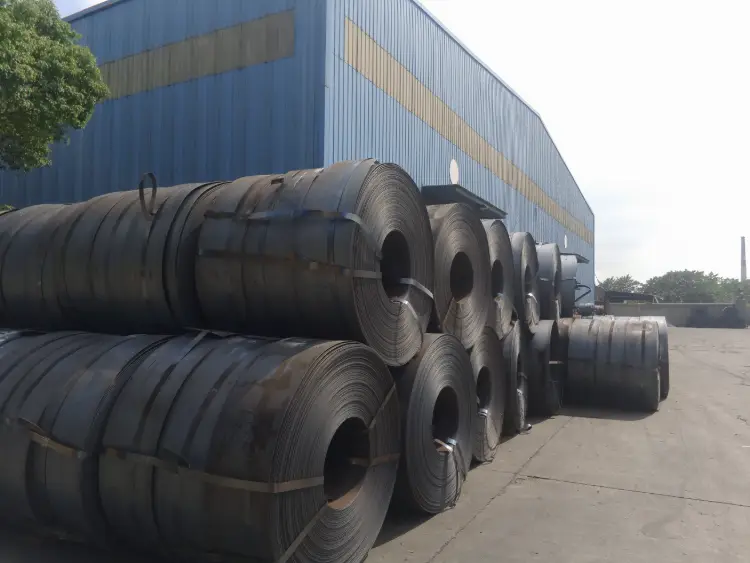
DIN 17102 EStE255 Carbon and Low-alloy High-strength Steel Coil
DIN 17102 EStE255 Carbon and Low-alloy High-strength Steel Coil - Properties, Equivalents and Applications
Detailed material data for EStE255 steel according to DIN 17102: chemical composition, mechanical and physical properties, international equivalents, similar grades, and application guidance.
Cold forming, bending, welding, blanking, punching
- Phone : +8618037372205
- Email : [email protected]
- WhatsApp: Contact via Whtsapp
- WeChat: +8618037372205
DIN 17102 EStE255 Carbon and Low-alloy High-strength Steel Coil Introduction
EStE255 is a hot-rolled, weldable fine-grain structural steel specified in the German standard DIN 17102. It belongs to the carbon and low-alloy high-strength steel group, designed for cold forming and welded structures.
- Minimum yield strength of 255 MPa for thicknesses up to 16 mm, combined with good elongation and impact toughness.
- Low carbon content ensures excellent weldability without preheating.
- Microalloying with niobium, vanadium or titanium provides grain refinement and precipitation strengthening.
- Used in automotive, construction and mechanical engineering for weight reduction and high load-bearing capacity.
The material is predominantly supplied as hot-rolled coil or cut-to-length sheet, and can be further processed by cold forming, bending and welding.
DIN 17102 EStE255 Carbon and Low-alloy High-strength Steel Coil Chemical composition according to DIN 17102 for EStE255, heat analysis
The steel is microalloyed with strong nitride/carbide formers such as Nb, V and Ti to achieve fine grain and high strength. The sum of Nb+V+Ti is restricted to ensure consistent formability. Aluminium is added for deoxidation and grain refinement.
- Maximum limits guarantee good weldability and toughness.
- All values comply with the requirements of DIN 17102:1983 for grade EStE255 in product thickness ranges typically up to 50 mm.
| Element | Value (%) | Remarks |
|---|---|---|
| C (Carbon) | ≤ 0.12 | Ladle analysis |
| Si (Silicon) | ≤ 0.50 | Ladle analysis |
| Mn (Manganese) | ≤ 1.30 | Ladle analysis |
| P (Phosphorus) | ≤ 0.030 | Ladle analysis |
| S (Sulfur) | ≤ 0.030 | Ladle analysis |
| Al (Aluminium, total) | ≥ 0.015 | Minimum for fine grain practice |
| Nb (Niobium) | ≤ 0.09 | Microalloying element |
| V (Vanadium) | ≤ 0.20 | Microalloying element |
| Ti (Titanium) | ≤ 0.22 | Microalloying element |
| Nb+V+Ti | ≤ 0.22 | Sum of microalloying elements |
DIN 17102 EStE255 Carbon and Low-alloy High-strength Steel Coil Thermal and electrical physical properties for EStE255
Properties are representative for low-carbon microalloyed steels at room temperature, unless otherwise specified. Thermal expansion, conductivity and specific heat apply to the typical working temperature range.
- Density is used for weight calculations.
- Elastic moduli are required for stiffness and forming simulations.
- Electrical resistivity is relevant for resistance welding processes.
| Property | Typical value | Unit | Test condition / Temperature |
|---|---|---|---|
| Density (ρ) | 7.85 | g/cm³ | at 20 °C |
| Elastic modulus (E) | 210 | GPa | at 20 °C |
| Shear modulus (G) | approx. 80 | GPa | at 20 °C |
| Poisson's ratio (ν) | 0.3 | – | at 20 °C |
| Thermal expansion coefficient (α) | 12.0 | 10⁻⁶/K | 20 – 100 °C |
| Thermal expansion coefficient (α) | 12.5 | 10⁻⁶/K | 20 – 200 °C |
| Thermal expansion coefficient (α) | 13.3 | 10⁻⁶/K | 20 – 400 °C |
| Thermal conductivity (λ) | 50 | W/(m·K) | at 20 °C |
| Specific heat capacity (cp) | 460 | J/(kg·K) | at 20 °C |
| Electrical resistivity (ρ_e) | 0.18 | Ω·mm²/m | at 20 °C |
DIN 17102 EStE255 Carbon and Low-alloy High-strength Steel Coil Mechanical properties for EStE255 according to DIN 17102
Mechanical properties for longitudinal test pieces in the as-delivered condition (thermomechanically rolled). Values depend on product thickness. Bend test: 180° bend with specified mandrel diameter, no cracks allowed. Impact test: Charpy-V notch, average energy at -20 °C. For thicknesses below 10 mm, yield strength may be slightly higher but agreed upon.
- Elongation measured on gauge length L0 = 5.65√S0 (A5) or proportional specimens.
| Property | Standard requirement | Unit | Test condition |
|---|---|---|---|
| Yield strength (ReH) | ≥ 255 | MPa | t ≤ 16 mm |
| Yield strength (ReH) | ≥ 235 | MPa | 16 mm < t ≤ 35 mm |
| Yield strength (ReH) | ≥ 225 | MPa | 35 mm < t ≤ 50 mm |
| Tensile strength (Rm) | 360 – 460 | MPa | t ≤ 50 mm |
| Elongation (A) | ≥ 24 | % | t ≤ 16 mm, L0=5.65√S0 |
| Elongation (A) | ≥ 23 | % | 16 mm < t ≤ 35 mm, L0=5.65√S0 |
| Elongation (A) | ≥ 22 | % | 35 mm < t ≤ 50 mm, L0=5.65√S0 |
| Bend test | 0.5 a | mandrel diameter | t ≤ 16 mm, 180° bend |
| Bend test | 1 a | mandrel diameter | 16 mm < t ≤ 35 mm, 180° bend |
| Bend test | 1.5 a | mandrel diameter | 35 mm < t ≤ 50 mm, 180° bend |
| Impact energy (KV) | ≥ 27 | J | -20 °C, longitudinal, 10×10 mm² specimen |
| Impact energy (KV) | ≥ 20 | J | -20 °C, longitudinal, for thicknesses 5 – 10 mm (10×7.5 mm²) |
DIN 17102 EStE255 Carbon and Low-alloy High-strength Steel Coil International grades with completely equivalent designation to EStE255
| Country / Region | Standard | Grade | Remarks |
|---|---|---|---|
| Europe | EN 10149-2 | S260NC | Thermomechanically rolled, min. ReH 260 MPa (t≤16 mm); closest match for EStE255 |
| Italy | UNI 7947 | FeE255KG | Equivalent fine-grain steel, identical designation |
| France (historical) | NF A36-231 | E255D | Former French standard, same concept |
| International | ISO 6930-2 | FeE255 | Same yield strength class, similar chemistry |
DIN 17102 EStE255 Carbon and Low-alloy High-strength Steel Coil Application Introduction
EStE255 is ideal for cold-formed structural parts requiring a balanced combination of strength, weldability and formability. Typical applications include:
- Automotive frames, chassis parts, cross members, seat structures.
- Agricultural and construction machinery: booms, frames, buckets.
- Storage racks, shelving systems, scaffolding.
- General welded structures where low-temperature toughness is required.
Due to its fine-grain microstructure, the material can be bent, punched, and drawn without cracking. It is widely used in thicknesses from 1.5 mm to 16 mm as hot-rolled strip or sheet.
Product Applications: Vehicle chassis and subframes, Hydraulic formed tubular parts, Racking uprights, beams and braces, Formed weldments for machine frames, Cold-formed open sections (C, Z, U profiles)
Processed into products: Longitudinal and cross beams, Axle supports and spring brackets, Trailer hitches and drawbars, Roll-over protective structures (ROPS), Pressing and stamping of brackets, flanges, and housings
Application industries: Automotive (passenger cars and commercial vehicles), Agricultural machinery, Construction and building machinery, Material handling and storage systems, Mechanical engineering and welded structures
DIN 17102 EStE255 Carbon and Low-alloy High-strength Steel Coil Similar steel grades with comparable properties
| Country / Region | Standard | Grade | Remarks |
|---|---|---|---|
| Europe | EN 10149-2 | S315MC | Higher strength (min. ReH 315 MPa), similar formability and welding; requires process adaptation |
| Germany | DIN 17102 | EStE285 | Next higher grade in the same standard, min. ReH 285 MPa |
| Germany | DIN 17102 | EStE315 | Higher strength variant, often used for weight reduction with redesign |
| Japan | JIS G 3134 | SPFH 540 | Similar high-strength hot-rolled steel for automotive, min. tensile strength 540 MPa (typically higher strength) |
| USA | ASTM A1011 | Grade 50 | Standard HSLA steel with min. yield 345 MPa; chemical composition differs but can be a substitute for thicker sections |
Notes:
EStE255 is no longer actively maintained in the latest European standards; EN 10149-2 S260NC is the direct successor. However, many drawings still reference the old DIN designation. When ordering, it is recommended to specify EN 10149-2 S260NC with optional improved cold formability (e.g., S260NC+Z for electrolytically galvanized, or pickled/oiled surface finish). Weldability: Excellent, suitable for all conventional welding processes (MAG, spot, laser). No preheating required for thicknesses ≤30 mm. Tolerances: Thickness and flatness according to EN 10051 if produced under the EN standard.
- Share



