
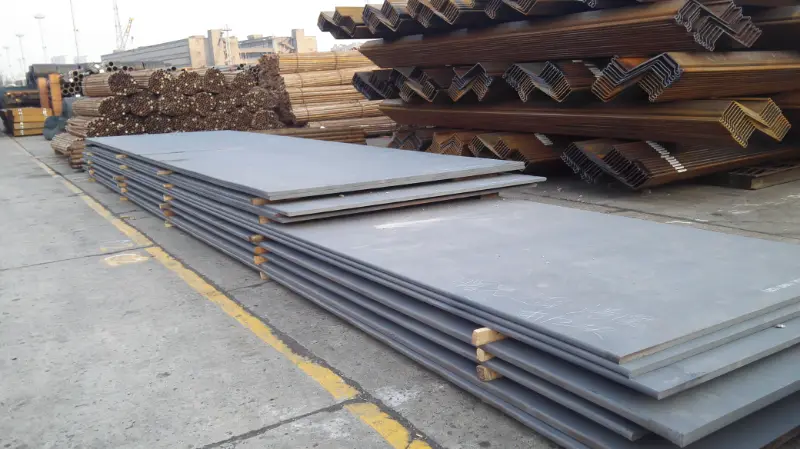
CCS EQ70 (E690) High-Strength Shipbuilding Steel
CCS EQ70 Shipbuilding Steel Coil Properties, Specification & Equivalent Grades
Detailed material properties of CCS EQ70 shipbuilding steel coil including chemical composition, mechanical properties, thermal and electrical properties. Find equivalent grades and application guide.
Quenched and tempered (Q&T); suitable for cold forming, machining, and welding under controlled procedures.
- Phone : +8618037372205
- Email : [email protected]
- WhatsApp: Contact via Whtsapp
- WeChat: +8618037372205
CCS EQ70 High-Strength Shipbuilding Steel Introduction
CCS EQ70 is a high-strength quenched and tempered shipbuilding steel coil certified by China Classification Society (CCS). It belongs to the 690 MPa yield strength class and is designed for critical offshore and marine structural applications. Key characteristics include:
- Minimum yield strength of 690 MPa, enabling weight reduction in large structures.
- Excellent low-temperature toughness (E-grade, -40°C impact test) for harsh marine environments.
- Good weldability with appropriate preheating and consumables.
- Available in coils for subsequent cutting and forming processes.
Typical applications are in the construction of offshore platforms, high-stress ship hull members, and heavy-lift crane booms.
CCS EQ70 High-Strength Shipbuilding Steel Chemical Composition
The chemical composition of CCS EQ70 steel is carefully controlled to achieve high strength and good low-temperature toughness. Key alloying elements such as chromium, nickel, and molybdenum are often added to ensure adequate hardenability during quenching. Grain-refining elements (Nb, V, Ti) and aluminum are present to maintain fine austenite grain size. Maximum limits for impurities like phosphorus and sulfur are strictly enforced to preserve toughness and weldability. Typical product analysis tolerances apply as per CCS rules.
| Element | Standard Value (max, unless range given) | Remarks |
|---|---|---|
| C | ≤0.20 | Carbon |
| Si | ≤0.55 | Silicon |
| Mn | ≤1.70 | Manganese |
| P | ≤0.025 | Phosphorus |
| S | ≤0.025 | Sulfur |
| Als (acid soluble) | ≥0.015 | Aluminium, total or acid soluble |
| Nb | ≤0.06 | Niobium |
| V | ≤0.10 | Vanadium |
| Ti | ≤0.02 | Titanium |
| Cu | ≤0.50 | Copper |
| Cr | ≤1.50 | Chromium |
| Ni | ≤2.00 | Nickel |
| Mo | ≤0.50 | Molybdenum |
| N | ≤0.012 | Nitrogen |
CCS EQ70 High-Strength Shipbuilding Steel Thermal and Electrical Physical Properties
These physical properties are typical for quenched and tempered low-alloy steels with 690 MPa yield strength. Actual values may vary slightly depending on the exact chemical composition and heat treatment condition. The data is provided for design calculations (thermal expansion, heat transfer, electrical conductivity). Density, elastic moduli, and thermal properties are measured at room temperature unless otherwise noted.
| Property | Typical Value | Unit | Condition / Temperature |
|---|---|---|---|
| Density (ρ) | 7.85 | g/cm³ | 20°C |
| Modulus of elasticity (E) | 205 – 210 | GPa | 20°C |
| Shear modulus (G) | 79 – 81 | GPa | 20°C, calculated from E and ν |
| Poisson's ratio (ν) | 0.28 – 0.30 | – | 20°C |
| Thermal expansion coefficient (α) | 12.0 – 12.5 | 10⁻⁶/K | 20–100°C |
| Thermal conductivity (λ) | 35 – 42 | W/(m·K) | 20°C |
| Specific heat capacity | 450 – 480 | J/(kg·K) | 20°C |
| Electrical resistivity (ρ_e) | 0.20 – 0.30 | μΩ·m | 20°C |
CCS EQ70 High-Strength Shipbuilding Steel Mechanical Properties
Mechanical testing is performed on quenched and tempered specimens taken from the product. The values below are the minimum requirements according to CCS rules for EQ70 steel (thickness ≤150 mm). Tensile testing is conducted at room temperature in the transverse direction. Impact tests use standard Charpy V-notch specimens and are carried out at -40°C in the longitudinal direction. Bend test is performed with a former diameter equal to 3 times the specimen thickness for transverse specimens. Note that properties can be tailored through heat treatment and thickness reduction.
| Property | Required Value | Unit | Test Condition |
|---|---|---|---|
| Yield strength (ReH) | ≥690 | MPa | Room temperature, transverse, 0.2% offset |
| Tensile strength (Rm) | 770 – 940 | MPa | Room temperature, transverse |
| Elongation (A) | ≥14 | % | Gauge length 5.65√So, transverse |
| Impact energy (KV) | ≥50 (average), ≥35 (individual) | J | Longitudinal, -40°C, Charpy V-notch |
| Bend test (diameter) | 3a (a = specimen thickness) | – | Transverse, 180° bending |
CCS EQ70 High-Strength Shipbuilding Steel Fully Equivalent Material Standards and Substitutable Grades
| Country / Region | Standard | Grade | Remarks |
|---|---|---|---|
| International Association of Classification Societies | IACS UR W31 | E690 | Common standard for high strength hull steel |
| USA / ABS | ABS Rules | EQ70 | Identical grade and properties |
| Norway / Germany (DNV GL) | DNV GL Rules | E690 (VL E690) | Same strength and toughness class |
| France / BV | BV Rules | E690 | Identical performance requirements |
| UK / LR | LR Rules | E690 | Equivalent to CCS EQ70 |
| Japan / NK (ClassNK) | NK Rules | E690 | Same yield and impact specification |
| South Korea / KR | KR Rules | E690 | Directly comparable |
| Italy / RINA | RINA Rules | E690 | Same minimum requirements |
| India / IRS | IRS Rules | E690 | Matched mechanical properties |
CCS EQ70 High-Strength Shipbuilding Steel Application Introduction
CCS EQ70 steel coil is primarily used in offshore and marine engineering where high strength and toughness are mandatory. It allows designers to reduce structural weight while maintaining safety and service life. The material is delivered in the quenched and tempered condition, ready for fabrication. Key application considerations:
- Welding: Use low-hydrogen consumables, matched filler metals (e.g., AWS A5.28 ER110S-G), and appropriate preheat/interpass temperatures.
- Forming: Cold forming is possible but may require stress relieving; hot forming must be followed by a new quench and temper.
- Inspection: Non-destructive testing (UT, MT) often specified for critical joints.
Product Applications: Ship hull plates and stiffeners, Deck and bottom structural members, Offshore platform tubular nodes and braces, Lifting equipment such as mobile crane telescopic booms, Subsea frames and pressure housings
Processed into products: Transverse frames and longitudinal girders, Main deck plates (especially in high-load areas), Helideck structures, Crane pedestal and slewing rings, Jack-up leg chords and racks, Shear plates and insert plates in high-stress regions
Application industries: Shipbuilding (naval vessels, icebreakers, large container ships), Offshore oil & gas (jack-up rig legs, semi-submersible platforms, FPSOs), Renewable energy (offshore wind turbine foundations, transition pieces), Heavy engineering (crane booms, earthmoving equipment), Ship repair and conversion
CCS EQ70 High-Strength Shipbuilding Steel Similar / Comparable Substitute Materials
| Country / Region | Standard | Grade | Remarks |
|---|---|---|---|
| China | GB/T 712 | FH70 (Q690CF) | National equivalent; confirm delivery condition and impact temperature (F-grade -60°C is more stringent). |
| European Union | EN 10025-6 | S690QL / S690QL1 | Structural steel with min 690 MPa yield; check notch toughness class (e.g., -40°C). |
| USA | ASTM A514 / A517 | Grade Q | Quenched and tempered alloy steel plate for structural applications; verify impact requirements. |
| USA | ASTM A709 / A709M | Grade HPS 100W (yield 690) | High performance steel, mainly for bridge construction; toughness may differ. |
| Japan | JIS G 3106 | SM570 (yield 460) | Lower strength; can be considered only if design allows reduced yield. |
Notes:
Processing notes: Preheating before welding is recommended at 100–150°C depending on thickness and heat input. Post-weld heat treatment (PWHT) is generally not required for thicknesses below 50 mm but may be specified for stress relief. Tolerances: Thickness, width, and flatness tolerances comply with CCS rules or as agreed in contract. Certification: Mill test certificates (MTC) per EN 10204 type 3.1 are standard; additional classification society surveys may be required for marine applications. Ordering information: Specify grade, dimensions, delivery condition, and any supplementary requirements (e.g., through-thickness tensile testing per Z35).
- Share



