
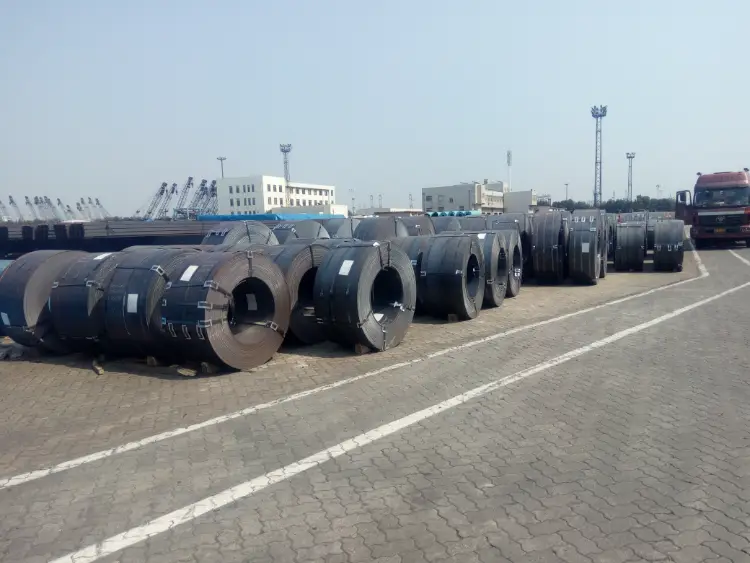
CCS EQ63 Quenched & Tempered Shipbuilding Steel Coil
CCS EQ63 Quenched & Tempered Shipbuilding Steel Coil: Properties, Equivalents & Applications
Complete data for CCS EQ63 shipbuilding steel coil: chemical composition, mechanical and physical properties, international equivalents, forming and welding guidance, and typical applications in ship and offshore structures.
Hot rolling, controlled rolling, quenching and tempering, cold forming, welding (with preheat and low-hydrogen procedures), machining
- Phone : +8618037372205
- Email : [email protected]
- WhatsApp: Contact via Whtsapp
- WeChat: +8618037372205
CCS EQ63 Quenched & Tempered Shipbuilding Steel Coil Introduction
CCS EQ63 is an extra high-strength, quenched and tempered shipbuilding steel grade specified by the China Classification Society (CCS). With a minimum yield strength of 620 MPa, it belongs to the advanced high-tensile hull structural steels designed for critical load-bearing applications in shipbuilding and offshore engineering.
- Key characteristics: outstanding strength-to-weight ratio, excellent low-temperature toughness (impact tested at -40 °C), good weldability with appropriate procedures, and reliable through-thickness performance.
- Heat treatment: delivered in the quenched and tempered (Q&T) condition to achieve fine-grained bainitic/martensitic microstructures that deliver the specified mechanical properties.
- Certification: fully compliant with CCS Rules for Materials and Welding and aligned with IACS UR W31, ensuring worldwide acceptance in marine classification.
- Availability: typically supplied as coils, plates, or cut-to-length sheets, EQ63 can be cold formed, machined, and welded following qualified procedures.
CCS EQ63 Quenched & Tempered Shipbuilding Steel Coil Chemical Composition
The table shows typical maximum or range values according to CCS Rules for EQ63 steel. Carbon equivalent (CEV) is controlled to ensure weldability. Microalloying elements such as Nb, V, and Ti are added for grain refinement and precipitation strengthening. Note: Actual values shall comply with the mill's test certificate and may be adjusted within the limits depending on product thickness and required supplementary properties.
| Element | Standard Value (wt%) | Remarks |
|---|---|---|
| Carbon (C) | ≤ 0.20 | Max. |
| Silicon (Si) | 0.10 – 0.55 | Range |
| Manganese (Mn) | 0.90 – 1.70 | Range; may be adjusted for thick sections |
| Phosphorus (P) | ≤ 0.025 | Max. |
| Sulfur (S) | ≤ 0.025 | Max. |
| Copper (Cu) | ≤ 0.35 | Max. |
| Chromium (Cr) | ≤ 0.20 | Max. |
| Nickel (Ni) | ≤ 0.80 | Max. |
| Molybdenum (Mo) | ≤ 0.30 | Max. |
| Niobium (Nb) | ≤ 0.05 | Max. |
| Vanadium (V) | ≤ 0.10 | Max. |
| Titanium (Ti) | ≤ 0.02 | Max. |
| Aluminium (Al) total | ≥ 0.020 | Min., if Al is used for grain refinement |
| Nitrogen (N) | ≤ 0.020 | Max. (≤ 0.012 if Al treated) |
| Carbon Equivalent (CEV) | ≤ 0.55 | Typical agreement value: CEV = C + Mn/6 + (Cr+Mo+V)/5 + (Ni+Cu)/15 |
CCS EQ63 Quenched & Tempered Shipbuilding Steel Coil Physical Properties
The following values are representative for this class of steel at room temperature unless otherwise noted. They are not mandatory specification requirements but are useful for design calculations. Note: Properties can vary slightly with exact composition and heat treatment. Density is 7.85 g/cm³; thermal expansion and conductivity are similar to other structural steels.
| Property | Standard Requirement Value | Unit | Test Condition / Remarks |
|---|---|---|---|
| Density (ρ) | 7.85 × 10³ | kg/m³ | 20 °C |
| Elastic Modulus (E) | 205 | GPa | Tensile modulus, room temperature |
| Shear Modulus (G) | 80 | GPa | Calculated from E and ν |
| Poisson's Ratio (ν) | 0.30 | – | Elastic range |
| Thermal Expansion Coefficient (α) | 12.0 × 10⁻⁶ | 1/K | 20 – 100 °C |
| Thermal Expansion Coefficient (α) | 13.0 × 10⁻⁶ | 1/K | 20 – 200 °C |
| Thermal Conductivity (λ) | 45 – 50 | W/(m·K) | 20 °C |
| Specific Heat Capacity (cp) | 460 – 500 | J/(kg·K) | 20 °C |
| Electrical Resistivity (ρe) | ~0.20 | μΩ·m | 20 °C |
CCS EQ63 Quenched & Tempered Shipbuilding Steel Coil Mechanical Properties
Tensile and impact properties are determined on transverse specimens unless otherwise agreed. The yield strength (ReH) and tensile strength (Rm) are valid for the thickness ranges listed. Charpy V‑notch impact test is performed at -40 °C (E‑grade). Key points: higher thicknesses lead to a slight reduction in strength due to mass effect; post‑welding heat treatment is not normally required, but preheating may be recommended. Bend test ensures formability.
| Property | Standard Requirement Value | Unit | Test Condition / Thickness |
|---|---|---|---|
| Yield Strength (ReH) | ≥ 620 | MPa | t ≤ 50 mm |
| Yield Strength (ReH) | ≥ 600 | MPa | 50 mm < t ≤ 70 mm |
| Yield Strength (ReH) | ≥ 580 | MPa | 70 mm < t ≤ 100 mm |
| Tensile Strength (Rm) | 720 – 900 | MPa | All thicknesses |
| Elongation (A5) | ≥ 15 | % | Transverse, gauge length 5.65√S0, t ≤ 50 mm |
| Elongation (A5) | ≥ 15* | % | *May be reduced for thicker sections as per standard |
| Charpy V‑notch Impact Energy (KV) | ≥ 41 (longitudinal) / ≥ 27 (transverse) | J | -40 °C, 10×10 mm specimen, t ≤ 50 mm |
| Charpy V‑notch Impact Energy (KV) | ≥ 34 (long.) / ≥ 24 (trans.) | J | -40 °C, 10×10 mm specimen, 50 < t ≤ 70 mm |
| Charpy V‑notch Impact Energy (KV) | ≥ 27 (long.) / ≥ 20 (trans.) | J | -40 °C, 10×10 mm specimen, 70 < t ≤ 100 mm |
| Bend Test | Mandrel diameter = 3t | – | 180° bend, no cracks; test specimen width ≥ 2t |
CCS EQ63 Quenched & Tempered Shipbuilding Steel Coil Exact International Equivalents & Replaceable Grades
| Country / Region | Standard | Grade | Remarks |
|---|---|---|---|
| China | CCS Rules | EQ63 | Original specification |
| International (IACS) | IACS UR W31 | EQ63 | Identical mechanical requirements; chemical limits harmonized |
| Norway/Germany | DNV GL | VL E620 | Former DNV E620; DNV GL rules |
| USA | ABS | EQ63 | ABS Rules for Materials and Welding |
| UK | Lloyd's Register | LR EQ63 | LR Rules |
| France | Bureau Veritas | BV E620 | BV Rules |
| Japan | ClassNK | NK KE620 | Nippon Kaiji Kyokai |
| Italy | RINA | RINA E620 | Registro Italiano Navale |
| South Korea | Korean Register | KR RE620 | KR Rules |
| Russia | RS | RS E620 | Russian Maritime Register of Shipping |
CCS EQ63 Quenched & Tempered Shipbuilding Steel Coil Application Introduction
EQ63 steel is engineered for the most demanding marine environments where high strength and low-temperature toughness are essential. Its superior mechanical performance enables weight savings without compromising safety.
- Typical processing: delivered in Q&T condition, so cold forming must respect minimum bending radii and possible stress relief. Welding requires low-hydrogen consumables and controlled heat input to avoid cold cracking. Preheating (50–150 °C) may be required depending on thickness and carbon equivalent.
- Corrosion protection: surface preparation and coating systems are similar to other shipbuilding steels; the alloy is not inherently corrosion‑resistant.
Product Applications: Container ship hull girders, Bulk carrier and tanker decks, Jack‑up rig legs and spudcans, FPSO module support structures, LNG carrier containment systems structural parts
Processed into products: Longitudinal stiffeners and stringers, Transverse web frames and floors, Bulkhead plates and stiffeners, Hatch coaming bars and corner pieces, Ship rudder horn castings (plated construction), Crane pedestal and king post reinforcements, High‑stress node plates in tubular joints
Application industries: Commercial and naval shipbuilding, Offshore oil & gas platforms, Wind turbine installation vessels, Heavy lift and crane vessels, Arctic and ice-class ship construction
CCS EQ63 Quenched & Tempered Shipbuilding Steel Coil Similar & Nearby Grades
| Country / Region | Standard | Grade | Remarks |
|---|---|---|---|
| International | IACS UR W31 | EQ62 | Yield strength ≥ 560 MPa; lower strength, slightly better ductility and toughness |
| International | IACS UR W31 | EQ70 | Yield strength ≥ 690 MPa; higher strength, more demanding welding procedures |
| Europe | EN 10025‑6 | S690QL | Quenched and tempered structural steel, not specifically for shipbuilding, but similar strength level and composition |
Notes:
- The chemicals and properties listed are based on the CCS Rules for Materials and Welding, Part 1, Chapter 5 (Extra High Strength Hull Structural Steels) and are aligned with IACS UR W31. Actual mill certificates may show tighter ranges.
- For thicknesses above 100 mm, special agreement with the classification society is usually required; properties may be further adjusted.
- Through‑thickness properties (Z‑quality: Z25, Z35) can be ordered to reduce lamellar tearing risk in highly restrained welded joints.
- Supplementary ultrasonic testing (e.g., ASTM A578/A578M) is normally carried out for such high‑strength grades.
- All data provided are for reference; the user must consult the latest applicable CCS rules and the steel manufacturer for the specific project.
- Share



