
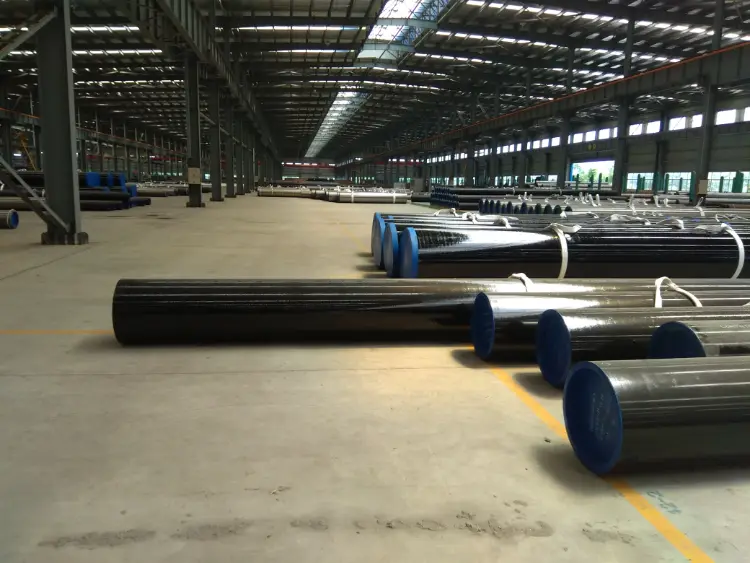
ASTM A671 CC60 LSAW Pipe
ASTM A671 CC60 LSAW Pipe: Low-Temperature Carbon Steel for Pressure Vessels and Piping
Detailed material data for ASTM A671 CC60 electric-fusion-welded LSAW steel pipe, including chemical composition, mechanical properties, thermal properties, equivalents, and applications in low-temperature service.
Manufactured from normalized plate, formed, and welded by LSAW process; post-weld heat treatment may be applied; final pipe can be further processed by machining, bending, and welding.
- Phone : +8618037372205
- Email : [email protected]
- WhatsApp: Contact via Whtsapp
- WeChat: +8618037372205
ASTM A671 CC60 LSAW Pipe Introduction
ASTM A671 CC60 is an electric-fusion-welded steel pipe manufactured from normalized carbon steel plates conforming to ASTM A516 Grade 60. Designed specifically for atmospheric and lower temperature service, this pipe grade combines good weldability with reliable notch toughness at temperatures down to -46°C (depending on class). The base metal features a carefully controlled chemistry with low carbon and manganese content to ensure consistent mechanical properties while maintaining excellent formability. The pipe is produced by longitudinal submerged arc welding (LSAW), which yields a robust, uniform weld with mechanical properties matching the base metal. Common applications include low-temperature pressure vessels, cryogenic storage tanks, and process piping in the oil & gas, petrochemical, and chemical industries. Delivery condition is normalized, providing a fine-grained microstructure that enhances toughness and resistance to brittle fracture at low temperatures.
ASTM A671 CC60 LSAW Pipe Chemical Composition of Base Metal
The chemical composition corresponds to the normalized plate used for manufacturing ASTM A671 CC60 pipe. The steel is fully killed and fine grain treated, ensuring uniform properties and good low‑temperature toughness. Residual elements are kept low to avoid adverse effects on weldability and impact performance.
Note: The limits below are for product analysis per ASTM A516/A516M. For wall thicknesses greater than 12.5 mm, manganese requirements may vary; consult the standard for precise ranges.
| Element | Content (wt.%) | Remarks |
|---|---|---|
| Carbon (C) | ≤ 0.21 | For thickness ≤ 12.5 mm; may be lower for greater thickness |
| Silicon (Si) | 0.15 – 0.40 | For killed steel |
| Manganese (Mn) | 0.60 – 0.90 | For thickness ≤ 50 mm; 0.85–1.20 for >50 mm |
| Phosphorus (P) | ≤ 0.025 | Max limit |
| Sulfur (S) | ≤ 0.025 | Max limit |
| Copper (Cu) | ≤ 0.35 | Residual; when specified |
| Nickel (Ni) | ≤ 0.25 | Residual; when specified |
| Chromium (Cr) | ≤ 0.25 | Residual; when specified |
| Molybdenum (Mo) | ≤ 0.08 | Residual; when specified |
| Vanadium (V) | ≤ 0.02 | Residual; when specified |
| Niobium (Nb) | ≤ 0.01 | Residual; when specified |
| Aluminum (Al) | ≥ 0.020 | Grain refining element, if added |
ASTM A671 CC60 LSAW Pipe Thermal and Electrical Physical Properties
The following values are typical for normalized carbon steel with similar composition to ASTM A516 Grade 60. They are not mandatory specification requirements but are useful for design calculations. Actual values may vary slightly depending on precise chemical composition and heat treatment.
Note: Thermal expansion coefficient and thermal conductivity are for the temperature range near ambient conditions.
| Property | Typical Value | Unit | Test Condition |
|---|---|---|---|
| Density (ρ) | 7850 | kg/m³ | Room temperature |
| Elastic Modulus (E) | 205 | GPa | At 20°C |
| Shear Modulus (G) | 80 | GPa | Calculated |
| Poisson's Ratio (ν) | 0.30 | — | At 20°C |
| Thermal Expansion Coefficient (α) | 11.7 | ×10⁻⁶/°C | 20–100°C |
| Thermal Conductivity (λ) | 51.9 | W/m·K | At 20°C |
| Specific Heat Capacity (c) | 486 | J/kg·K | At 20–100°C |
| Electrical Resistivity (ρ_e) | 0.142 | ×10⁻⁶ Ω·m | At 20°C |
ASTM A671 CC60 LSAW Pipe Typical Tensile and Impact Properties of ASTM A671 CC60 Pipe
Mechanical properties are derived from the base metal standard ASTM A516 Grade 60 in normalized condition. Requirements apply to the weld and heat-affected zone as well as the parent metal. The values below are for pipe wall thickness ≤ 40 mm unless otherwise noted. Impact toughness is guaranteed by the selected temperature class (e.g., Class 2: -46°C, Class 3: -60°C); the purchaser specifies the required Charpy test temperature.
Note: Elongation measured on a 2 in. (50 mm) gage length; bend test mandrel diameter depends on specimen thickness.
| Property | Value | Unit | Test Condition |
|---|---|---|---|
| Tensile Strength (Rm) | 415 – 550 | MPa | Room temperature, transverse specimen |
| Yield Strength (ReH) | ≥ 220 | MPa | For thickness ≤ 40 mm; lower for greater thickness |
| Elongation in 2 in. (50 mm) (A) | ≥ 25 | % | For thickness ≤ 12.5 mm |
| Elongation in 8 in. (200 mm) (A) | ≥ 21 | % | For thickness ≤ 12.5 mm |
| Bend Test (Guided Bend) | No cracks ≥ 3 mm | — | Bend angle 180°; mandrel diameter per standard |
| Charpy V-Notch Impact (KV₂) | ≥ 27 (avg.) / ≥ 20 (single) | J | At specified temperature (e.g., -46°C for Class 2) |
| Charpy V-Notch Impact (KV₂) | ≥ 34 (avg.) / ≥ 27 (single) | J | At -60°C (Class 3, typical optional requirement) |
ASTM A671 CC60 LSAW Pipe Complete Equivalent Material Standards and Grade Replacements
| Country/Region | Standard | Grade | Remarks |
|---|---|---|---|
| USA | ASTM A516 / A516M | Grade 60 | Base plate material; not a pipe standard but identical chemistry and properties. |
| Europe | EN 10028-2 | P265GH (1.0425) | Plate for pressure vessels; slightly higher yield (265 MPa) and comparable tensile. |
| Europe | EN 10217-3 | P265NH | Welded steel pipes for pressure purposes; similar to A671 CC60 but with different test requirements. |
| Japan | JIS G3106 | SM400C | Rolled steel for welded structure; comparable weldability and toughness; used for low‑temperature service. |
| International | ISO 9328-2 | P265GH | Ferritic‑pearlitic steel for pressure vessels; closely aligned with EN 10028-2. |
ASTM A671 CC60 LSAW Pipe Application Introduction
ASTM A671 CC60 LSAW pipe is specifically engineered for demanding low‑temperature environments where resistance to brittle fracture is critical. Its fine‑grained normalized microstructure ensures consistent performance in sub‑zero conditions, making it suitable for a wide range of industrial applications.
Product Applications: Low‑temperature pressure vessels and storage spheres, Cryogenic piping spools and headers, Heat exchanger shells and channels, Process piping networks in liquefied natural gas (LNG) terminals, Steam methane reformer (SMR) outlet manifolds
Processed into products: LSAW pipe sections (straight lengths, cut‑to‑size), Pipe fittings (elbows, tees, reducers) fabricated from the same material, Nozzle reinforcement pads for pressure vessels, Welded branch connections and stiffening rings, Transition pieces between vessels and piping
Application industries: Oil & Gas (onshore and offshore piping, LNG facilities), Petrochemical (ethylene, propylene, and other cryogenic processes), Chemical Processing (low‑temperature reactors, storage systems), Power Generation (cooling water systems, heat exchangers), Cryogenic Storage (LPG, liquid nitrogen, and carbon dioxide tanks)
ASTM A671 CC60 LSAW Pipe Similar/Alternative Steel Grades Frequently Used in Low-Temperature Piping
| Country/Region | Standard | Grade | Remarks |
|---|---|---|---|
| USA | ASTM A671 | CB60 | Same pipe standard, but base metal is ASTM A515 Gr. 60 (semi‑killed, carbon‑silicon steel); lower toughness than CC60. |
| USA | ASTM A672 | CC60 | Electric‑fusion‑welded pipe for moderate temperature service; also uses A516 Gr. 60 plate but with different test philosophy. |
| USA | ASTM A516 | Grade 65 | Plate with higher tensile strength (450–585 MPa); suitable when increased strength is required, but toughness may be compromised. |
| Europe | EN 10217-3 | P275NH | Welded pipe with slightly higher yield (275 MPa); good low‑temperature toughness; direct alternative for many applications. |
| Japan | JIS G3128 | SM490C | High‑strength rolled steel with excellent toughness; often used in bridges and pressure equipment. |
Notes:
- Welding: The pipe is intended for field or shop welding using low‑hydrogen processes; filler metal should match the base metal's strength and toughness requirements. Preheating and interpass temperature control are essential for thick‑wall pipe.
- Testing: ASTM A671 mandates hydrostatic testing of each length, with optional nondestructive examination (radiographic or ultrasonic) of the weld seam. Charpy testing is carried out on the base metal, weld metal, and heat‑affected zone.
- Certification: All pipes are supplied with material test reports (MTRs) showing chemical analysis, mechanical test results, and heat treatment recordings. Dual certification to other pressure vessel standards may be possible upon request.
- Share



