
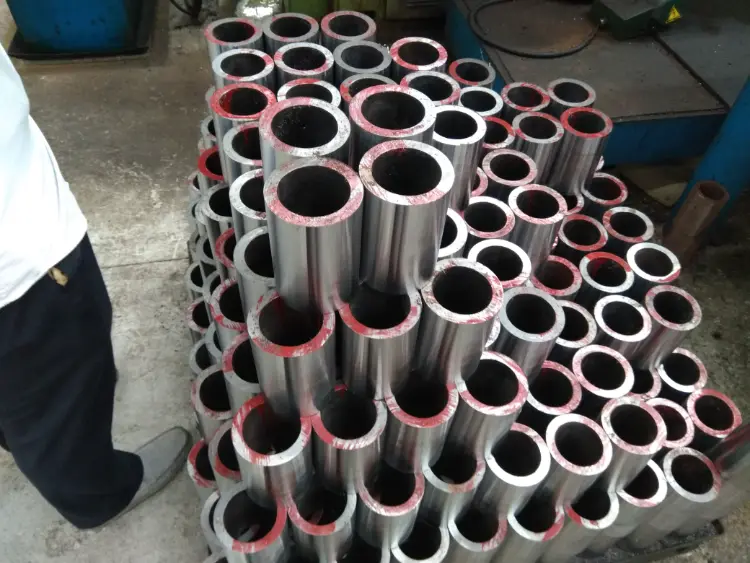
ASTM A671 CB65 LSAW Pipe
ASTM A671 CB65 LSAW Pipe: Comprehensive Material Properties & Applications
In-depth analysis of ASTM A671 Grade CB65 longitudinal submerged arc welded (LSAW) steel pipe including chemical composition, mechanical and physical properties, international equivalents, and typical applications.
Longitudinal Submerged Arc Welding (LSAW) from steel plate; pipe may be cold expanded after welding
- Phone : +8618037372205
- Email : [email protected]
- WhatsApp: Contact via Whtsapp
- WeChat: +8618037372205
ASTM A671 CB65 LSAW Pipe Introduction
ASTM A671 CB65 is a grade of electric-fusion-welded (EFW) pipe produced by the longitudinal submerged arc welding (LSAW) process. It belongs to the family of carbon steel plates intended for use in pressure piping and general service applications. The steel is typically semi-killed and exhibits a good combination of weldability, strength, and toughness at atmospheric temperatures. CB65 designates a minimum tensile strength of 65 ksi (450 MPa), with a minimum yield strength of 35 ksi (240 MPa). This pipe grade is widely used in oil and gas transportation, water pipelines, structural supports, and low-temperature service where notch toughness is not a mandatory code requirement. The standard specifies chemistry limits, tensile properties, and bend testing. Plates are supplied in the as-rolled or normalised condition prior to forming, and the final pipe may be supplied as-welded or stress-relieved.
ASTM A671 CB65 LSAW Pipe Chemical Composition
The chemical requirements for ASTM A671 Grade CB65 are based on the analysis of the steel plate used to form the pipe. The steel is generally semi-killed and elements like silicon are optionally controlled. Standard specifies maximum limits for carbon, manganese, phosphorus, sulfur, and silicon when required. Typical plate chemistry ensures good weldability and adequate strength. Values are from ASTM A671/A671M Table 1.
| Element | Specified Value | Remarks |
|---|---|---|
| Carbon (C) | ≤ 0.24% | Heat analysis; may be lower for better weldability |
| Manganese (Mn) | ≤ 1.20% | Manganese content contributes to strength and toughness |
| Phosphorus (P) | ≤ 0.035% | Max limit for both heat and product analysis |
| Sulfur (S) | ≤ 0.035% | Low sulfur improves ductility and cleanliness |
| Silicon (Si) | 0.15–0.30% (when required) | Required for semi-killed steel practice; may be specified by purchaser |
ASTM A671 CB65 LSAW Pipe Thermal and Electrical Physical Properties
The following physical properties are typical for carbon steel grades similar to ASTM A671 CB65. They are representative of the steel in the range 0–100°C unless noted otherwise. These values are not mandated by the standard but are based on engineering handbooks and can be used for design calculations. Actual properties may vary slightly with exact chemical composition and heat treatment.
| Property | Typical Value | Unit | Condition / Reference Temperature |
|---|---|---|---|
| Density (ρ) | 7.85 | g/cm³ | Room temperature |
| Modulus of Elasticity (E) | 200–210 | GPa | At 20°C |
| Shear Modulus (G) | 79.3–80.3 | GPa | Calculated from E and ν |
| Poisson's Ratio (ν) | 0.27–0.30 | — | In elastic range |
| Thermal Expansion (α) | 11.7 | 10⁻⁶ /°C | 20–100°C mean coefficient |
| Thermal Conductivity (λ) | 52 | W/(m·K) | At 20°C |
| Specific Heat Capacity (c) | 486 | J/(kg·K) | 20–100°C mean |
| Electrical Resistivity (ρ_e) | 0.142 | µΩ·m | At 20°C |
ASTM A671 CB65 LSAW Pipe Mechanical Properties
Tensile and bend properties are determined on transverse specimens taken from the pipe wall. The minimum tensile strength is 65 ksi (450 MPa) and the minimum yield strength is 35 ksi (240 MPa). Elongation values are based on a 2-inch (50.8 mm) gauge length and depend on specimen thickness. Bend testing is mandatory and ensures adequate ductility of the weld and base metal. Impact testing is not required by the base standard but may be specified as supplementary requirement S2. All values refer to the pipe body at room temperature in the as-delivered condition.
| Property | Specified Value | Unit | Test Condition |
|---|---|---|---|
| Yield Strength (ReH) | ≥ 240 (min) | MPa [ksi] | Transverse strip, 0.2% offset, room temperature |
| Tensile Strength (Rm) | 450–585 | MPa [65–85 ksi] | Transverse strip, room temperature |
| Elongation (A) | see formula* | % | Gauge length 50.8 mm (2 in); *For thickness t ≤ 7.9 mm (0.312 in): A ≥ 22%; t > 7.9 mm: A = 56t + 17.5 (rounded to nearest %) |
| Bend Test | Bend angle 180°; no cracks | — | Mandrel diameter = 3 × specimen thickness; specimen axis transverse to weld |
ASTM A671 CB65 LSAW Pipe Exact Equivalent Material Standards and Replaceable Grades
| Country/Region | Standard | Grade | Remarks |
|---|---|---|---|
| USA | ASTM A671 | CB65 | The exact source grade; no other direct identity in international standards. |
| - | - | - | No full international equivalents exist because chemistry and tensile requirements are specific to ASTM A671. |
ASTM A671 CB65 LSAW Pipe Application Introduction
ASTM A671 CB65 LSAW pipes are employed where moderate strength, good weldability, and low cost are primary requirements. The pipe can be supplied in large diameters (up to 60 inches and beyond) and long lengths, making it ideal for long-distance transmission and structural projects. It is suitable for service at ambient and moderately low temperatures where notch toughness is not a design factor. Common processing includes cutting, beveling, and welding into spools or on-site joints. The material can be used as pressure-retaining components up to certain design stresses as per applicable codes (ASME B31.3, B31.4, etc.).
Product Applications: Line pipe for liquid and gas transportation, Piling pipe (spiral or longitudinal weld), Penstocks for hydropower plants, Steel casing for wells, Structural tubular members, Fire protection piping (sprinkler mains)
Processed into products: Straight pipe sections, Induction bends (hot-formed from CB65 pipe), Weld-on flanges and fittings (matching material grade), Tees and reducers fabricated from plate, Pipe supports and saddles, Drip rings and other welded attachments
Application industries: Oil & Gas (onshore flowlines, gathering lines), Water & Wastewater (transmission mains, penstocks), Construction & Civil Engineering (piling, structural columns, bridge supports), Power Generation (cooling water lines, ash handling), Petrochemical & Refining (low-pressure process piping), Mining (slurry transport)
ASTM A671 CB65 LSAW Pipe Similar / Closely Matching Alternative Materials
| Country/Region | Standard | Grade | Remarks |
|---|---|---|---|
| USA | API 5L | X42 (L290) | Higher yield strength (≥290 MPa) but similar tensile range; used for line pipe; weldability and ductility comparable. |
| USA | ASTM A53 | Grade B | Tensile ≥415 MPa, yield ≥240 MPa; for seamless and welded pipe; close to CB65 lower bound; often used in structural and pressure applications. |
| EU | EN 10217-3 | P265GH | Pressure purpose welded pipe; yield 265 MPa min, tensile 410–530 MPa; similar carbon steel, commonly used for pressure equipment. |
| China | GB/T 9711 | L290 (X42) | Comparable to API 5L X42, often used for long-distance pipelines, with chemical limits adjusted to Chinese practice. |
| Japan | JIS G3454 | STPG 410 | Carbon steel pipes for pressure service; tensile ≥410 MPa, yield ≥240 MPa; quite similar mechanical requirements for lower-pressure classes. |
Notes:
Supplementary requirements of ASTM A671 may impact the final properties:
- S1: Product analysis with tighter tolerances.
- S2: Charpy V-notch impact testing at specified temperatures.
- S5: Non-destructive examination of the weld seam.
- S6: Radiographic inspection.
The purchaser should specify any such requirements in the order. Additionally, the steel plate may be supplied in a normalised condition if improved toughness or uniformity is desired. For sour service or HIC resistance, special chemistry with low sulfur and calcium treatment may be needed, which is outside the basic CB65 specification.
- Share



