
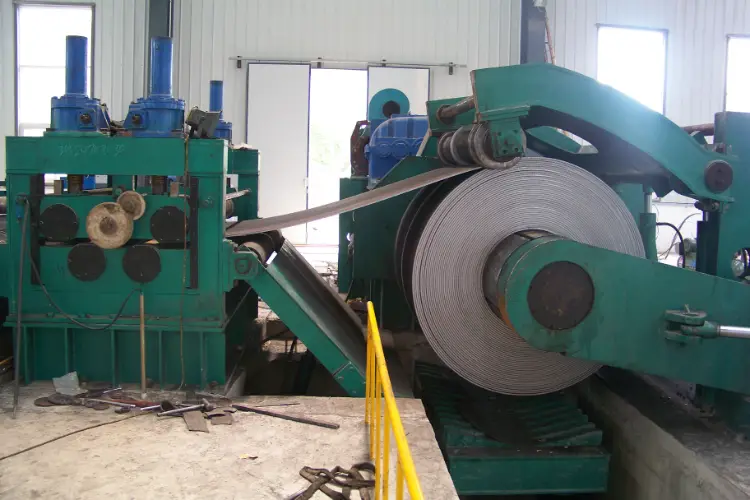
ASTM A131 EH40 Shipbuilding Steel Coil
ASTM A131 EH40 Shipbuilding Steel Coil: High-Strength, Low-Temperature Marine Structural Plate for Arctic and Heavy-Duty Vessels
ASTM A131 EH40 is a high-strength hull structural steel with excellent weldability and guaranteed impact toughness at -40°C, widely used in shipbuilding and offshore engineering.
Hot rolling, Normalizing, Thermo-Mechanical Controlled Processing (TMCP), Quenching and Tempering (optional)
- Phone : +8618037372205
- Email : [email protected]
- WhatsApp: Contact via Whtsapp
- WeChat: +8618037372205
ASTM A131 EH40 Shipbuilding Steel Coil Introduction
ASTM A131 Grade EH40 is a normal and higher strength hull structural steel plate and coil supplied primarily in the normalized or thermomechanically controlled processed (TMCP) condition. It is designed for critical shipbuilding applications where high strength, excellent low-temperature notch toughness, and good weldability are essential. With a minimum yield strength of 390 MPa and a tensile strength range of 510–650 MPa, EH40 is suitable for heavy load-bearing structural components in ships, offshore platforms, and Arctic-class vessels. The steel offers reliable resistance to brittle fracture down to -40°C, meeting rigorous classification society rules. Its chemical composition is carefully balanced with microalloying elements like Nb, V, and Ti for grain refinement and precipitation strengthening, ensuring homogeneous mechanical properties even in thick sections. Typical applications include
- Shell plating
- Decks
- Bulkheads
- Stiffeners
- Structural frames
ASTM A131 EH40 Shipbuilding Steel Coil Chemical Composition
The following table lists the ladle analysis limits for ASTM A131 Grade EH40. Grain-refining elements such as Nb, V, and Ti are added to improve strength and toughness. The acid-soluble aluminum content ensures fine grain size. Residual elements are kept low to maintain weldability and toughness. All values are in accordance with ASTM A131/A131M-19, Table 2.
| Chemical Element | Standard Value (max or range) | Remarks |
|---|---|---|
| Carbon (C) | ≤ 0.18% | Principal hardening element |
| Manganese (Mn) | 0.90 – 1.60% | Increases strength and toughness |
| Silicon (Si) | 0.10 – 0.50% | Deoxidizer, solid solution strengthener |
| Phosphorus (P) | ≤ 0.025% | Harmful impurity, tightly controlled |
| Sulfur (S) | ≤ 0.025% | Harmful impurity, tied to inclusion control |
| Aluminum (Al, acid soluble) | ≥ 0.015% | Grain refinement, if used |
| Niobium (Nb) | ≤ 0.05% | Grain refining and precipitation strengthening |
| Vanadium (V) | ≤ 0.10% | Grain refining and precipitation strengthening |
| Titanium (Ti) | ≤ 0.02% | Grain refining, nitrogen fixation |
| Chromium (Cr) | ≤ 0.25% | Residual, may be added for hardenability |
| Nickel (Ni) | ≤ 0.40% | Residual, improves toughness |
| Molybdenum (Mo) | ≤ 0.08% | Residual, increases hardenability |
| Copper (Cu) | ≤ 0.35% | Residual, may assist atmospheric corrosion resistance |
| Nitrogen (N) | ≤ 0.009% | Tied with Al, V, Ti to prevent strain aging |
ASTM A131 EH40 Shipbuilding Steel Coil Thermal and Electrical Physical Properties
The following physical properties are typical for EH40 steel at room temperature and ambient conditions. These values are based on general carbon-manganese steel data and can vary slightly with composition and heat treatment. They are useful for design calculations involving heat transfer, stress analysis, and electrical applications.
| Property | Typical Value | Unit | Test Condition / Remark |
|---|---|---|---|
| Density (ρ) | 7.85 | g/cm³ | Room temperature |
| Elastic Modulus (E) | 200 – 210 | GPa | Room temperature; 195 GPa at 300°C |
| Shear Modulus (G) | 80 – 84 | GPa | Calculated from E and ν |
| Poisson's Ratio (ν) | 0.27 – 0.30 | – | Elastic range |
| Thermal Expansion Coefficient (α) | 11.7 | 10⁻⁶/K | 20–100°C; 12.5 at 20–200°C, 13.5 at 20–400°C |
| Thermal Conductivity (λ) | ~50 (at 20°C), ~45 (at 200°C) | W/(m·K) | Decreases with temperature |
| Specific Heat Capacity (c_p) | ~460 | J/(kg·K) | Room temperature; increases to ~540 at 600°C |
| Electrical Resistivity (ρ_e) | ~0.20 – 0.25 | 10⁻⁶ Ω·m | At 20°C, increases with temperature |
ASTM A131 EH40 Shipbuilding Steel Coil Mechanical Properties
The mechanical properties of EH40 are guaranteed for thicknesses up to 100 mm. Tensile testing is performed on transverse specimens. Charpy V-notch impact tests are conducted at -40°C. Bend tests ensure formability. The values below meet or exceed the minimum requirements of ASTM A131/A131M. Actual properties may vary depending on delivery condition and thickness.
| Property | Standard Required Value | Unit | Test Condition / Remark |
|---|---|---|---|
| Yield Strength (ReH) | ≥ 390 (≥ 57 ksi) | MPa | t ≤ 100 mm, transverse |
| Tensile Strength (Rm) | 510 – 650 (74 – 94 ksi) | MPa | t ≤ 100 mm, transverse |
| Elongation (A) | ≥ 20% (200 mm gauge) | % | t ≤ 25 mm; ≥ 24% in 50 mm gauge for thinner material |
| Charpy Impact (KV2) | ≥ 34 J average (≥ 25 ft·lbf) | J | -40°C, t ≤ 50 mm, longitudinal/transverse |
| Charpy Impact (KV2) | ≥ 27 J average | J | -40°C, 50 < t ≤ 70 mm |
| Charpy Impact (KV2) | ≥ 20 J average | J | -40°C, 70 < t ≤ 100 mm (by agreement) |
| Bend Test (180°) | d=3a (t ≤ 25 mm) | – | No cracks; a = specimen thickness; wider specimens also acceptable |
| Bend Test (180°) | d=4a (25 < t ≤ 50 mm) | – | d = bend diameter, a = specimen thickness |
ASTM A131 EH40 Shipbuilding Steel Coil Fully Equivalent Material Standards and Substitutable Grades
| Country/Region | Standard | Grade | Remarks |
|---|---|---|---|
| USA | ASTM A131/A131M | EH40 | Base standard for this material |
| International (IACS) | UR W11 (Rev.8) | EH40 | Unified Requirement for normal and higher strength hull structural steels; recognized by all IACS members |
| UK | Lloyd's Register Rules | EH40 | Identical chemical and mechanical requirements |
| Norway / Germany | DNV Rules | EH40 | Equivalent in DNV ship steel classification |
| USA | ABS Rules | EH40 | American Bureau of Shipping equivalent |
| France | Bureau Veritas Rules | EH40 | BV equivalent |
| China | CCS Rules | EH40 | China Classification Society equivalent |
| Japan | NK Rules | EH40 | Nippon Kaiji Kyokai equivalent |
| Korea | KR Rules | EH40 | Korean Register equivalent |
| Italy | RINA Rules | EH40 | Registro Italiano Navale equivalent |
| Russia | RS Rules | EH40 | Russian Maritime Register of Shipping equivalent |
ASTM A131 EH40 Shipbuilding Steel Coil Application Introduction
ASTM A131 EH40 steel coil is engineered for the most demanding marine and offshore environments where high strength and excellent resistance to brittle fracture at sub-zero temperatures are critical. The steel's outstanding weldability and formability allow efficient construction of complex hull geometries, while its microalloyed composition ensures consistent properties through thickness. This grade is widely adopted by shipyards and offshore fabricators as a primary material for ice-strengthened vessels, Arctic-class tankers, and heavy-duty platform structures.
Product Applications: Hull shell plating for icebreakers and ice-class ships, Deck plates and bulkheads of large container ships and tankers, Structural members of semi-submersible drilling rigs, Stiffeners and girders for floating production storage and offloading (FPSO) units, Jack-up rig leg components and spudcans, Offshore wind turbine foundation structures (transition pieces, jackets)
Processed into products: Shell plate sections (bottom, side, and weather decks), Longitudinal and transverse frames, Web frames and stringers, Bracket floors and inner bottom plating, Bulkhead plates and corrugated bulkheads, Hatch coamings and deck openings, Helipad structures on offshore platforms, Fatigue-sensitive details such as knuckles and bracket toes
Application industries: Shipbuilding and ship repair, Offshore oil & gas platform construction, Marine engineering and naval architecture, Arctic and polar-class vessel manufacturing, Heavy lifting and salvage vessel design, Bridge and infrastructure fabrication (special cases)
ASTM A131 EH40 Shipbuilding Steel Coil Similar / Comparable Alternative Materials
| Country/Region | Standard | Grade | Remarks |
|---|---|---|---|
| USA | ASTM A131 | EH36 | Lower strength (min yield 355 MPa) but same toughness class; may be substituted for less demanding designs |
| USA | ASTM A131 | FH40 | Even higher toughness grade (impact test at -60°C) for severe Arctic service |
| USA | ASTM A131 | DH40 | Higher test temperature (-20°C impact) grade; may be acceptable for non-Arctic applications |
| Europe | EN 10025-4 | S420ML | Thermomechanically rolled fine-grain structural steel; min yield 420 MPa, -50°C impact; not automatically certifiable for shipbuilding |
| Europe | EN 10025-6 | S460QL | Quenched and tempered high-strength steel; higher strength but lower toughness guarantee at -40°C; used in offshore structures |
| USA | ASTM A572/A572M | Grade 60 [415] | High-strength low-alloy structural steel, but without specific low-temperature impact requirement for marine service |
| USA | API 2H / 2W | Grade 50 | Offshore structural steel plates with good LT toughness; similar strength range but different specification |
| Worldwide | ISO 4995 | HR420 | Hot-rolled structural steel sheet of higher yield strength; not treated for marine toughness, suitable for general structures |
Notes:
- EH40 steel is typically supplied with ultrasonic testing (UT) in accordance with ASTM A578 Level C or equivalent to ensure internal soundness.
- For thicknesses above 50 mm, normalizing or TMCP with accelerated cooling is strongly recommended to achieve uniform grain refinement and impact toughness.
- Welding consumables should be matched to the base metal strength and low-temperature toughness; preheat and interpass temperature control may be necessary depending on thickness and hydrogen level.
- This grade is often produced with a minimum acid-soluble aluminum content and may be treated for inclusion shape control (calcium treatment) to enhance through-thickness properties (Z-quality).
- When ordering, specify the delivery condition, thickness tolerance, and any supplementary requirements such as through-thickness testing (Z35) or fracture toughness testing (CTOD) per ASTM E1290.
- Share



