
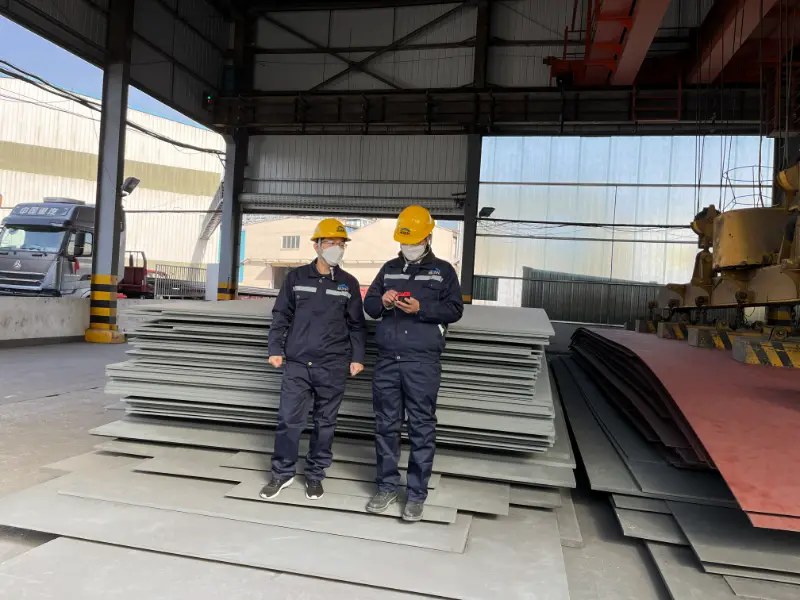
ASTM A131 EH32 Shipbuilding Steel
ASTM A131 EH32 Shipbuilding Steel: Technical Data, Properties & Equivalents
Comprehensive technical data for ASTM A131 EH32 steel coil, including chemical composition, mechanical and physical properties, equivalent grades, and shipbuilding applications per ASTM A131/A131M.
Normalizing (N), Thermo-Mechanical Control Process (TMCP) as agreed, Welding, Forming, Cutting
- Phone : +8618037372205
- Email : [email protected]
- WhatsApp: Contact via Whtsapp
- WeChat: +8618037372205
ASTM A131 EH32 Shipbuilding Steel Introduction
ASTM A131 EH32 is a high-strength, normalized shipbuilding steel grade governed by specification ASTM A131 / A131M. Belonging to the Higher Strength Hull Structural Steel category, it offers a minimum yield strength of 315 MPa. The 'E' grade signifies excellent low-temperature toughness, with guaranteed impact properties down to -40°C, making it suitable for critical structural components in Arctic-capable vessels. Fully killed and made to fine grain practice, EH32 provides superior weldability and resistance to brittle fracture in demanding marine environments. It is typically supplied in the normalized condition to refine the grain structure, ensuring uniform mechanical properties throughout the thickness.
ASTM A131 EH32 Shipbuilding Steel Chemical Composition
The chemical composition conforms to ASTM A131/A131M standards. The steel fully killed and made by fine grain practice. Microalloying elements such as niobium, vanadium, or titanium may be used singly or in combination to achieve grain refinement and precipitation strengthening.
- Carbon Equivalent (CE): Typically controlled ≤ 0.38% to ensure good field weldability.
- Fine Grain Practice: Aluminum is typically added as a grain refiner, resulting in an acid-soluble aluminum content of ≥ 0.015%.
| Element | Standard Value (max, wt.%) | Remarks |
|---|---|---|
| Carbon (C) | ≤ 0.18 | Heat Analysis |
| Manganese (Mn) | 0.90 - 1.60 | For thicknesses ≤ 12.5mm, Mn min may be 0.70% |
| Silicon (Si) | 0.10 - 0.50 | Killed steel |
| Phosphorus (P) | ≤ 0.035 | Max limit |
| Sulfur (S) | ≤ 0.035 | Max limit |
| Aluminum (Al) | ≥ 0.015 | Acid Soluble, for fine grain practice |
| Niobium (Nb) | 0.02 - 0.05 | Optional grain refiner |
| Vanadium (V) | 0.05 - 0.10 | Optional grain refiner |
| Titanium (Ti) | ≤ 0.02 | Optional grain refiner |
| Copper (Cu) | ≤ 0.35 | Residual element |
| Chromium (Cr) | ≤ 0.20 | Residual element |
| Nickel (Ni) | ≤ 0.40 | Residual element |
| Molybdenum (Mo) | ≤ 0.08 | Residual element |
| Carbon Equivalent (CEV) | ≤ 0.38 | CEV = C + Mn/6 + (Cr+Mo+V)/5 + (Ni+Cu)/15 |
ASTM A131 EH32 Shipbuilding Steel Thermal and Electrical Physical Properties
The physical properties of ASTM A131 EH32 are representative of standard low-alloy structural steels. These values are essential for design calculations involving thermal loading, heat transfer, and structural deformation. Properties like thermal conductivity and specific heat capacity are temperature-dependent.
- Density (ρ): The standard density is used for weight and mass calculations.
- Poisson's Ratio (ν): Assumed constant within the elastic range.
| Property | Typical Value | Unit | Test Condition |
|---|---|---|---|
| Density (ρ) | 7.85 | g/cm³ | At 20°C |
| Modulus of Elasticity (E) | 205 | GPa | At 20°C, Longitudinal |
| Shear Modulus (G) | 80 | GPa | At 20°C |
| Poisson's Ratio (ν) | 0.29 | — | At 20°C |
| Thermal Expansion Coefficient (α) | 11.5 | 10⁻⁶/K | 20°C to 100°C |
| Thermal Expansion Coefficient (α) | 12.2 | 10⁻⁶/K | 20°C to 200°C |
| Thermal Expansion Coefficient (α) | 13.0 | 10⁻⁶/K | 20°C to 400°C |
| Thermal Conductivity (λ) | 52 | W/(m·K) | At 20°C |
| Thermal Conductivity (λ) | 49 | W/(m·K) | At 100°C |
| Thermal Conductivity (λ) | 43 | W/(m·K) | At 300°C |
| Specific Heat Capacity | 470 | J/(kg·K) | At 20°C |
| Electrical Resistivity (ρ_e) | 0.21 | Ω·mm²/m | At 20°C |
ASTM A131 EH32 Shipbuilding Steel Mechanical Properties
Mechanical property requirements per ASTM A131/A131M. Property values are dependent on the product thickness. Tensile testing is performed on transverse specimens in accordance with ASTM A370. Impact testing is a mandatory requirement for Grade 'E' steel, with Charpy V-notch tests conducted at -40°C.
- Yield Strength Point: The yield point is clearly defined due to the normalized ferritic-pearlitic microstructure.
- Impact Energy: Guaranteed minimum average energy absorption for longitudinal specimens.
| Property | Standard Requirement Value | Unit | Test Condition / Specimen Orientation |
|---|---|---|---|
| Yield Strength (ReH) | ≥ 315 | MPa | t ≤ 50mm, Transverse |
| Yield Strength (ReH) | ≥ 315 | MPa | 50 < t ≤ 70mm, Transverse |
| Yield Strength (ReH) | ≥ 315 | MPa | 70 < t ≤ 100mm, Transverse |
| Tensile Strength (Rm) | 440 - 590 | MPa | t ≤ 100mm, Transverse |
| Elongation (A) | ≥ 22 | % | Gauge length 200mm (8 in.), t ≤ 50mm, Transverse |
| Elongation (A) | ≥ 22 | % | Gauge length 50mm (2 in.), t > 50mm, Transverse |
| Charpy V-Notch Impact Energy (KV) | ≥ 34 (Average of 3) | J | Test Temp. -40°C, Longitudinal |
| Charpy V-Notch Impact Energy (KV) | ≥ 24 (Min. Single) | J | Test Temp. -40°C, Longitudinal |
| Charpy V-Notch Impact Energy (KV) | ≥ 24 (Average of 3) | J | Test Temp. -40°C, Transverse |
| Charpy V-Notch Impact Energy (KV) | ≥ 17 (Min. Single) | J | Test Temp. -40°C, Transverse |
ASTM A131 EH32 Shipbuilding Steel Exact Equivalent Material Standards & Replaceable Grade Recommendations
| Country/Region | Standard | Grade/Designation | Remarks |
|---|---|---|---|
| International | ASTM A131/A131M | EH32 | Original specification, Hull Steel |
| European Union | EN 10025-4 | S355ML | Thermomechanical rolled, impact at -50°C, comparable but full assessment advised |
| China | GB/T 712 | EH32 | Direct equivalent, Chinese classification society standard |
| Japan | JIS G 3106 | SM490YB | Welded structural steel, Normalized, technically similar |
| United Kingdom | Lloyd's Register (LR) | EH32 | Direct equivalent, classification society rule |
| Norway/Germany | DNV GL | NV E32 or GL-E32 | Direct equivalent under unified DNV GL rules |
| France | Bureau Veritas (BV) | EH32 | Direct equivalent |
| Italy | Registro Italiano Navale (RINA) | EH32 | Direct equivalent |
| USA (Industry) | ABS Rules | ABS EH32 | Direct equivalent, American Bureau of Shipping |
ASTM A131 EH32 Shipbuilding Steel Application Introduction
ASTM A131 EH32 steel is specifically tailored for critical structural components in demanding marine environments. Its high strength-to-weight ratio and guaranteed low-temperature notch toughness make it ideal for weight-sensitive designs and structures operating in cold climates. The normalized microstructure ensures consistent formability and excellent weldability, which are crucial for efficient shipyard assembly processes.
Key Application Areas:
- Shipbuilding: Primary hull structures, decks, and superstructures of commercial and military vessels, particularly ice-class ships.
- Offshore Engineering: Jack-up rig legs, semi-submersible platforms, and living quarters modules subjected to harsh weather.
- Infrastructure: Arctic-grade bridges, lock gates, and mooring equipment.
Product Applications: Ship Hull Plates & Shells, Ship Inner Bottom & Longitudinal Stiffeners, Strength Deck Plating, Watertight Bulkheads, Transverse Web Frames, Offshore Platform Jacket Braces, Ice-Belt Plating for Arctic Vessels
Processed into products: Hull bottom and side shell strakes, Deck stringer plates and sheer strakes, Bilge keels and rubbing strakes, Transverse bulkhead plates and stiffeners, Longitudinal girders and frames, Bow and stern structural modules, Helideck support structures, Leg components for self-elevating platforms (Jack-ups)
Application industries: Commercial Shipbuilding (Container ships, Bulk carriers, Tankers), Naval & Defense Shipbuilding (Frigates, Destroyers, Support vessels), Offshore Oil & Gas (Fixed and floating platforms, FPSOs), Arctic & Ice-Class Marine Engineering, Port & Heavy Civil Infrastructure (Dock gates, Caissons)
ASTM A131 EH32 Shipbuilding Steel Similar/Proximate Alternative Material Recommendations
| Country/Region | Standard | Grade/Designation | Remarks and Analysis |
|---|---|---|---|
| International | ASTM A131/A131M | DH32 | Similar strength level but guaranteed impact only at -20°C; suitable for less critical or non-Arctic applications. |
| International | ASTM A131/A131M | EH36 | Higher yield strength grade (355 MPa min). Suitable for weight-reduction designs needing greater load capacity, but may require modified forming parameters. |
| International | ASTM A131/A131M | FH32 | Superior low-temperature toughness grade, guaranteed impact at -60°C. A cost-effective upgrade for extreme low-temperature regions but often with longer lead times. |
| European Union | EN 10025-4 | S355MLO | Offshore structural steel with improved through-thickness properties (Z-quality). Suitable for complex welded joints subject to high lamellar tearing risk. |
| European Union | EN 10025-3 | S355N | Normalized fine-grain structural steel. Similar strength and toughness, often used as a general structural substitute if class society certification is not mandatory. |
Notes:
Welding Considerations: EH32 exhibits excellent weldability using all common manual and automatic welding processes (SMAW, SAW, GMAW, FCAW). Preheating is generally not required for moderate thicknesses under normal shipyard conditions, but low-hydrogen practices are mandatory to prevent hydrogen-induced cracking. A heat input control is recommended to preserve the fine grain structure and mechanical properties in the heat-affected zone (HAZ).
Certification: This grade is typically supplied with certificates from recognized classification societies (e.g., LR, DNV, BV, ABS, CCS) in addition to the mill test certificate (MTC) per EN 10204 3.1 or 3.2.
- Share



