
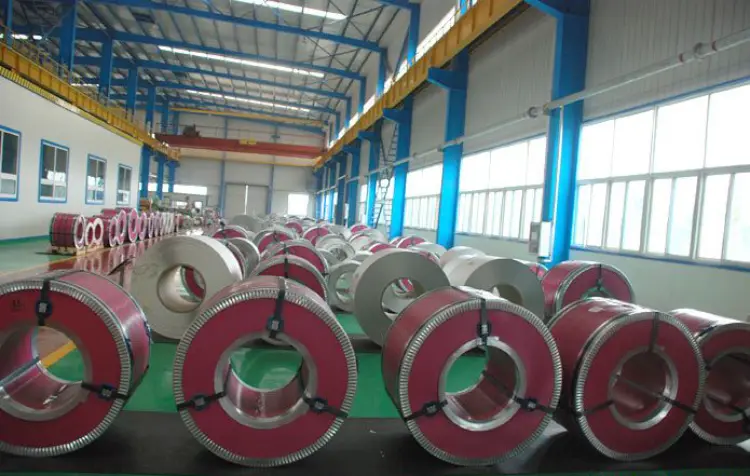
ASTM A131 AH36 Shipbuilding Steel Coil
ASTM A131 AH36 Shipbuilding Steel Coil: High-Strength Hull Structural Grade
Detailed technical data for ASTM A131 AH36 shipbuilding steel coil: chemical composition, mechanical properties, thermal and electrical properties, international equivalent grades, and similar materials. Designed for hull and marine construction.
Hot rolling, normalizing, thermomechanical controlled processing (TMCP), cold forming, welding, cutting
- Phone : +8618037372205
- Email : [email protected]
- WhatsApp: Contact via Whtsapp
- WeChat: +8618037372205
ASTM A131 AH36 Shipbuilding Steel Coil Introduction
ASTM A131 AH36 is a high-strength, low-carbon shipbuilding steel grade standardized under ASTM A131/A131M. It is primarily used in the construction of ships, barges, and offshore structures, offering a minimum yield strength of 355 MPa (51 ksi) and excellent weldability. The grade includes microalloying elements such as niobium, vanadium, and titanium to refine grain structure and enhance toughness. Key attributes:
- Good balance of strength and ductility
- Guaranteed impact toughness at 0 °C (34 J longitudinal average)
- Controlled carbon equivalent (CEV ≤ 0.38%) for improved weldability
- Available as coils and cut-to-length plates
Typically delivered in normalized or thermomechanical rolled condition.
ASTM A131 AH36 Shipbuilding Steel Coil Chemical Composition
The chemical composition conforms to ASTM A131/A131M. Microalloying elements are added to achieve the required strength and toughness. The carbon equivalent value (CEV) is limited to ensure good weldability. Remarks: Single values are maximums unless otherwise indicated; ranges are minimum to maximum. Optional elements are typically present if the steel is killed and microalloyed.
| Element | Standard Value (wt%) | Remarks |
|---|---|---|
| Carbon (C) | ≤ 0.18 | |
| Manganese (Mn) | 0.90 – 1.60 | |
| Silicon (Si) | 0.10 – 0.50 | |
| Phosphorus (P) | ≤ 0.035 | |
| Sulfur (S) | ≤ 0.035 | |
| Aluminum (Al, total) | ≥ 0.020 | For killed steel practice |
| Niobium (Nb) | 0.02 – 0.05 | Optional microalloy |
| Vanadium (V) | 0.05 – 0.10 | Optional microalloy |
| Titanium (Ti) | 0.007 – 0.05 | Optional microalloy |
| Copper (Cu) | ≤ 0.35 | If specified |
| Nickel (Ni) | ≤ 0.40 | If specified |
| Chromium (Cr) | ≤ 0.20 | If specified |
| Molybdenum (Mo) | ≤ 0.08 | If specified |
| Carbon Equivalent (CEV, IIW) | ≤ 0.38 | Typical maximum, CEV = C + Mn/6 + (Cr+Mo+V)/5 + (Ni+Cu)/15 |
ASTM A131 AH36 Shipbuilding Steel Coil Thermal and Electrical Physical Properties
The following physical properties are representative of AH36 steel at room temperature unless otherwise stated. These values are not audited by ASTM A131 but are widely accepted for engineering calculations.
| Property | Standard Value | Unit | Test Condition / Remarks |
|---|---|---|---|
| Density (ρ) | 7.85 | g/cm³ | 20 °C |
| Elastic Modulus (E) | 205 | GPa | 20 °C; tensile |
| Shear Modulus (G) | 80 | GPa | 20 °C |
| Poisson's Ratio (ν) | 0.3 | – | Elastic range |
| Thermal Expansion (α₁) | 11.7 × 10⁻⁶ | /°C | 20 – 100 °C; linear |
| Thermal Expansion (α₂) | 12.5 × 10⁻⁶ | /°C | 20 – 200 °C; linear |
| Thermal Conductivity (λ) | 51 | W/(m·K) | 20 °C |
| Specific Heat Capacity (c) | 460 | J/(kg·K) | 20 °C |
| Electrical Resistivity (ρₑ) | 0.22 × 10⁻⁶ | Ω·m | 20 °C; typical for C-Mn steel |
ASTM A131 AH36 Shipbuilding Steel Coil Mechanical Properties
Mechanical properties are determined in accordance with ASTM A370 or equivalent. The values below represent minimum requirements for plates ≤50 mm thickness unless otherwise noted. Charpy V-notch tests are conducted at 0 °C (AH designation). Bend tests confirm formability.
| Property | Standard Requirement | Unit | Test Condition |
|---|---|---|---|
| Yield Strength (ReH) | ≥ 355 | MPa (ksi) | t ≤ 50 mm; plate transverse |
| Tensile Strength (Rm) | 490 – 620 | MPa (ksi) | t ≤ 50 mm; plate transverse |
| Elongation (A) in 200 mm (8 in) | ≥ 21 | % | t ≤ 50 mm; rectangular specimen |
| Elongation (A) in 50 mm (2 in) | ≥ 24 | % | t ≤ 50 mm; round or flat specimen |
| Charpy V-notch (Avg. long.) | ≥ 34 | J (ft·lbf) | 0 °C, longitudinal |
| Charpy V-notch (Avg. trans.) | ≥ 24 | J (ft·lbf) | 0 °C, transverse |
| Bend Test (t ≤ 25 mm) | 180° no cracks | – | Pin diameter = 2 × thickness |
| Bend Test (25 < t ≤ 50 mm) | 180° no cracks | – | Pin diameter = 3 × thickness |
ASTM A131 AH36 Shipbuilding Steel Coil Fully Equivalent Standards and Substitutable Grades
| Country / Region | Standard | Grade | Remarks |
|---|---|---|---|
| USA | ASTM A131/A131M | AH36 | Original grade; coil and plate |
| International (IACS) | Classification Societies | AH36 | Common designation by ABS, DNV GL, LR, BV, CCS, NK, KR, RINA |
| American Bureau of Shipping | ABS Rules | AH36 | Identical mechanical and chemical requirements |
| DNV GL | DNVGL Rules | NV A36 | Vessel class A36; same strength and toughness |
| Lloyd's Register | LR Rules | AH36 | Identical grade for marine applications |
| Bureau Veritas | BV Rules | AH36 | Same specifications as ASTM |
| China Classification Society | CCS Rules | AH36 | Fully equivalent |
| Nippon Kaiji Kyokai | NK Rules | KA36 | Equivalent chemistry and properties, 0 °C impact |
| Korean Register | KR Rules | AH36 | Identical to ASTM AH36 |
| Registro Italiano Navale | RINA Rules | AH36 | Same strength level and weldability |
ASTM A131 AH36 Shipbuilding Steel Coil Application Introduction
ASTM A131 AH36 steel coil is engineered for ship hull construction and marine environments. Its combination of high strength, good ductility, and guaranteed low-temperature toughness makes it suitable for critical structural components. Common applications include:
- Main hull plates and shell plating
- Strength decks and bulkheads
- Longitudinals, stiffeners, and frames
- Offshore platform topside modules
- Barge and pontoon construction
The material can be processed into a wide range of fabricated parts via cutting, bending, and welding.
Product Applications: Hot-rolled steel coils and cut sheets, Pre-fabricated hull sections, Welded structural assemblies, Bent profiles and rolled shapes, Flame-cut and machined blanks
Processed into products: Hull shell plates (bottom, side, deck), Transverse and longitudinal bulkheads, Stiffeners (flat bars, bulb flats, angles), Deck beams and longitudinal girders, Web frames and brackets, Keel plates and bilge strakes, Hatch coamings and corner plates, Offshore module primary steelwork
Application industries: Commercial shipbuilding (cargo, tanker, container ships), Naval and defense vessels, Offshore oil & gas (jack-up rigs, FPSO modules), Marine infrastructure (docks, piers, locks), Barge and dredger manufacturing
ASTM A131 AH36 Shipbuilding Steel Coil Similar / Alternative Material Recommendations
| Country / Region | Standard | Grade | Remarks |
|---|---|---|---|
| European Union | EN 10025-2 | S355J0 | Yield 355 MPa; 0 °C impact 27 J min (vs. 34 J for AH36); chemistry differences |
| European Union | EN 10025-2 | S355J2 | Yield 355 MPa; -20 °C impact 27 J; higher toughness; compositional variations |
| Japan | JIS G3106 | SM490YA | Yield 365 MPa (higher); 0 °C impact 27 J; not guaranteed for EH grade; check CEV |
| Germany | DIN 17100 | St52-3 | Obsolete; yield 355 MPa; impact 27 J at 0 °C; comparable strength, lower toughness |
| China | GB/T 712 | AH36 | Identical to IACS AH36; Chinese shipbuilding standard; fully interchangeable |
Notes:
Additional Information:
- AH36 coils are often supplied with mill test certificates (EN 10204 3.1 or 3.2) showing chemical and mechanical test results.
- For thicknesses above 12.5 mm, normalizing or TMCP is recommended to ensure uniform properties and impact toughness.
- Preheating may be required during welding depending on thickness and carbon equivalent; typical preheat is 50-100 °C for thickness >30 mm when CEV is near the upper limit.
- The steel can be galvanized or coated for additional corrosion protection in marine environments.
- Customer-specific supplementary requirements (e.g., ultrasonic testing, stricter S limits, Z-direction testing) can be agreed upon at the time of order.
- Share



