
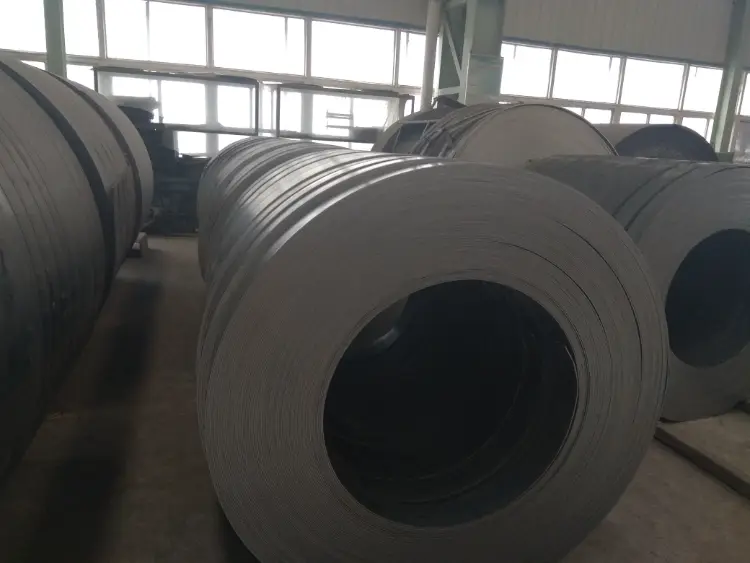
ASME SA283 Grade D Carbon Steel Coil
ASME SA283 Grade D Carbon Steel Coil: Properties, Equivalents & Applications
Comprehensive material data for ASME SA283/SA283M Grade D carbon steel coil including chemical composition, mechanical and physical properties, international equivalents, and application guidance.
Hot rolling, normalizing (optional), stress relieving (optional)
- Phone : +8618037372205
- Email : [email protected]
- WhatsApp: Contact via Whtsapp
- WeChat: +8618037372205
ASME SA283 Grade D Carbon Steel Coil Introduction
ASME SA283/SA283M Grade D is a low and intermediate tensile strength carbon steel plate and coil designed for general structural applications. It is covered by ASME Boiler and Pressure Vessel Code Section II, Material A, and is essentially identical to ASTM A283 Grade D. The material exhibits a good balance of strength and ductility, with a specified tensile strength range of 415–550 MPa (60–80 ksi) and a minimum yield point of 230 MPa (33 ksi). Its carbon-manganese composition ensures excellent weldability and formability, making it suitable for riveted, bolted, or welded construction. Key features:
- Moderate strength with reliable ductility
- Excellent weldability using standard methods
- Economical choice for structural projects
- Available in thick plates and coils
The grade is typically supplied in as-rolled condition and finds wide use in building frameworks, bridges, storage tanks, freight cars, and various machinery components. Plates over 40 mm are usually provided in killed steel with controlled silicon content to improve through-thickness properties.
ASME SA283 Grade D Carbon Steel Coil Chemical Composition
The chemical composition limits are based on heat analysis in accordance with ASME SA283/SA283M. The steel is essentially carbon-manganese with controlled phosphorus and sulfur. Silicon is specified when killed steel is required, particularly for thicker plates, to ensure soundness. Key points:
- Carbon provides strength while maintaining weldability
- Manganese enhances strength and counteracts sulfur brittleness
- Low phosphorus and sulfur levels improve ductility and toughness
| Chemical Element | Standard Value (wt%) | Remarks |
|---|---|---|
| Carbon (C) | max 0.27 | Heat analysis |
| Manganese (Mn) | max 0.90 | For all plate thicknesses; heat analysis |
| Phosphorus (P) | max 0.035 | Heat analysis |
| Sulfur (S) | max 0.040 | Heat analysis |
| Silicon (Si) | 0.15–0.40 | Required for plates over 40 mm thickness or when killed steel is specified; optional for thinner gauges |
| Iron (Fe) | Balance | Remainder |
ASME SA283 Grade D Carbon Steel Coil Thermal and Electrical Physical Properties
The physical properties listed are typical for carbon steel of this grade at room temperature unless otherwise noted. They are not mandatory specification requirements but provide essential design data. Includes:
- Density and elastic constants for structural calculations
- Thermal expansion and conductivity for thermal stress analysis
- Specific heat and electrical resistivity for heating and electrical applications
| Property | Typical Value | Unit | Condition / Temperature |
|---|---|---|---|
| Density (ρ) | 7.85 | g/cm³ | At 20°C |
| Elastic Modulus (E) | 200 | GPa | Tension, room temperature |
| Shear Modulus (G) | 80 | GPa | Estimated from E and ν |
| Poisson's Ratio (ν) | 0.29 | – | Room temperature |
| Thermal Expansion (α) | 11.7 | 10⁻⁶/K | 20–100°C |
| Thermal Expansion (α) | 12.5 | 10⁻⁶/K | 20–200°C |
| Thermal Expansion (α) | 13.5 | 10⁻⁶/K | 20–400°C |
| Thermal Conductivity (λ) | 52 | W/(m·K) | At 100°C |
| Specific Heat Capacity | 486 | J/(kg·K) | Typical for carbon steel |
| Electrical Resistivity (ρₑ) | 0.16 | µΩ·m | At 20°C |
ASME SA283 Grade D Carbon Steel Coil Mechanical Properties
Mechanical properties are determined on test samples taken from the coil or plate in accordance with ASME SA283/SA283M. Values depend on the product thickness and specimen orientation. Properties include:
- Yield point and tensile strength ensure structural load-bearing capacity
- Elongation indicates excellent ductility for forming and impact resistance
- Bend test demonstrates cold formability without cracking
All values are minimum unless a range is given.
| Property | Value | Unit | Test Condition |
|---|---|---|---|
| Yield Point, min | 230 | MPa (33 ksi) | All thicknesses, transverse specimens |
| Tensile Strength | 415–550 | MPa (60–80 ksi) | All thicknesses |
| Elongation (Gauge 200 mm) | 20 | % | Thickness ≤ 8.0 mm |
| Elongation (Gauge 200 mm) | 22 | % | Thickness > 8.0 mm to 20.0 mm |
| Elongation (Gauge 200 mm) | 22 | % | Thickness > 20.0 mm to 40.0 mm |
| Elongation (Gauge 200 mm) | 22 | % | Thickness > 40.0 mm to 75.0 mm |
| Elongation (Gauge 50 mm) | 23 | % | Thickness ≤ 8.0 mm |
| Elongation (Gauge 50 mm) | 25 | % | Thickness > 8.0 mm to 20.0 mm |
| Elongation (Gauge 50 mm) | 25 | % | Thickness > 20.0 mm to 40.0 mm |
| Elongation (Gauge 50 mm) | 25 | % | Thickness > 40.0 mm to 75.0 mm |
| Bend Test (180°) | No cracks | – | Mandrel diameter: 1t — thickness ≤ 20 mm |
| Bend Test (180°) | No cracks | – | Mandrel diameter: 1.5t — thickness > 20 mm to 40 mm |
| Bend Test (180°) | No cracks | – | Mandrel diameter: 2t — thickness > 40 mm to 75 mm |
ASME SA283 Grade D Carbon Steel Coil Fully Equivalent Material Standards and Substitutable Grades
| Country/Region | Standard | Grade | Remarks |
|---|---|---|---|
| United States | ASTM A283/A283M | Grade D | Identical to ASME SA283 Grade D; same chemistry and mechanical requirements |
ASME SA283 Grade D Carbon Steel Coil Application Introduction
ASME SA283 Grade D carbon steel coil and plate are widely employed in welded, bolted, and riveted structures where moderate strength and economy are key priorities. Typical application areas:
- Primary framing members in industrial buildings
- Bridge deck plates and stiffeners
- Storage tank shells and bottoms for non-critical fluids
- Freight car bodies and underframes
- Heavy machinery frames and supports
Its good formability allows it to be manufactured into numerous standard and custom shapes.
Product Applications: Hot-rolled steel plates and coils, Welded built-up beams and columns, Storage tanks (oil, water, chemicals under ambient conditions), Bridge girders and deck plates, Rail car underframes and bodies, Bases and frames for machinery
Processed into products: Base plates and bearing plates, Gusset plates and connecting plates, Stiffeners and rib plates, Brackets and support arms, Flanges for light poles and towers, Truck frames and trailer components, Tank shell courses and bottom plates, Floor plates and decking
Application industries: Heavy civil and building construction, Bridge engineering, Storage tank and silo manufacturing, Railway wagon and locomotive manufacturing, Agricultural and earthmoving equipment, General fabrication and machine building
ASME SA283 Grade D Carbon Steel Coil Similar and Alternative Material Recommendations
| Country/Region | Standard | Grade | Remarks |
|---|---|---|---|
| European Union | EN 10025-2 | S275JR (1.0044) | Comparable tensile strength (410–560 MPa) and higher yield (275 MPa); used for structural applications. Chemical requirements differ; weldability is good. |
| Japan | JIS G3101 | SS400 | Tensile strength 400–510 MPa, yield ≥ 245 MPa; similar structural carbon steel, but strength ranges slightly lower. Often used as an alternative after engineering evaluation. |
| China | GB/T 700 | Q235B | Tensile strength 370–500 MPa, yield 235 MPa; economical structural steel with comparable carbon-manganese composition; check thickness ranges. |
| International | ISO 630 | E275C | Tensile strength 410–560 MPa, yield 275 MPa; suitable for general structural purposes; similar weldability and formability. |
Notes:
The material can be welded by all common processes (SMAW, GMAW, SAW) without the need for post-weld heat treatment under normal conditions. Preheating may be required for thick sections or low ambient temperatures. For improved toughness or tighter chemistry, consider pressure vessel quality grades such as SA516. When ordering, specify the product form (coil or cut plate), edge condition, and any supplementary requirements (e.g., killed steel, special flatness).
- Share



