
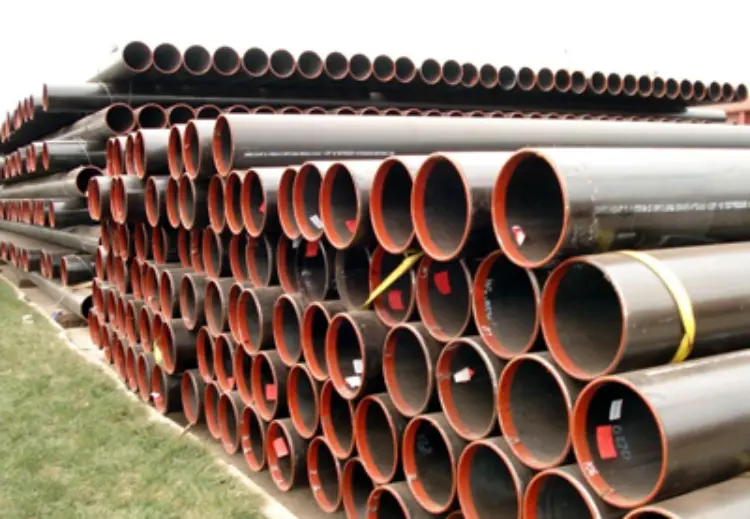
ASME SA213 T91 Boiler Steel Pipe
ASME SA213 T91 Boiler Steel Pipe: 9Cr-1Mo-V-Nb High-Temperature Alloy Tube
Comprehensive technical data on ASME SA213 Grade T91 seamless ferritic alloy-steel tube for high-temperature service, including chemistry, mechanical and physical properties, international equivalents, and application guidance.
Hot-finished or cold-drawn seamless; heat treatment: normalize at 1040–1080 °C + temper at 730–800 °C
- Phone : +8618037372205
- Email : [email protected]
- WhatsApp: Contact via Whtsapp
- WeChat: +8618037372205
ASME SA213 T91 Boiler Steel Pipe Introduction
ASME SA213 T91 (also designated UNS K90901) is a modified 9% chromium, 1% molybdenum ferritic/martensitic steel tube stabilized with vanadium and niobium, and controlled nitrogen additions. It is widely used in fossil-fuel power plants, petrochemical processing, and other high-temperature applications for its outstanding creep strength, good oxidation resistance up to approximately 600–650 °C, and superior thermal conductivity compared to austenitic stainless steels. The fine-tuned microstructure—achieved through normalizing and tempering—provides long-term microstructural stability, making T91 a cost-effective alternative for superheater, reheater, and main steam piping in advanced supercritical and ultrasupercritical boilers. When manufactured to ASME SA213/SA213M, these tubes are delivered in either hot-finished or cold-drawn seamless condition, fully heat-treated and tested to stringent NDE requirements.
ASME SA213 T91 Boiler Steel Pipe Chemical Composition
The chemical composition of ASME SA213 T91 is tightly controlled to achieve the desired high-temperature strength, oxidation resistance, and weldability. Vanadium and niobium promote fine carbide/nitride precipitation strengthening, while nitrogen forms stable V-Nb carbonitrides. Low sulfur and phosphorus levels ensure excellent ductility and toughness. The limits below are in accordance with ASTM A213/A213M-23 (and equivalent ASME SA213).
| Chemical Element | Standard Value (wt%) | Remarks |
|---|---|---|
| Carbon (C) | 0.08 – 0.12 | Austenitizing former; strength and hardenability |
| Manganese (Mn) | 0.30 – 0.60 | Deoxidizer; contributes to strength and toughness |
| Phosphorus (P) | ≤ 0.020 | Impurity; kept low to maintain ductility |
| Sulfur (S) | ≤ 0.010 | Impurity; low levels improve hot workability |
| Silicon (Si) | 0.20 – 0.50 | Deoxidizer; improves oxidation resistance |
| Chromium (Cr) | 8.00 – 9.50 | Primary element for oxidation and corrosion resistance; carbide former |
| Molybdenum (Mo) | 0.85 – 1.05 | Solid-solution strengthening; improves creep resistance |
| Vanadium (V) | 0.18 – 0.25 | Precipitation strengthening via V(C,N) |
| Nitrogen (N) | 0.030 – 0.070 | Stabilizes carbonitrides; enhances creep strength |
| Nickel (Ni) | ≤ 0.40 | Residual element; limited to maintain ferritic structure |
| Aluminum (Al) | ≤ 0.020 | Deoxidation control; excess may harm toughness |
| Niobium (Nb) (Cb) | 0.06 – 0.10 | Grain refinement; precipitation hardening |
| Titanium (Ti) | ≤ 0.01 | Trace; controlled to avoid coarse inclusions |
| Zirconium (Zr) | ≤ 0.01 | Trace; similar to Ti |
ASME SA213 T91 Boiler Steel Pipe Thermal and Electrical Physical Properties
These are typical physical properties for ASME SA213 T91 in the normalized and tempered condition. Values may vary slightly with heat treatment and temperature. They reflect the stable martensitic microstructure and are essential for thermal-mechanical design calculations in high-temperature applications.
| Property | Typical Value | Unit | Test Condition / Temperature |
|---|---|---|---|
| Density (ρ) | 7.77 | g/cm³ | 20 °C (room temperature) |
| Modulus of Elasticity (E) | 200 | GPa | 20 °C |
| Modulus of Elasticity (E) | 190 | GPa | 200 °C |
| Modulus of Elasticity (E) | 180 | GPa | 400 °C |
| Shear Modulus (G) | 77 | GPa | 20 °C (calculated from E and ν) |
| Poisson's Ratio (ν) | 0.30 | - | 20 °C |
| Coefficient of Thermal Expansion (α) | 10.9 | µm/m·°C | 20 – 100 °C |
| Coefficient of Thermal Expansion (α) | 11.5 | µm/m·°C | 20 – 200 °C |
| Coefficient of Thermal Expansion (α) | 11.9 | µm/m·°C | 20 – 300 °C |
| Coefficient of Thermal Expansion (α) | 12.3 | µm/m·°C | 20 – 400 °C |
| Thermal Conductivity (λ) | 26 | W/m·K | 20 °C |
| Thermal Conductivity (λ) | 27 | W/m·K | 100 °C |
| Thermal Conductivity (λ) | 28 | W/m·K | 200 °C |
| Thermal Conductivity (λ) | 29 | W/m·K | 300 °C |
| Thermal Conductivity (λ) | 28 | W/m·K | 400 °C |
| Specific Heat Capacity (c) | 460 | J/kg·K | 20 °C |
| Specific Heat Capacity (c) | 480 | J/kg·K | 200 °C |
| Specific Heat Capacity (c) | 520 | J/kg·K | 400 °C |
| Electrical Resistivity (ρ_e) | 0.60 | µΩ·m | 20 °C |
ASME SA213 T91 Boiler Steel Pipe Mechanical Properties at Room Temperature
Mechanical properties are determined on longitudinal test specimens in the heat-treated condition per ASME SA213. T91 tubes are tested in the normalized and tempered state. Hardness testing is mandatory. For products with wall thicknesses that allow full-section or strip specimens, elongation requirements apply as indicated. Actual values often exceed these minimums.
| Property | Minimum / Maximum | Unit | Test Condition / Specimen |
|---|---|---|---|
| Tensile Strength (Rm) | ≥ 585 (85 ksi) | MPa | Room temperature, longitudinal strip or full-section |
| Yield Strength (ReH, 0.2% offset) | ≥ 415 (60 ksi) | MPa | Room temperature |
| Elongation (A) | ≥ 20 | % | Longitudinal strip test; gauge length 2 in. (50 mm) |
| Elongation (A) | ≥ 14* | % | Transverse strip test, wall ≤ 5/16 in. (7.9 mm) |
| Elongation (A) | ≥ 15* | % | Transverse strip test, wall > 5/16 in. |
| Hardness (Brinell) | ≤ 250 HBW | - | As per ASTM E10 |
| Hardness (Vickers) | ≤ 265 HV | - | As per ASTM E92 |
| Hardness (Rockwell C) | ≤ 25 HRC | - | As per ASTM E18 |
ASME SA213 T91 Boiler Steel Pipe Exact International Equivalents and Substitutable Grades
| Country / Region | Standard | Grade / Designation | Remarks |
|---|---|---|---|
| USA (ASME/ASTM) | ASME SA213 / ASTM A213 | T91 (tube) | Seamless ferritic alloy-steel tube; the reference grade |
| USA (ASME/ASTM) | ASME SA335 / ASTM A335 | P91 (pipe) | Seamless pipe version; identical chemistry, same heat treatment |
| USA (ASME/ASTM) | ASME SA182 / ASTM A182 | F91 (forging) | Forged flanges, fittings, valves |
| USA (ASME/ASTM) | ASME SA369 | FP91 (forged pipe) | Forged and bored pipe |
| USA (ASME/ASTM) | ASME SA387 / ASTM A387 | Gr. 91 (plate) | Plate for pressure vessels |
| Europe | EN 10216-2 | X10CrMoVNb9-1 (1.4903) | Seamless steel tube; fully equivalent |
| Europe | EN 10217-5 | X10CrMoVNb9-1 | Welded tube option (if applicable) |
| International (ISO) | ISO 9329-2 | TS9 | Seamless tube for pressure purposes |
| Japan | JIS G3462 | STBA28 | Boiler and heat exchanger tubes; similar chemistry |
| UK (obsolete, but reference) | BS 3059-2 | 91 | Steel boiler and superheater tubes |
| France | NF A49-213 | TU Z10 CDVNb 09-01 | Seamless tubes |
ASME SA213 T91 Boiler Steel Pipe Application Introduction
ASME SA213 T91 is the workhorse material for modern high-efficiency boilers and heat recovery steam generators (HRSGs). Its combination of high-temperature strength and oxidation resistance makes it ideal for steam-side components operating at metal temperatures up to ~625 °C. It is highly weldable when proper preheat (200–300 °C) and post-weld heat treatment (at 730–780 °C) are applied. Common product forms include straight tube bundles, bent tube sections, and prefabricated panels. The grade is also specified for header sections and steam transfer lines when manufactured according to SA335 P91.
Product Applications: Superheater and reheater tube banks, Economizer tubes (where higher temperatures are encountered), Main steam and hot reheat piping (SA335 P91), Boiler drum to header connecting tubes, High-temperature heat exchangers for process plants
Processed into products: Seamless tube bends ('U-bends' for heat exchangers), Butt-welded tube-to-tube joints, Tube-to-header welded stubs, Desuperheaters injectors and liners, Thermal sleeves and thermowells in high-temperature regions
Application industries: Fossil-fuel power generation (supercritical and ultrasupercritical boilers), Combined-cycle gas turbine (CCGT) heat recovery steam generators (HRSG), Petrochemical and refinery (furnace tubes, transfer lines), Industrial boilers and process heaters, Nuclear power (some balance-of-plant applications)
ASME SA213 T91 Boiler Steel Pipe Similar or Alternative Materials
| Country / Region | Standard | Grade | Remarks |
|---|---|---|---|
| USA | ASTM A213 | T9 (9Cr-1Mo) | Older 9% Cr ferritic steel without V/Nb; lower creep strength, suitable up to ~600 °C |
| USA | ASTM A213 | T92 (NF616) | Advanced 9Cr-0.5Mo-1.8W with V, Nb, B; higher creep strength, used for ultrasupercritical boilers |
| Europe | EN 10216-2 | X11CrMo9-1 (1.7386) | Equivalent to T9; lower strength than T91 |
| Europe | EN 10216-2 | X10CrWMoVNb9-2 (1.4901) | Tungsten-containing grade similar to T92 |
| Japan | JIS G3462 | STBA27 | Equivalent to T9 |
| General | - | Modified 9Cr-1Mo (P91) | Used in heavy-wall pipe; same family, often used as benchmark |
Notes:
Heat treatment is critical: T91 must be normalized at 1040–1080 °C followed by air cooling or accelerated cooling, then tempered at 730–800 °C. Improper heat treatment leads to inadequate creep strength and toughness.
Welding: Use matching filler metals (e.g., AWS A5.28 ER90S-B9) with low hydrogen practice; preheat to 200–300 °C and maintain interpass; post-weld heat treat at 730–780 °C for 1 hour per 25 mm thickness (minimum 1 hour).
NDE: Ultrasonic testing or eddy current testing per the standard is required.
Service limitations: Prolonged exposure above 650 °C may cause accelerated oxidation and microstructural degradation; design typically limits metal temperature to ≈620 °C.
- Share



