
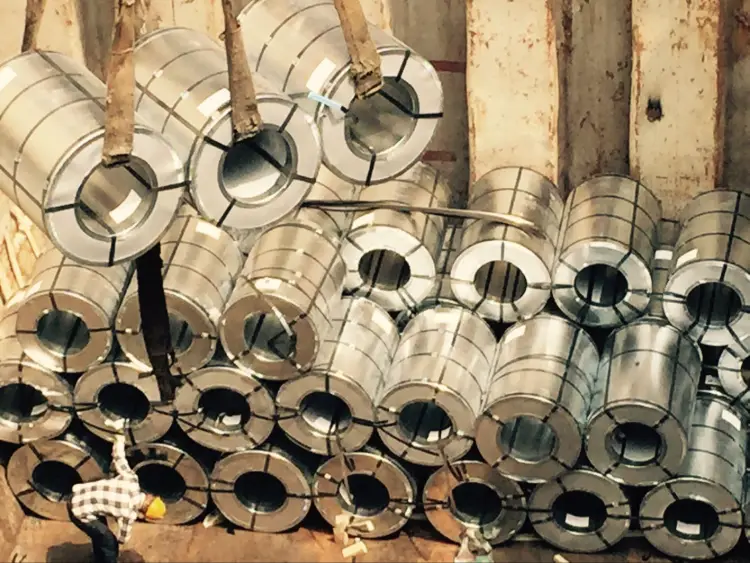
API 5L PSL2 X60N (L415N) Pipeline Steel Coil
API 5L PSL2 X60N (L415N) Pipeline Steel Coil - Full Technical Datasheet
Complete grade profile for API 5L PSL2 X60N (L415N) pipeline steel coil: chemical composition limits, mechanical & physical properties, international equivalents and application recommendations.
Normalizing rolling (N), normalizing, hot rolling, cold forming, welding (ERW, SAW)
- Phone : +8618037372205
- Email : [email protected]
- WhatsApp: Contact via Whtsapp
- WeChat: +8618037372205
API 5L PSL2 X60N Pipeline Steel Coil Introduction
API 5L PSL2 X60N (L415N) is a high-strength low-alloy (HSLA) steel supplied as coil, plate or strip for line pipe. The 'N' designation indicates delivery in the normalized rolling or normalizing condition. PSL2 imposes tighter chemical and mechanical requirements than PSL1, including mandatory Charpy V-notch toughness and restrictive carbon equivalent. The grade combines a minimum yield strength of 415 MPa with good weldability and adequate toughness for oil and gas transmission pipelines, often in sour or low-temperature service when additional testing is specified.
API 5L PSL2 X60N Pipeline Steel Coil Chemical Composition According to API 5L PSL2 for Grade X60N
The following elements are controlled per cast analysis. For product analysis, the tolerances of API 5L Table 8 apply. The carbon equivalent CEIIW or CEPcm may be further restricted by supplementary requirements.
- Cementite-forming and grain-refining elements (Nb, V, Ti) are typically added to achieve high strength with good toughness.
- S is limited to 0.015 % max to enhance resistance to hydrogen-induced cracking in sour service.
| Element | Standard Value (wt %) | Remarks |
|---|---|---|
| C (Carbon) | ≤ 0.24 | for t ≤ 25 mm; higher thickness limits may be different |
| Mn (Manganese) | ≤ 1.40 | PSL 2 maximum; typical range 1.00 – 1.40 |
| P (Phosphorus) | ≤ 0.025 | Maximum |
| S (Sulfur) | ≤ 0.015 | Maximum |
| Si (Silicon) | ≤ 0.45 | Typical 0.15 – 0.35 |
| Ni (Nickel) | ≤ 0.30 | Residual, not normally added |
| Cr (Chromium) | ≤ 0.30 | Residual, not normally added |
| Cu (Copper) | ≤ 0.50 | Residual; may be higher if agreed |
| Mo (Molybdenum) | ≤ 0.15 | Residual |
| Nb (Niobium) | ≤ 0.05 | Grain refinement – individual or in combination with V, Ti |
| V (Vanadium) | ≤ 0.10 | |
| Ti (Titanium) | ≤ 0.04 | |
| N (Nitrogen) | ≤ 0.012 | If not otherwise agreed |
| Al (Aluminium) | ≤ 0.060 total | If acid-soluble Al is not specified |
| Nb+V+Ti | ≤ 0.15 | Sum as per note |
| CEIIW | Typically ≤ 0.43 | Carbon equivalent (Max) for PSL2, product analysis |
API 5L PSL2 X60N Pipeline Steel Coil Thermal and Electrical Physical Properties
Physical properties are not specified in API 5L; the values below are representative of a medium‑carbon, low‑alloy pipeline steel with similar composition. These data can be used for engineering calculations such as thermal expansion, heat transfer, and induction bending.
- Density varies slightly with alloy content.
- Electrical resistivity increases with temperature; the given value is at 20 °C.
| Property | Typical Value | Unit | Test Condition |
|---|---|---|---|
| Density (ρ) | 7.85 | g/cm³ | Room temperature |
| Modulus of Elasticity (E) | 210 | GPa | Room temperature, static |
| Shear Modulus (G) | 80 | GPa | Calculated, room temperature |
| Poisson's Ratio (ν) | 0.3 | – | Within elastic range |
| Coefficient of Thermal Expansion (α) | 11.7 | 10⁻⁶/K | 20 – 100 °C |
| Coefficient of Thermal Expansion (α) | 12.5 | 10⁻⁶/K | 20 – 300 °C |
| Thermal Conductivity (λ) | 50 | W/(m·K) | At 20 °C |
| Thermal Conductivity (λ) | 46 | W/(m·K) | At 200 °C |
| Specific Heat Capacity (cp) | 460 | J/(kg·K) | 20 °C |
| Electrical Resistivity (ρe) | 0.20 | μΩ·m | At 20 °C |
API 5L PSL2 X60N Pipeline Steel Coil Typical Mechanical Properties for API 5L PSL2 X60N
Values are for pipe body transverse specimens unless noted otherwise. Actual property requirements depend on product form and wall thickness. Charpy V-notch impact temperature is normally 0 °C, but other test temperatures (e.g. −20 °C, −45 °C) may be specified in the purchase order.
- Yield strength (Rt0.5) must lie within the specified range; an upper limit of 565 MPa prevents excessive strength that impairs toughness.
- Elongation is calculated using a standard formula or taken from Table 21 of API 5L.
| Property | Requirement | Unit | Test Condition / Remarks |
|---|---|---|---|
| Yield Strength (ReH / Rt0.5) | 415 – 565 | MPa | Transverse; PSL2 requires both lower and upper limit |
| Tensile Strength (Rm) | 520 – 760 | MPa | Transverse; minimum / maximum range |
| Elongation (A) | ≥ 22 (for thicknesses typical in coil) | % | Gauge length 2 in. (50 mm); exact value depends on wall thickness according to API 5L Table 21 |
| Elongation (A) | ≥ Aformula = 1940 S00.2 / Rm0.9 | % | Alternative formula for thin wall; S0 = original cross-sectional area (mm²) |
| Yield to Tensile Ratio (Rt0.5/Rm) | ≤ 0.93 (bulk forming) | – | Often required for plastic deformation capacity |
| Bend Test | No cracks; bend angle 180° | – | Mandrel diameter = 3 × specimen thickness (t ≤ 12.7 mm) or higher for thicker material |
| Charpy V-Notch Impact (KV) – transverse | ≥ 27 (full size, average) | J | 0 °C, unless otherwise agreed; individual min 70 % of average |
| Charpy V-Notch Impact (KV) – transverse | ≥ 40 (full size, average) | J | −20 °C (typical supplementary requirement) |
| Drop Weight Tear Test (DWTT) | ≥ 85 % shear area average | % | Specified per API 5L SR 5; test temperature usually 0 °C or lower |
API 5L PSL2 X60N Pipeline Steel Coil Fully Equivalent Material Standards and Alternative Designations
| Country / Region | Standard | Designation | Remarks |
|---|---|---|---|
| International (ISO) | ISO 3183:2019 | L415N (PSL 2) | Chemically and mechanically identical to API 5L X60N |
| European Union | EN 10208-2:2009 | L415NB | PSL 2 equivalent in European specification for steel pipes for combustible fluids |
| China | GB/T 9711-2017 | L415N | National adoption of ISO 3183; identical PSL2 requirements |
| Russia | GOST R ISO 3183-2009 | K52 (close strength level) | Not a direct designation but closest GOST strength class; requires verifying PSL2 requirements |
| United Kingdom | BS EN 10208-2 | L415NB | Same as EN 10208-2 |
| Japan | JPI (modified ISO) | L415N | Used in project specifications; fully compatible |
API 5L PSL2 X60N Pipeline Steel Coil Application Introduction
API 5L PSL2 X60N coil is primarily transformed into longitudinal or spiral welded pipes of various diameters for high‑pressure transmission pipelines. The normalized microstructure ensures a fine grain size and good balance between strength and toughness, making the grade suitable for challenging environments including mildly sour service (when ordered with HIC/SSC testing).
- Commonly used for onshore gathering lines and cross‑country transmission pipelines.
- Can be employed as mother plate for induction bends and fittings after appropriate normalizing treatment.
Product Applications: Spiral submerged arc welded (SSAW) line pipe, Longitudinal submerged arc welded (LSAW) line pipe, Electric resistance welded (ERW) line pipe, Seamless line pipe (from skelp for secondary pipe making), Line pipe fittings (bends, tees, reducers – after hot forming and heat treatment)
Processed into products: Pipeline valves and connector bodies (if machined from high‑integrity steel), Induction bends (after normalizing), Flanges and weld‑neck components (from plate cut‑outs), Repair sleeves and reinforcing pads, Spool pieces and risers (produced from formed and welded coil)
Application industries: Oil & Gas – Upstream and Midstream Transmission, Petrochemical and Refinery Piping, Water Injection and Flowlines, Structural and Piling (where high strength is required), Offshore Topside Processing Piping
API 5L PSL2 X60N Pipeline Steel Coil Similar or Substitute Pipeline Steels
| Country / Region | Standard | Designation | Remarks |
|---|---|---|---|
| International | API 5L PSL2 | X52N (L360N) | Lower strength (360/460 MPa) – can replace X60N where design pressure allows; similar toughness and welding behavior |
| International | API 5L PSL2 | X65N (L450N) | Higher strength (450/535 MPa) – alternative when greater capacity is needed; requires adjustment of welding procedures |
| Europe | EN 10208-2 | L360NB | Equivalent to 52N; widely available, lower design strength |
| China | GB/T 9711 | L450N | Slightly higher strength (450 MPa min); can be used if fabrication facilities support higher grade |
| International | API 5L PSL2 | X60Q (L415Q) | Quenched and tempered variant; similar strength but different weldability and hardness; check for sour service compatibility |
Notes:
- For sour service applications, supplementary requirements SR 28 (HIC) and SR 30 (SSC) must be specified; the steelmaker will further restrict S content (often ≤ 0.003 %) and control inclusion shape.
- Coil internal quality is typically ultrasonically tested per ASTM A578 or equivalent.
- The PSL2 designation automatically includes Charpy testing, non‑destructive examination of the finished pipe, and certification to EN 10204 3.1 or 3.2.
- Welding procedure development should consider the carbon equivalent to select appropriate preheat and interpass temperatures.
- Share



