
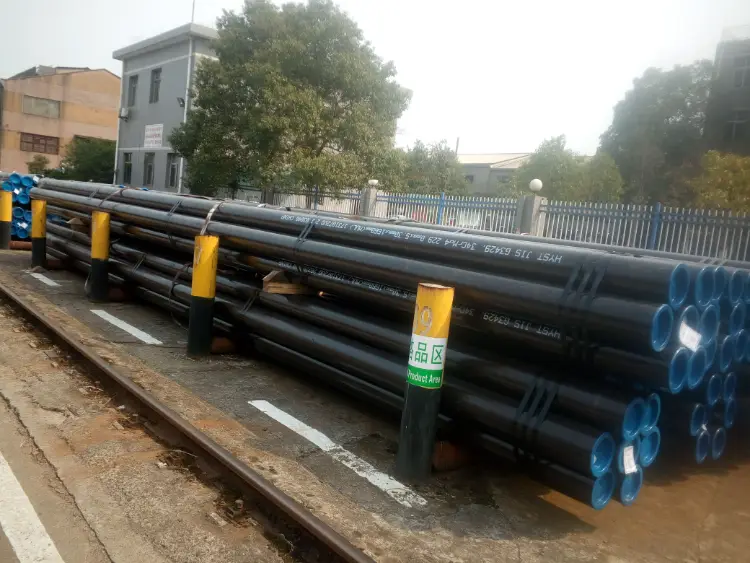
34CrMo4/2 Seamless Steel Pipe for Gas Cylinders
34CrMo4/2 Air Bottle Pipe: GB/T 18248 Material Data & Performance Guide
Explore the complete material data for 34CrMo4/2 air bottle pipes under GB/T 18248, including chemical composition, mechanical and physical properties, international equivalents, and application advice for high-pressure gas cylinders.
Hot-rolled or cold-drawn, followed by quench and temper (QT)
- Phone : +8618037372205
- Email : [email protected]
- WhatsApp: Contact via Whtsapp
- WeChat: +8618037372205
34CrMo4/2 Seamless Steel Pipe for Gas Cylinders Introduction
34CrMo4/2 air bottle pipe refers to a quenched and tempered seamless steel tube according to the Chinese standard GB/T 18248-2021 (Seamless steel tubes for gas cylinders). The base material 34CrMo4 is a chromium-molybdenum alloy steel with excellent strength, toughness, and heat resistance, making it ideal for manufacturing high-pressure gas cylinders. The "/2" designation often indicates a specific design stress or wall-thickness classification within the gas cylinder tube requirements. This material is predominantly used for CNG (compressed natural gas) cylinders, industrial gas cylinders, and fire extinguisher bodies, where reliability under cyclic pressure and low-temperature toughness are critical.
34CrMo4/2 Seamless Steel Pipe for Gas Cylinders Chemical Composition
The chemical composition of 34CrMo4/2 must comply with GB/T 18248-2021 for gas cylinder tubes. The alloying elements chromium and molybdenum provide hardenability and high-temperature strength. Strict control of impurities such as phosphorus, sulfur, and residual elements is required to ensure toughness and resistance to temper embrittlement.
- Heat analysis values are as per the standard.
- Product analysis tolerances are specified in the standard.
| Element | Specified Value (%) | Remarks |
|---|---|---|
| Carbon (C) | 0.30 – 0.37 | Key strength contributor |
| Silicon (Si) | 0.10 – 0.40 | Deoxidizer, increases strength |
| Manganese (Mn) | 0.60 – 0.90 | Improves hardenability |
| Phosphorus (P) | ≤ 0.020 | Harmful impurity, kept low for toughness |
| Sulfur (S) | ≤ 0.015 | Harmful impurity, low for cleanliness |
| Chromium (Cr) | 0.90 – 1.20 | Carbide former, enhances corrosion resistance |
| Molybdenum (Mo) | 0.15 – 0.30 | Increases high-temperature strength and hardenability |
| Nickel (Ni) | ≤ 0.30 | Residual element |
| Copper (Cu) | ≤ 0.20 | Residual element |
| Iron (Fe) | Balance | Base element |
34CrMo4/2 Seamless Steel Pipe for Gas Cylinders Thermal & Electrical Physical Properties
These physical properties are typical for the 34CrMo4 alloy steel in the quenched and tempered condition. They are not mandatory in GB/T 18248 but are essential for design calculations involving thermal expansion, heat conduction, and electrical resistivity. Values are given for a range of temperatures commonly encountered in service.
| Property | Typical Value | Unit | Test Condition |
|---|---|---|---|
| Density (ρ) | 7.85 | g/cm³ | At 20 °C |
| Elastic modulus (E) | 210 | GPa | At 20 °C |
| Shear modulus (G) | 81 | GPa | At 20 °C |
| Poisson's ratio (ν) | 0.3 | — | At 20 °C |
| Thermal expansion coefficient (α) | 11.1 | 10⁻⁶/K | 20–100 °C |
| Thermal expansion coefficient (α) | 12.1 | 10⁻⁶/K | 20–200 °C |
| Thermal expansion coefficient (α) | 12.9 | 10⁻⁶/K | 20–300 °C |
| Thermal expansion coefficient (α) | 13.5 | 10⁻⁶/K | 20–400 °C |
| Thermal conductivity (λ) | 42.7 | W/(m·K) | At 20 °C |
| Thermal conductivity (λ) | 41.0 | W/(m·K) | At 100 °C |
| Specific heat capacity (cp) | 460 | J/(kg·K) | At 20 °C |
| Electrical resistivity (ρe) | 0.21 | 10⁻⁶ Ω·m | At 20 °C |
34CrMo4/2 Seamless Steel Pipe for Gas Cylinders Mechanical Properties
Mechanical properties are for quenched and tempered tubes as specified in GB/T 18248-2021. The specified values are for samples taken in the longitudinal direction from tubes with wall thickness ≤ 15 mm. For thicker walls, properties may be agreed upon. Impact testing is performed at -50°C to guarantee low-temperature toughness critical for gas cylinder service.
| Property | Required Value | Unit | Test Condition |
|---|---|---|---|
| Tensile strength (Rm) | ≥ 900 | MPa | Room temperature, longitudinal specimen |
| Yield strength (ReH / Rp0.2) | ≥ 700 | MPa | Room temperature, longitudinal specimen |
| Elongation after fracture (A) | ≥ 12 | % | Room temperature, gauge length 5.65√S₀ |
| Impact absorbed energy (KV₂) | ≥ 40 (average) | J | -50 °C, V-notch, transverse specimen |
| Bend test (180°) | No cracks | — | Mandrel diameter D = 4a (a=wall thickness), 180° bend |
34CrMo4/2 Seamless Steel Pipe for Gas Cylinders Exact Equivalent Material Standards & Substitute Grades
| Country/Region | Standard | Grade | Remarks |
|---|---|---|---|
| China | GB/T 18248-2021 | 34CrMo4 | Original specification for gas cylinder tubes |
| European Union | EN 10297-1:2003 | 34CrMo4 (1.7220) | Seamless circular steel tubes for mechanical and general engineering purposes; equivalent chemical and mechanical properties |
| Japan | JIS G3429:2018 | STH22 (SCM435) | Seamless steel tubes for high pressure gas cylinders; similar strength class |
| International | ISO 9809-2:2010 | 34CrMo4 | Gas cylinders — Refillable seamless steel gas cylinders — Design, construction and testing; identical base material |
34CrMo4/2 Seamless Steel Pipe for Gas Cylinders Application Introduction
The 34CrMo4/2 air bottle pipe is engineered for high-pressure containment. Its high strength, excellent toughness at low and ambient temperatures, and fatigue resistance make it suitable for repeated filling cycles. Typical applications involve cold-forming of cylinder shoulders and ends, welding of neck rings and feet, and strict non-destructive testing. The material can be deep drawn or spun to form cylinder ends. It is also used in gaseous hydrogen transport and storage, provided hydrogen embrittlement is managed through appropriate heat treatment and surface condition.
Product Applications: CNG Type I cylinders (all-metal), Industrial seamless steel cylinders (10–80 liter), Fire extinguisher bodies, Hydrogen storage bundles (tube trailers), SCBA (Self-Contained Breathing Apparatus) cylinders, Hydraulic accumulators (with proper design validation)
Processed into products: Cylinder body (main tube section, drawn or spun ends), Neck ring (threaded boss for valve mounting), Foot ring (bottom protective sleeve), Boss forgings (when integrally forged from tube ends), Adapter blocks for bundle assembly
Application industries: Compressed natural gas (CNG) storage and transportation, Industrial gas (O2, N2, Ar, H2) supply, Firefighting equipment (CO2, dry chemical extinguisher bodies), Hydrogen mobility and refueling station storage, Medical oxygen cylinders, Scuba diving and breathing apparatus cylinders
34CrMo4/2 Seamless Steel Pipe for Gas Cylinders Similar / Comparable Material Recommendations
| Country/Region | Standard | Grade | Remarks |
|---|---|---|---|
| China | GB/T 18248-2021 | 35CrMo | Slightly higher carbon; comparable strength and toughness, often used for similar gas cylinder applications |
| China | GB/T 18248-2021 | 30CrMo | Lower carbon; may have lower strength but higher toughness; can be considered where slightly lower strength is acceptable |
| USA | ASTM A519 | 4135 / 4137 | Seamless mechanical tubing; 4135 closely matches 34CrMo4, 4137 has slightly higher carbon; both can be heat treated to comparable strength levels |
| Germany (historical) | DIN 2448/17204 | 34CrMo4 | Seamless steel tubes; earlier editions used before EN harmonization, material essentially identical |
Notes:
Additional requirements per GB/T 18248:
- Non-destructive testing: Every tube must be ultrasonically or eddy-current tested for longitudinal and transverse defects.
- Hardness: Typically ≤ 30 HRC after QT, but the standard does not specify a hardness limit; it is verified through mechanical properties.
- Grain size: Fine grain practice is required; grain size shall be 5 or finer according to ASTM E112.
- Surface condition: Free from cracks, laps, and harmful defects; can be delivered with phosphated or painted external surface.
- Hydrogen embrittlement resistance: For hydrogen service, specific guidelines on maximum hardness and residual stresses apply beyond the standard scope.
- Share



