
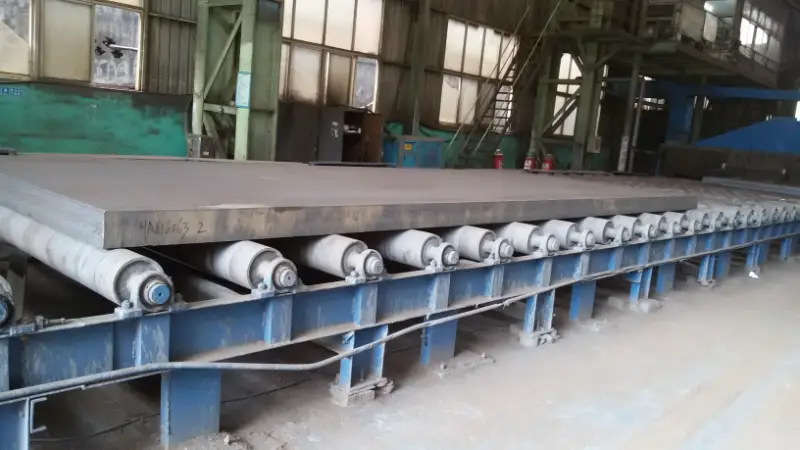
310S (S31008) Austenitic Stainless Steel Plate/Coil
310S (S31008) Austenitic Stainless Steel Plate/Coil - High-Temperature Oxidation Resistance
Detailed material data for 310S (UNS S31008) stainless steel plate and coil: chemical composition, mechanical properties, physical properties, international equivalents, and typical applications.
Hot rolling, cold rolling, annealing, pickling, descaling, cutting, forming
- Phone : +8618037372205
- Email : [email protected]
- WhatsApp: Contact via Whtsapp
- WeChat: +8618037372205
310S Austenitic Stainless Steel Plate/Coil Introduction
310S (UNS S31008) is a low-carbon austenitic stainless steel with excellent resistance to oxidation, sulfidation, and carburization at elevated temperatures up to 1100°C (2000°F) under mildly cyclic conditions. The low carbon content (≤0.08%) minimizes carbide precipitation during welding or service in the 425–860°C range, ensuring superior intergranular corrosion resistance. It contains high chromium (24–26%) and nickel (19–22%) contents, providing outstanding high-temperature strength and creep resistance.
- Typical applications include furnace components, heat treatment equipment, and chemical processing where high-temperature corrosion resistance is required.
- Available as hot-rolled or cold-rolled plate, sheet, strip, and coil in various surface finishes (No.1, 2B, BA, etc.).
- Excellent weldability with matching filler metals such as 310 or 312 electrodes.
310S Austenitic Stainless Steel Plate/Coil Chemical Composition
The chemical composition meets the requirements of ASTM A240 for UNS S31008. The analysis is representative of solution-annealed material. Iron (Fe) is the balance.
| Element | Standard Value | Remarks |
|---|---|---|
| Carbon (C) | ≤0.08 | Low carbon improves intergranular corrosion resistance |
| Manganese (Mn) | ≤2.00 | |
| Silicon (Si) | ≤1.50 | Higher silicon can enhance scaling resistance |
| Phosphorus (P) | ≤0.045 | |
| Sulfur (S) | ≤0.030 | |
| Chromium (Cr) | 24.0–26.0 | Provides oxidation resistance |
| Nickel (Ni) | 19.0–22.0 | Stabilizes austenite and improves creep strength |
310S Austenitic Stainless Steel Plate/Coil Physical Properties
The data represent typical properties for 310S in the solution-annealed condition. Actual values may be influenced by processing and service environment. Thermal expansion, thermal conductivity, and electrical resistivity are critical for high-temperature design.
| Property | Typical Value | Unit | Test Condition / Temperature Range |
|---|---|---|---|
| Density (ρ) | 8.0 × 10³ | kg/m³ | At 20°C |
| Elastic Modulus (E) | 200 | GPa | At 20°C |
| Shear Modulus (G) | 77 | GPa | At 20°C |
| Poisson's Ratio (ν) | 0.30 | At 20°C | |
| Thermal Expansion Coefficient (α) | 15.9 | 10⁻⁶/K | 20–100°C |
| Thermal Expansion Coefficient (α) | 16.2 | 10⁻⁶/K | 20–200°C |
| Thermal Expansion Coefficient (α) | 16.8 | 10⁻⁶/K | 20–400°C |
| Thermal Expansion Coefficient (α) | 17.5 | 10⁻⁶/K | 20–600°C |
| Thermal Expansion Coefficient (α) | 18.0 | 10⁻⁶/K | 20–800°C |
| Thermal Expansion Coefficient (α) | 18.5 | 10⁻⁶/K | 20–1000°C |
| Thermal Conductivity (λ) | 14.2 | W/(m·K) | At 100°C |
| Thermal Conductivity (λ) | 17.5 | W/(m·K) | At 500°C |
| Specific Heat Capacity (Cp) | 500 | J/(kg·K) | At 20°C |
| Electrical Resistivity (ρ_e) | 0.78 × 10⁻⁶ | Ω·m | At 20°C |
310S Austenitic Stainless Steel Plate/Coil Mechanical Properties
Tests performed on solution-annealed material in accordance with ASTM A240. Properties may vary slightly depending on thickness, manufacturing route, and exact heat treatment. Values listed are minimum requirements unless stated otherwise.
| Property | Required Value | Unit | Test Condition |
|---|---|---|---|
| Yield Strength (ReH, 0.2% offset) | ≥205 | MPa | Room temperature, annealed |
| Tensile Strength (Rm) | ≥515 | MPa | Room temperature, annealed |
| Elongation (A, 50 mm gauge length) | ≥40 | % | Room temperature, annealed |
| Hardness, Rockwell B (HRB) | ≤95 | HRB | Room temperature, annealed |
| Hardness, Brinell (HBW) | ≤219 | HBW | Room temperature, annealed |
310S Austenitic Stainless Steel Plate/Coil Internationally Equivalent Standards & Substitute Grades
| Country / Region | Standard | Grade | Remarks |
|---|---|---|---|
| USA | ASTM A240/A240M | 310S (UNS S31008) | Primary grade |
| Europe | EN 10088-2 | 1.4845 (X6CrNi25-21) | Carbon max 0.10%; slightly higher C than 310S, but generally considered equivalent for many applications |
| Japan | JIS G4304 | SUS310S | Same chemical limits as ASTM 310S |
| China | GB/T 4237 | 06Cr25Ni20 | Former designation 0Cr25Ni20; identical composition |
| International | ISO 15510 | X6CrNi25-21 | Carbon max 0.08% |
310S Austenitic Stainless Steel Plate/Coil Application Introduction
310S finds extensive use in high-temperature environments where oxidation and creep resistance are required. The alloy is ideal for continuous service up to 1150°C and cyclic service up to 1040°C. Its good formability and weldability allow fabrication into complex shapes.
Product Applications: Furnace muffles, radiant tubes, and retorts, Heat exchanger plates and shells for flue gas, Annealing and carburizing boxes, Thermal oxidizer components, Expansion bellows for ducting, Burner nozzles and flame tubes
Processed into products: Continuous heat-treat furnace hearth rollers and skids, Reformer catalyst tubes, Coil support frames and hangers, High-temperature fasteners and bolts, Distillation trays and packing in crude oil heaters
Application industries: Heat treatment and industrial furnace manufacturing, Petrochemical (e.g., reformers, cracking furnaces), Power generation (boilers, superheaters, gas turbine combustion parts), Cement and lime production (kiln components), Glass industry (feeder parts, lehr rolls), Food processing (high-temperature ovens, conveyors)
310S Austenitic Stainless Steel Plate/Coil Alloys with Similar High-Temperature Performance for Possible Replacement
| Country / Region | Standard | Grade | Remarks |
|---|---|---|---|
| USA | ASTM A240 | 310 (UNS S31000) | Higher carbon (≤0.25%); similar oxidation resistance but prone to sensitization; suitable for non-welded static components. |
| Europe | EN 10028-7 | 1.4841 (X15CrNiSi25-21) | Contains 1.5-2.5% Si for improved scale resistance; often used for furnace components. |
| Europe | EN 10095 | 1.4893 (X6CrNiNb25-21) | Niobium-stabilized version of 310S; better creep resistance above 800°C. |
| USA / Europe | ASTM A213 / EN 10216-5 | TP310HCbN (UNS S31042) / 1.4952 | High-temperature boiler grade with Nb and N additions; superior creep strength up to 700°C, but cannot replace 310S in all oxidizing environments. |
| USA | ASTM A240 | 253MA (UNS S30815) | Leaner chromium (21%) but adds cerium and nitrogen for improved oxidation and creep resistance; lower density alternative. |
Notes:
Welding: 310S can be welded by common methods (TIG, MIG, SMAW, SAW) using matching filler metals such as ER310 or E310-15/16. Preheating is not required. Maintain low interpass temperature to avoid hot cracking. Post-weld annealing is not mandatory for moderate corrosion environments, but may be applied for severe conditions or to restore full ductility.
Oxidation resistance: The alloy forms a tightly adherent Cr₂O₃ scale that becomes protective above 800°C. In carburizing atmospheres, the high nickel content resists carbon uptake, making 310S a preferred choice for heat-treating equipment.
Limitations: Not recommended for deep cryogenic service due to potential embrittlement. In chloride-containing environments above 60°C, stress corrosion cracking can occur, similar to other 300-series austenitic grades.
- Share



