
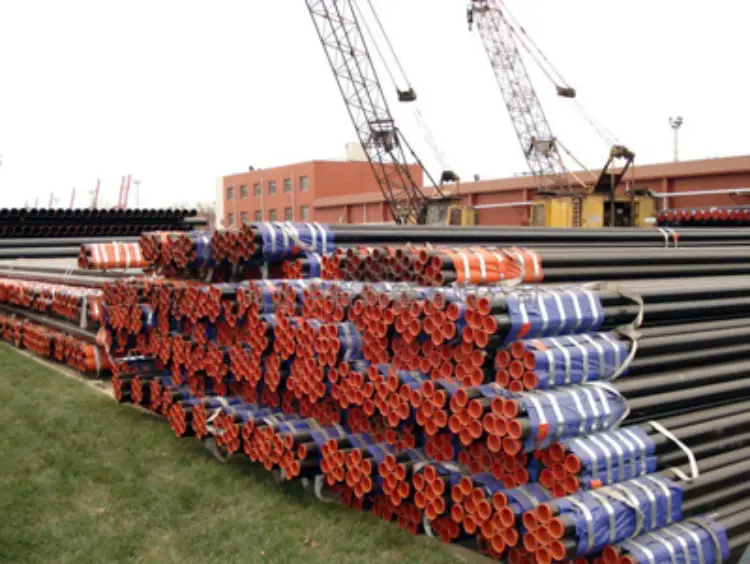
S960Q High-Strength Structural Steel for SSAW Pipe
S960Q High-Strength Structural Steel for SSAW Pipe - EN 10025-6 Grade Details
Comprehensive technical data for EN 10025-6 S960Q quenched and tempered steel used in spiral submerged arc welded pipes, including chemical composition, mechanical properties, thermal & electrical physical properties, equivalent grades, and application guidance.
Quenched and tempered, suitable for welding, hot and cold forming, and machining
- Phone : +8618037372205
- Email : [email protected]
- WhatsApp: Contact via Whtsapp
- WeChat: +8618037372205
S960Q High-Strength Structural Steel for SSAW Pipe Introduction
S960Q is a quenched and tempered high yield strength structural steel according to EN 10025-6. It provides a minimum yield strength of 960 MPa and excellent toughness, making it ideal for heavy-duty welded structures and spiral submerged arc welded (SSAW) pipes. The steel is fully killed and fine grain treated, offering a combination of very high strength, good weldability and impact resistance at -20 °C. Typical applications include heavy machinery, offshore platforms, bridges and pressure vessels where weight savings and high load capacity are critical.
S960Q High-Strength Structural Steel for SSAW Pipe Chemical Composition
Ladle analysis limits for S960Q as specified in EN 10025-6. The steel is fully killed and contains fine grain elements such as Nb, V, Ti. All values are maximum unless a range is shown.
| Element | Standard Value (%) | Notes |
|---|---|---|
| C | ≤0.20 | max |
| Si | ≤0.80 | max |
| Mn | ≤1.70 | max |
| P | ≤0.020 | max |
| S | ≤0.010 | max |
| N | ≤0.015 | max |
| B | ≤0.005 | max |
| Cr | ≤1.50 | max |
| Cu | ≤0.50 | max |
| Mo | ≤0.70 | max |
| Nb | ≤0.06 | max |
| Ni | ≤2.0 | max |
| Ti | ≤0.05 | max |
| V | ≤0.12 | max |
| Zr | ≤0.15 | max |
S960Q High-Strength Structural Steel for SSAW Pipe Thermal and Electrical Physical Properties
These values are typical for quenched and tempered structural steels and are provided for design guidance. They are not mandatory requirements of EN 10025-6 but are representative of S960Q steel at room temperature unless another condition is noted.
| Property | Approximate Value | Unit | Condition |
|---|---|---|---|
| Density (ρ) | 7850 | kg/m³ | 20 °C |
| Elastic modulus (E) | 210 | GPa | 20 °C |
| Shear modulus (G) | 81 | GPa | 20 °C |
| Poisson's ratio (ν) | 0.3 | – | 20 °C |
| Thermal expansion coefficient (α) | 11.1 | 10⁻⁶/K | 20 – 100 °C |
| Thermal conductivity (λ) | 50 | W/(m·K) | 20 °C |
| Specific heat capacity | 460 | J/(kg·K) | 20 °C |
| Electrical resistivity (ρₑ) | 0.23 | 10⁻⁶ Ω·m | 20 °C |
S960Q High-Strength Structural Steel for SSAW Pipe Mechanical Properties
Minimum mechanical properties for flat products of S960Q according to EN 10025-6, tested in the quenched and tempered condition. Tensile tests are transverse unless otherwise noted. Impact tests are performed on longitudinal Charpy V‑notch specimens at -20 °C.
| Property | Standard Value | Unit | Test Condition |
|---|---|---|---|
| Yield strength (ReH) | ≥960 | MPa | Thickness ≤50 mm |
| Yield strength (ReH) | ≥900 | MPa | Thickness >50 to ≤100 mm |
| Tensile strength (Rm) | 980 – 1150 | MPa | Thickness ≤50 mm |
| Tensile strength (Rm) | 930 – 1100 | MPa | Thickness >50 to ≤100 mm |
| Elongation (A) | ≥10 | % | Gauge length L₀ = 5.65√S₀; thickness ≤100 mm |
| Impact energy (KV₂) | ≥27 (longitudinal) | J | -20 °C; thickness ≤100 mm |
| Bend test | 4t | – | Mandrel diameter; thickness ≤50 mm, 180° bend |
| Bend test | 5t | – | Mandrel diameter; thickness >50 to ≤100 mm, 180° bend |
S960Q High-Strength Structural Steel for SSAW Pipe Completely Equivalent Material Standards & Substitute Grades
| Region/Country | Standard | Grade | Remarks |
|---|---|---|---|
| International | ISO 4950-3 | S960Q | Same quenched and tempered high yield strength flat products; fully equivalent |
S960Q High-Strength Structural Steel for SSAW Pipe Application Introduction
S960Q combines ultra‑high strength with good weldability and toughness, enabling weight‑optimised designs. It is particularly suited for spiral welded pipes and heavy structural components that must withstand high static and dynamic loads. The steel can be processed using conventional workshop methods, but welding requires controlled heat input and consideration of pre‑heat/interpass temperatures to maintain mechanical properties.
Product Applications: Spiral submerged arc welded (SSAW) pipes for oil, gas, water and slurry transport, Welded structural hollow sections for columns and trusses, Heavy‑duty crane booms and lifting equipment, Pressure vessels and storage tanks (where permitted by design codes), Mining and earth‑moving machinery components
Processed into products: Jack‑up rig leg rack chords and bracings, Crane base frames and telescopic boom sections, Padeyes and lifting lugs, Welded box girders for bridges, Structural nodes in offshore platforms
Application industries: Oil and gas (long‑distance transmission pipelines, offshore risers), Heavy engineering (mobile cranes, excavator booms, heavy transport vehicles), Civil engineering (bridges, high‑rise building columns, stadium roofs), Offshore and marine (platform structures, wind turbine foundations), Mining equipment (dump truck bodies, conveyor booms)
S960Q High-Strength Structural Steel for SSAW Pipe Similar / Alternative Material Recommendations
| Region/Country | Standard | Grade | Remarks |
|---|---|---|---|
| European Union | EN 10025-6 | S960QL | Same base composition and strength; improved low‑temperature toughness (impact at -40 °C); slightly tighter quality requirements |
| European Union | EN 10149-2 | S960MC | Thermomechanical rolled cold-forming steel; min. yield 960 MPa, tensile 1000–1200 MPa; lower elongation (≥7 %); suitable for cold-formed profiles but not directly equivalent for welded heavy plates |
| Sweden (commercial) | SSAB Strenx® | Strenx 960 | Commercial brand with properties conforming to EN 10025-6 S960Q/QL or EN 10149-2 S960MC; widely used for structural components |
Notes:
Welding: Low hydrogen consumables are recommended. Pre‑heat and interpass temperature should be carefully controlled according to the steel thickness and applied welding procedure. Post‑weld heat treatment is generally not required for S960Q but may be considered for stress relief.
Forming: Cold forming is possible with adequate bending radii; for tight bends hot forming or stress relieving may be needed.
Ordering: When specifying S960Q for SSAW pipes, supplementary requirements such as notch toughness at lower temperatures, through‑thickness properties (e.g., to EN 10164), or additional testing should be agreed upon at the time of enquiry and order.
- Share



