
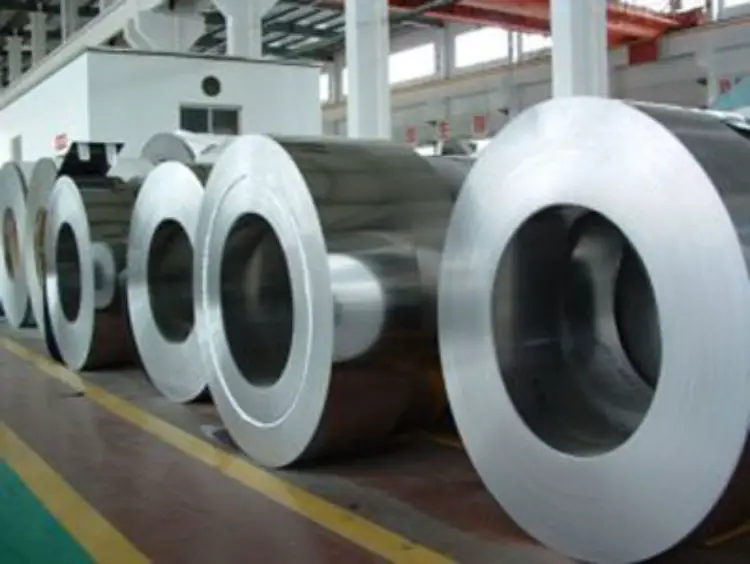
JIS G3106 SM490YB High-Strength Structural Steel Coil
JIS G3106 SM490YB High-Strength Structural Steel Coil - Composition, Properties & Global Equivalents
Complete technical profile for JIS G3106 SM490YB carbon and low-alloy high-strength steel coil. Includes chemical composition, mechanical and thermal properties, and international cross-reference to help engineers select the right material for welded structures.
Cutting, bending, welding, machining, hot/cold forming
- Phone : +8618037372205
- Email : [email protected]
- WhatsApp: Contact via Whtsapp
- WeChat: +8618037372205
JIS G3106 SM490YB High-Strength Structural Steel Coil Introduction
JIS G3106 SM490YB is a hot-rolled carbon and low-alloy high-strength structural steel coil specifically designed for welded structures. It belongs to the SM490Y family with guaranteed yield point and improved notch toughness at 0°C (Grade B). The material offers a minimum yield strength of 365 MPa and tensile strength in the range of 490–610 MPa for thicknesses up to 16 mm. With controlled microalloying elements such as Nb, V or Ti, it achieves fine grain strengthening and excellent weldability.
- Guaranteed yield point even after hot rolling
- Reliable Charpy impact energy at 0°C (≥27 J for thickness >12 mm)
- Good formability and fatigue strength suitable for heavy welded fabrication
JIS G3106 SM490YB High-Strength Structural Steel Coil Chemical Composition
The chemical composition according to JIS G 3106 specifies maximum limits for main elements. Microalloying elements (Nb, V, Ti) may be added singly or in combination for grain refinement and strengthening. The carbon equivalent (CEV) is controlled to ensure good weldability, especially for thicker sections. No deliberate addition of boron is permitted.
| Element | Requirements (max %) | Remarks |
|---|---|---|
| C | 0.20 | For t > 40 mm, CEV ≤ 0.44% (ladle analysis) |
| Si | 0.55 | May be lower depending on deoxidation practice |
| Mn | 1.60 | Higher Mn contributes to strength and toughness |
| P | 0.035 | Stringent control for low-temperature toughness |
| S | 0.035 | Low sulfur improves lamellar tearing resistance |
| Nb, V, Ti (optional) | – | Added for grain refinement; content governed by good welding practice and CEV limits |
JIS G3106 SM490YB High-Strength Structural Steel Coil Physical and Electrical Properties
The following values are typical for a low-carbon structural steel in the as-rolled condition at room temperature. Actual values may vary slightly depending on exact chemistry and processing. These data assist in thermal expansion, heat transfer, and electromagnetic modelling.
| Property | Typical Value | Unit | Test Conditions / Reference |
|---|---|---|---|
| Density (ρ) | 7.85 | g/cm³ | 20°C, ambient |
| Elastic modulus (E) | 200 – 210 | GPa | 20°C, tensile |
| Shear modulus (G) | ≈ 80.0 | GPa | Calculated from E and ν |
| Poisson's ratio (ν) | 0.30 | – | Elastic range |
| Thermal expansion coefficient (α) | 12.0 × 10⁻⁶ | K⁻¹ | 20–100°C |
| Thermal conductivity (λ) | 51.9 | W/(m·K) | 20°C |
| Specific heat capacity (cp) | 486 | J/(kg·K) | 20°C |
| Electrical resistivity (ρₑ) | 0.15–0.25 | μΩ·m | 20°C |
JIS G3106 SM490YB High-Strength Structural Steel Coil Mechanical Properties
Mechanical properties are tested on transverse specimens according to JIS Z 2242/2241. Yield strength and tensile strength vary with product thickness. Charpy V-notch impact tests are performed at 0°C for thickness above 12 mm; sub-size specimens require adjusted minimum energy values. Bending test is through 180° without cracking on the outside of the bend.
| Property | Required Value | Unit | Test Conditions / Thickness Range |
|---|---|---|---|
| Yield strength (ReH) | ≥ 365 | MPa | t ≤ 16 mm |
| Yield strength (ReH) | ≥ 355 | MPa | 16 < t ≤ 40 mm |
| Yield strength (ReH) | ≥ 335 | MPa | 40 < t ≤ 75 mm |
| Tensile strength (Rm) | 490 – 610 | MPa | t ≤ 16 mm |
| Tensile strength (Rm) | 490 – 610 | MPa | 16 < t ≤ 40 mm |
| Tensile strength (Rm) | 490 – 610 | MPa | 40 < t ≤ 75 mm |
| Elongation (A) | ≥ 15 (1A) / ≥ 19 (No.5) | % | t ≤ 16 mm (gauge length: L₀=5.65√S₀ or L₀=50 mm) |
| Elongation (A) | ≥ 17 (1A) / ≥ 21 (No.5) | % | 16 < t ≤ 40 mm |
| Elongation (A) | ≥ 19 (1A) / ≥ 23 (No.5) | % | 40 < t ≤ 75 mm |
| Charpy impact energy (KV₂) | ≥ 27 | J | 0°C, full-size 10×10 mm, t > 12 mm |
| Bending test | Bend angle 180°, inner diameter = 3a (a = thickness) | – | t ≤ 16 mm, no cracking |
JIS G3106 SM490YB High-Strength Structural Steel Coil Fully Equivalent International Standards and Alternative Designations
| Region / Country | Standard | Grade / Designation | Remarks |
|---|---|---|---|
| Japan | JIS G 3106 | SM490YB | Base standard; 0°C impact toughness class |
| Europe | EN 10025-2:2019 | S355J0 (+N or +AR) | Identical yield class, impact at 0°C; chemistry may differ slightly |
| China | GB/T 1591-2018 | Q345D | Yield ≥345 MPa, impact 0°C; equivalent for general structural use |
| USA | ASTM A572/A572M-21 | Grade 50 [345] (with Suppl. S5 if impact test required) | Similar strength; impact requirements need supplementary agreement |
| International | ISO 630-3:2021 | E355D | Hot-rolled structural steel, impact grade D (0°C), harmonized with JIS |
JIS G3106 SM490YB High-Strength Structural Steel Coil Application Introduction
SM490YB steel coils and plates are engineered for demanding welded structures where guaranteed yield strength and reliable low-temperature toughness are essential. Its balanced chemistry and controlled rolling process provide excellent weldability without preheating up to moderate thicknesses, good fatigue resistance, and sufficient ductility for cold forming. Typical applications span multiple industries.
Product Applications: Welded H-beams and I-beams, Box columns and structural tubing, Bridge box girders and plate girders, Ship superstructure assemblies, Pressure vessel shells (ambient/low-temperature service), Welded pipe for structural or low-pressure fluid transport
Processed into products: Flanges, webs, stiffeners and splice plates in steel bridges, Deck plates and longitudinal stiffeners in ship hulls, Main frames, brackets and reinforcement plates in heavy earth-moving machinery, Pedestal structures and transition pieces for wind turbines, Tank wall courses and bottom plates of API 650 tanks (where low-temp ductility is needed), Railcar center sills and bolster bolsters
Application industries: Civil engineering and construction (high-rise buildings, bridge girders, stadiums), Shipbuilding and marine engineering (hulls, decks, offshore module structures), Railway vehicles and transportation (freight car frames, bogie components), Heavy machinery and construction equipment (excavator booms, crane booms, bulldozer frames), Oil and gas (storage tanks, pressure vessels for moderate services), Renewable energy (wind turbine tower sections, solar support structures)
JIS G3106 SM490YB High-Strength Structural Steel Coil Similar or Closely Related Materials
| Region / Country | Standard | Grade | Remarks |
|---|---|---|---|
| Japan | JIS G 3106 | SM490YA | Same strength but impact test at room temperature (A class); less stringent toughness |
| Europe | EN 10025-2 | S355JR | Impact at +20°C; lower toughness guarantee; otherwise comparable strength |
| China | GB/T 1591 | Q345C | Impact test at 0°C; slightly lower minimum yield (345 MPa); widely available |
| USA | ASTM A572 | Grade 50 | Common structural steel; Charpy requirements not mandatory unless ordered to a supplementary specification |
| India | IS 2062 | E350C | Strength range comparable; impact grade C (0°C); small differences in limits for P and S |
Notes:
Welding recommendation: SM490YB can be welded by all common arc processes (SMAW, SAW, GMAW) using low-hydrogen consumables matched to the steel strength. For thicknesses above 40 mm or when CEV exceeds 0.43%, preheating to 100–150°C is advised to avoid cold cracking. The material is not intended for high-temperature pressure vessel design under ASME Code; for such applications, refer to JIS G 3115 or equivalent.
Surface condition: As-rolled surface may have mill scale; removal by shot blasting or pickling is recommended before painting or galvanizing to ensure coating adhesion.
Tolerances: Dimensional and shape tolerances are governed by JIS G 3193 for hot-rolled steel plates and sheets.
- Share



