
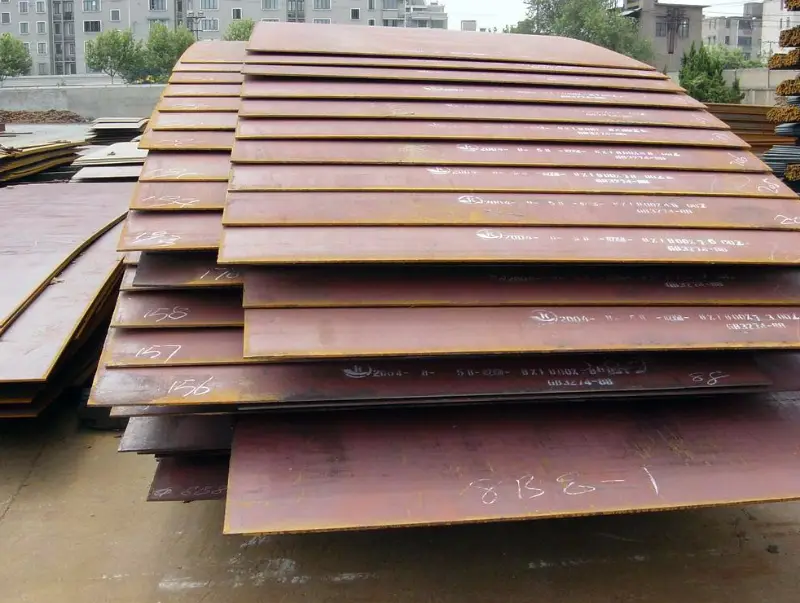
High-Strength Quenched and Tempered Steel
ASME SA514 Grade P High Strength Steel Coil: Quenched & Tempered Properties
Complete material data for ASME SA514/SA514M Grade P carbon and low-alloy high-strength steel coil, including chemical composition, mechanical properties, physical performance, international equivalents, and application guidance.
Hot rolling, cold forming, welding, machining, cutting
- Phone : +8618037372205
- Email : [email protected]
- WhatsApp: Contact via Whtsapp
- WeChat: +8618037372205
High-Strength Quenched and Tempered Steel Introduction
ASME SA514 Grade P is a quenched and tempered, high-strength low-alloy (HSLA) steel coil designed for structural and pressure vessel applications where high yield strength, good weldability, and excellent notch toughness are required. This grade belongs to the SA514/SA514M specification and offers a minimum yield strength of 690 MPa (100 ksi) for thicknesses up to 63.5 mm.
Key characteristics include:
- High strength-to-weight ratio, enabling lighter structures.
- Good low-temperature toughness when impact tested.
- Controlled hardenability through boron addition.
- Supplied in the quenched and tempered condition for optimal mechanical performance.
Typical applications cover pressure vessels, bridges, heavy machinery, and offshore platforms.
High-Strength Quenched and Tempered Steel Chemical Composition
Ladle analysis in accordance with ASME SA514/SA514M Grade P. All values are given as mass percentages unless otherwise noted. The composition is designed to optimize hardenability and strength while maintaining weldability.
- Boron is added to enhance hardenability without significantly increasing carbon equivalent.
- Low sulphur and phosphorus levels ensure good cleanliness and toughness.
| Element | Standard Range (%) | Remarks |
|---|---|---|
| Carbon, C | 0.12 – 0.21 | Critical for strength and hardenability |
| Manganese, Mn | 0.45 – 0.70 | Contributes to strength and deoxidation |
| Phosphorus, P | ≤ 0.035 | Low level required for toughness |
| Sulfur, S | ≤ 0.035 | Controlled for cleanliness |
| Silicon, Si | 0.20 – 0.35 | Deoxidizer and strength enhancer |
| Chromium, Cr | 0.85 – 1.20 | Improves hardenability and corrosion resistance |
| Molybdenum, Mo | 0.45 – 0.60 | Increases high-temperature strength and hardenability |
| Nickel, Ni | 1.20 – 1.50 | Enhances toughness and low-temperature properties |
| Boron, B | 0.001 – 0.005 | Micro-alloying element for deep hardenability |
High-Strength Quenched and Tempered Steel Thermal and Electrical Physical Properties
These physical properties are representative for high-strength quenched and tempered steels like A514/SA514 Grade P. Actual values may vary slightly depending on exact heat treatment and testing conditions.
- Thermal conductivity decreases with increasing temperature.
- The coefficient of thermal expansion (CTE) is given for the range 20–100 °C.
- Electrical resistivity is typical for low-alloy steels.
| Property | Typical Value | Unit | Test Condition / Remarks |
|---|---|---|---|
| Density (ρ) | 7.85 | g/cm³ | Room temperature |
| Elastic modulus (E) | 205 – 210 | GPa | Room temperature |
| Shear modulus (G) | 80 – 81 | GPa | Calculated from E and ν |
| Poisson's ratio (ν) | 0.28 – 0.30 | - | Elastic range |
| Thermal expansion coefficient (α) | 11.0 – 12.0 | ×10⁻⁶/K | 20–100 °C |
| Thermal conductivity (λ) | 42 – 45 | W/(m·K) | At 100 °C |
| Specific heat capacity | 460 – 500 | J/(kg·K) | Room temperature to 100 °C |
| Electrical resistivity (ρ_e) | 0.20 – 0.25 | μΩ·m | At 20 °C |
High-Strength Quenched and Tempered Steel Mechanical Properties
Tensile and yield properties for ASME SA514 Grade P as specified in the standard. Values are for the quenched and tempered condition. Elongation decreases slightly with increasing thickness.
- Transverse tension tests are standard for plates/coils.
- Bend tests are performed on samples from both ends of the coil to verify ductility.
- Impact toughness is subject to supplementary requirements when specified.
| Property | Specified Value | Unit | Test Condition / Remarks |
|---|---|---|---|
| Yield Strength (ReH) | ≥ 690 | MPa | Thickness ≤ 63.5 mm (2.5 in.) |
| Yield Strength (ReH) | ≥ 620 | MPa | Thickness > 63.5 mm up to 152.4 mm |
| Tensile Strength (Rm) | 760 – 895 | MPa | All thicknesses |
| Elongation (A) in 50 mm | ≥ 16 | % | Thickness ≤ 19.0 mm (3/4 in.) |
| Elongation (A) in 50 mm | ≥ 14 | % | Thickness > 19.0 mm up to 63.5 mm |
| Elongation (A) in 50 mm | ≥ 14 | % | Thickness > 63.5 mm up to 152.4 mm |
| Bend Test (180°) | No cracks | - | Bend diameter varies with thickness; typically 1.5T to 2.5T |
| Charpy V-Notch Impact (KV) | As per agreement | J | Optional supplement, e.g., 27 J at -40 °C common |
High-Strength Quenched and Tempered Steel Exact Equivalent Standards and Replaceable Grades
| Country/Region | Standard | Grade | Remarks |
|---|---|---|---|
| United States | ASTM A514/A514M | Grade P | Chemically and mechanically identical; interchangeable in design |
| United States | ASME SA514/SA514M | Grade P | Original specification; identical to ASTM A514 Grade P |
High-Strength Quenched and Tempered Steel Application Introduction
ASME SA514 Grade P steel coil is engineered for demanding applications that require high strength, good weldability, and reliable low-temperature performance. Its quenched and tempered microstructure provides a uniform balance of properties.
Design Considerations:
- Pre-heating and interpass temperature control are recommended during welding to avoid hydrogen-induced cracking.
- Post-weld heat treatment may affect strength; consult the standard before applying stress relief.
- Forming operations are best performed in the as-supplied condition; hot forming may require re-heat treatment.
Product Applications: High-pressure storage spheres and tanks, Reactor vessels, Long-span bridge girders, Crane booms and lattice structures, Offshore platform substructures, Large-diameter penstocks
Processed into products: Welded shell plates for pressure vessels, Chord and web members of truss bridges, Boom extensions and outrigger pads for mobile cranes, Load-bearing frames for heavy mining trucks, Structural nodes for offshore jacket platforms, Thick-wall hydraulic cylinder bodies
Application industries: Pressure vessel and boiler manufacturing, Heavy structural engineering, Mining and earthmoving equipment, Offshore and marine engineering, Bridge construction, Nuclear and thermal power generation
High-Strength Quenched and Tempered Steel Similar / Alternative Material Recommendations
| Country/Region | Standard | Grade | Remarks / Analysis |
|---|---|---|---|
| Europe | EN 10025-6 | S690QL / S690QL1 | Similar strength level (690 MPa yield) but different alloy design (Cr-Mo vs Ni-Cr-Mo-B). Check toughness and weldability before substitution. |
| Japan | JIS G 3128 | SHY685 | High-strength quenched and tempered steel for pressure vessels; yield 685 MPa. Chemical composition not identical, but performance is comparable. |
| China | GB/T 16270 | Q690D / Q690E | With minimum yield 690 MPa; alloy content differs. Suitable for structural use, verify Charpy requirements. |
| ISO | ISO 4950-2 | E690DD | High yield strength flat products; similar mechanical properties. The composition may require re-qualification for the intended service. |
Notes:
Formability: Hot and cold forming are possible, but cold forming radii should be increased compared to mild steel to avoid cracking.
Corrosion Resistance: The atmospheric corrosion resistance is similar to that of ordinary low-alloy steels; protective coatings are recommended for corrosive environments.
Inspection: Ultrasonic testing per SA578 or SA435 is commonly requested for pressure-boundary applications.
- Share



