
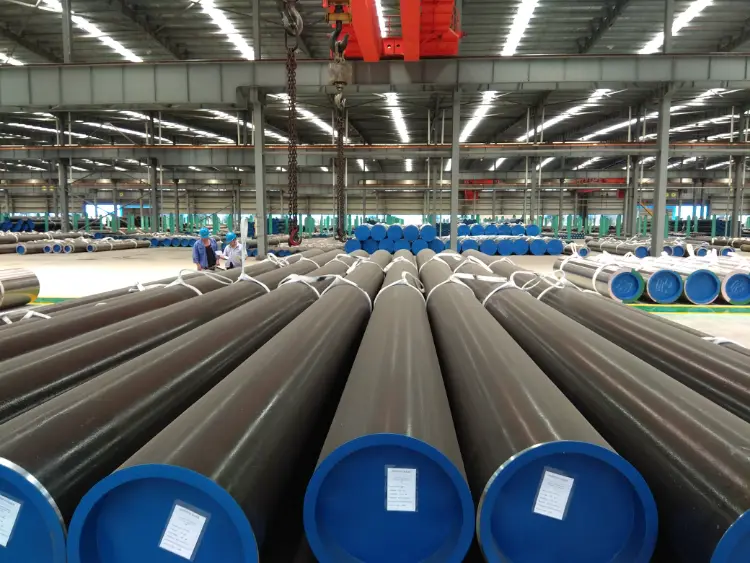
EN10219 S420MLH ERW Pipe
EN10219 S420MLH ERW Pipe: High-Strength Low-Temperature Structural Hollow Section
Detailed material properties of S420MLH ERW pipe according to EN 10219 standard, including chemical composition, mechanical characteristics, thermal and electrical physical properties, international equivalents, and application recommendations.
Cold forming, welding (ERW), subsequent normalizing or stress-relieving if required
- Phone : +8618037372205
- Email : [email protected]
- WhatsApp: Contact via Whtsapp
- WeChat: +8618037372205
EN10219 S420MLH ERW Pipe Introduction
S420MLH is a structural steel grade defined in EN 10219 for cold-formed welded structural hollow sections. It is produced via the thermomechanical rolling process (M) with a minimum yield strength of 420 MPa and guaranteed impact toughness at -50 °C (L). The suffix H indicates hollow section. This grade offers an excellent combination of high strength, good weldability, and superior low-temperature toughness, making it suitable for demanding structural applications in bridges, offshore structures, cranes, and heavy machinery. The ERW (Electric Resistance Welded) manufacturing route ensures consistent wall thickness and dimensional accuracy. Typical delivery condition is as-welded or normalized after welding, depending on the product specification level.
EN10219 S420MLH ERW Pipe Chemical Composition
Chemical composition according to EN 10219-1 for grade S420MLH. The values represent ladle analysis limits. S420MLH is a thermomechanically rolled fine-grain steel with controlled alloying to achieve the required strength and low-temperature toughness. Carbon equivalent (CEV) values are restricted to ensure good weldability. Detailed element constraints are provided below; elements not listed may be present as residuals.
| Element | Standard Value (%) | Remarks |
|---|---|---|
| C (Carbon) | ≤ 0.16 | Max for thickness ≤ 40 mm; lower limits enhance weldability |
| Si (Silicon) | ≤ 0.50 | Deoxidizer, improves strength |
| Mn (Manganese) | ≤ 1.70 | Main strength and toughness enhancer |
| P (Phosphorus) | ≤ 0.025 | Maximum to retain toughness |
| S (Sulfur) | ≤ 0.020 | Maximum for cleanliness and low-temperature properties |
| Nb (Niobium) | ≤ 0.05 | Microalloying for grain refinement |
| V (Vanadium) | ≤ 0.12 | Optional microalloying for precipitation strengthening |
| Al (Aluminum) | ≥ 0.020 (total Al) | Grain refinement (fine-grain practice) |
| Ti (Titanium) | ≤ 0.05 | Optional; may be added for grain size control |
| Ni (Nickel) | ≤ 0.80 | Increases toughness at low temperatures; not mandatory |
| Mo (Molybdenum) | ≤ 0.20 | For enhanced weldability and strength |
| Cu (Copper) | ≤ 0.35 | Residual element, also improves corrosion resistance |
| CEV (Carbon Equivalent) | ≤ 0.43 (typical for thickness ≤ 16 mm) | Based on CEV = C + Mn/6 + (Cr+Mo+V)/5 + (Ni+Cu)/15; value may vary with thickness |
EN10219 S420MLH ERW Pipe Thermal and Electrical Physical Properties
The following physical properties are typical for S420MLH structural steel at room temperature. They are not part of the mandatory inspection per EN 10219 but are derived from parallel EN 10025-4 data for comparable thermomechanically rolled steels and can be used for structural design calculations.
| Property | Standard Reference Value | Unit | Test Condition / Remarks |
|---|---|---|---|
| Density (ρ) | 7850 | kg/m³ | At 20 °C |
| Modulus of Elasticity (E) | 210 | GPa | At room temperature |
| Shear Modulus (G) | ~81 | GPa | Typical for steel |
| Poisson's Ratio (ν) | 0.3 | – | Elastic range |
| Thermal Expansion Coefficient (α) | 11.7 | 10⁻⁶/K | Linear, between 20 °C and 100 °C |
| Thermal Expansion Coefficient (α) | 12.5 | 10⁻⁶/K | 20 °C to 300 °C |
| Thermal Conductivity (λ) | 50 | W/(m·K) | At 20 °C; decreases with temperature |
| Specific Heat Capacity | 460 | J/(kg·K) | At 20 °C |
| Electrical Resistivity (ρ_e) | 0.22 – 0.25 | μΩ·m | At 20 °C |
EN10219 S420MLH ERW Pipe Mechanical Properties
Mechanical properties in accordance with EN 10219-1 for S420MLH hollow sections, tested on longitudinal test pieces at room temperature. The values vary with product thickness. For ERW pipes, the weld seam must also meet specified requirements. The material exhibits a minimum yield strength of 420 MPa for thickness ≤ 16 mm. Elongation is based on a gauge length of 5.65√S0 (proportional test piece).
| Property | Standard Required Value | Unit | Test Condition / Remarks |
|---|---|---|---|
| Yield Strength (ReH), min. | 420 | MPa | Thickness ≤ 16 mm |
| Yield Strength (ReH), min. | 400 | MPa | 16 mm < thickness ≤ 40 mm |
| Yield Strength (ReH), min. | 390 | MPa | 40 mm < thickness ≤ 63 mm |
| Tensile Strength (Rm) | 520 – 680 | MPa | Thickness ≤ 40 mm |
| Tensile Strength (Rm) | 500 – 660 | MPa | 40 mm < thickness ≤ 63 mm |
| Elongation (A), min. | 19 | % | Thickness ≤ 40 mm (longitudinal, proportional gauge) |
| Elongation (A), min. | 18 | % | 40 mm < thickness ≤ 63 mm |
| Ratio ReH/Rm, max. | 0.91 | – | To ensure adequate formability |
| Impact Energy (KV), longitudinal, at -50 °C, min. | 27 | J | Charpy V-notch, average of 3 tests; single min. 19 J |
| Bend Test (Weld Seam) | No cracks or defects | – | Mandrel diameter = 3 × thickness for grade S420MLH; bend angle 180° |
EN10219 S420MLH ERW Pipe Fully Equivalent Material Standards and Substitute Grades
| Country/Region | Standard | Grade | Remarks |
|---|---|---|---|
| Germany/Europe | EN 10219-1 | S420MLH | Original designation; identical requirements |
| Japan | JIS G 3466 | STKR490 | Similar strength and low-temperature toughness with slight compositional adjustments; not a full equivalent but widely accepted |
| China | GB/T 1591 | Q420D (for plates, if forming to hollow section) | Comparable in strength and low-temperature impact, but check product form equivalency |
| USA | ASTM A500 / A500M | Grade C (with supplementary low-temperature toughness) | A500 Grade C has 50 ksi (345 MPa) min yield; not equal in strength, special grade required |
| United Kingdom | BS EN 10219-1 | S420MLH | Identical to EN standard, adopted as British Standard |
EN10219 S420MLH ERW Pipe Application Introduction
S420MLH ERW pipes are engineered for load-bearing structural applications that require high strength, excellent low-temperature toughness, and good weldability. The thermomechanically rolled fine-grain microstructure enables design optimization and safe performance even at cryogenic ambient temperatures. Typical applications span heavy civil engineering, offshore, industrial machinery, and transport. The ERW production method provides close dimensional tolerances and is cost-effective for series production.
Product Applications: Structural hollow section columns and beams, ERW pipes for piling and foundation, Welded lattice towers and telecommunication masts, Offshore platform structural pipes, Crane boom segments, Roll-over protective structures (ROPS)
Processed into products: Bridge arch ribs and cross-bracings, Pin-jointed truss members, Hydraulic cylinder bodies, Shafts and axles in heavy transport vehicles, Foundation pipe piles with splice welding, Boom and jib sections for mobile cranes, Offshore flare tower pipe members, Deck support frames
Application industries: Civil Engineering (bridges, stadiums, high-rise structures), Offshore and Marine (jacket legs, flare booms, structural members), Heavy Machinery and Crane Construction, Transport (truck chassis, trailers, railcar bodies), Wind Energy Towers and Foundations, Mining and Earth-moving Equipment
EN10219 S420MLH ERW Pipe Similar or Alternative Material Recommendations
| Country/Region | Standard | Grade | Remarks |
|---|---|---|---|
| Europe | EN 10025-4 | S420M (flat products) | Same base steel but for plates and sections; not hollow section-specific; mechanical and chemical properties align closely |
| Europe | EN 10219-1 | S420MH | Same strength level but impact tested only at -20 °C; suitable if -50 °C toughness is not required |
| Europe | EN 10219-1 | S460MLH | Higher yield strength (460 MPa) at similar toughness level; may be used for weight reduction |
| International | ISO 630-3 | S420M | International standard for structural steels with thermomechanical rolling; not hollow section specific |
| Russia | GOST 19281 | 09G2S (with mod. for low temp.) | Comparable Mn-Si steel with impact at -60 °C; require verification for hollow sections |
Notes:
- The ERW welding process must be qualified, and the weld seam shall not impair the mechanical properties of the hollow section. Tensile and bend tests on the weld zone are mandatory per EN 10219.
- For thicknesses > 63 mm, other technical delivery conditions may apply; S420MLH is typically available up to 65 mm wall thickness in ERW.
- Post-weld heat treatment (PWHT) is not normally required due to the low carbon equivalent, but stress relieving above 580 °C can alter mechanical properties; consult the steel manufacturer.
- Corrosion protection (galvanizing, painting) must consider the silicon content to avoid issues with hot-dip galvanizing; silicon ≤ 0.04 % is recommended for full batch galvanizing.
- All data are based on EN 10219-1:2006 + AC:2010. Always verify the latest revision of the standard for current requirements.
- Share



