
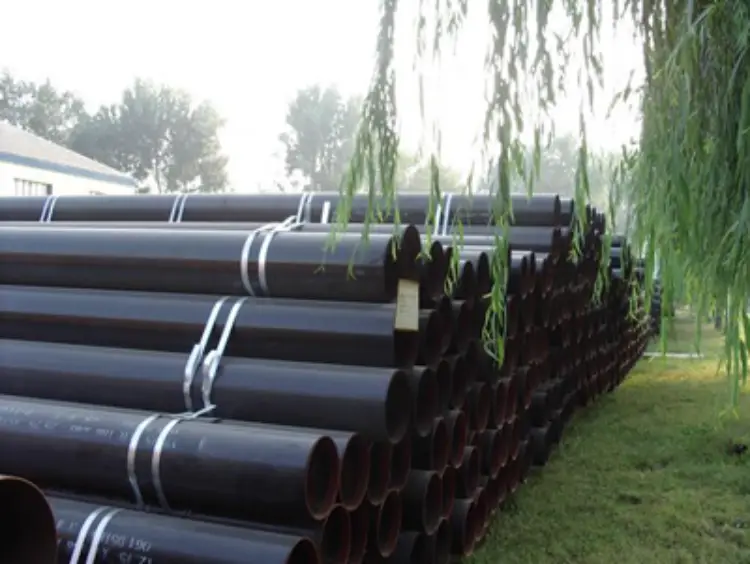
EN10219 S355NLH ERW Pipe
EN10219 S355NLH ERW Pipe: High-Strength Fine-Grain Structural Hollow Section for Low-Temperature Applications
Comprehensive material data for EN 10219 S355NLH electric resistance welded pipe: chemical composition, mechanical and physical properties, equivalent grades, and application guidance for structural engineering.
Cold forming from hot-rolled strip, high-frequency electric resistance welding (ERW), and subsequent normalizing of the weld seam or full-body normalizing
- Phone : +8618037372205
- Email : [email protected]
- WhatsApp: Contact via Whtsapp
- WeChat: +8618037372205
EN10219 S355NLH ERW Pipe Introduction
S355NLH is a normalized/normalized rolled, fine-grain structural steel grade for cold-formed welded hollow sections specified in EN 10219-1. It offers a minimum yield strength of 355 MPa and is characterized by excellent toughness at temperatures down to -50 °C, ensuring reliable performance in low-temperature and demanding structural applications. The steel is fully killed and fine-grain treated, with controlled carbon equivalent values to provide good weldability. It is widely used in civil engineering, offshore structures, heavy machinery, and bridges where both high strength and notch toughness are critical. The ERW (Electric Resistance Welded) manufacturing process produces cost-effective circular, square, or rectangular hollow sections, and the post-weld normalizing treatment restores the mechanical properties in the weld zone.
EN10219 S355NLH ERW Pipe Chemical Composition
Chemical composition limits as per EN 10219-1:2006 for grade S355NLH, based on cast analysis. The steel is fully killed and contains grain-refining elements such as aluminum, niobium, vanadium, or titanium.
- Carbon Equivalent Value (CEV): max. 0.45% for thickness ≤ 40 mm; higher values may be agreed for thicker sections.
- Grain refinement: Al total ≥ 0.020% or sufficient other grain-refining elements.
- Single element limits may be slightly higher if the total Nb+V+Ti ≤ 0.22%.
| Element | Standard Value (max %) | Remarks |
|---|---|---|
| C | 0.18 | t ≤ 40 mm |
| Si | 0.50 | |
| Mn | 1.65 | |
| P | 0.030 | |
| S | 0.025 | |
| Nb | 0.05 | May be substituted by V+Ti |
| V | 0.12 | |
| Al (total) | ≥ 0.020 | Minimum for fine grain practice |
| Ti | 0.05 | |
| Cr | 0.30 | |
| Ni | 0.50 | |
| Mo | 0.10 | |
| Cu | 0.35 | |
| N | 0.015 | Maximum, aluminum-nitrogen ratio controlled for grain refinement |
EN10219 S355NLH ERW Pipe Thermal and Electrical Physical Properties
The following physical properties are typical for normalized S355NLH structural steel and are not mandatory requirements of EN 10219-1. They are supplied for design calculations. Values are given at room temperature unless noted otherwise.
- Thermal conductivity decreases with increasing temperature.
- Thermal expansion coefficient increases with temperature; interpolate for intermediate values.
- Magnetic properties: ferromagnetic at room temperature.
| Property | Typical Value | Unit | Condition / Remarks |
|---|---|---|---|
| Density ρ | 7850 | kg/m³ | Room temperature |
| Modulus of elasticity E | 210 | GPa | Room temperature, static loading |
| Shear modulus G | 81 | GPa | Calculated: G = E / [2(1+ν)] |
| Poisson's ratio ν | 0.3 | — | Room temperature, elastic range |
| Thermal expansion coefficient α | 12.0 × 10⁻⁶ | K⁻¹ | 20 °C to 100 °C |
| Thermal expansion coefficient α | 12.5 × 10⁻⁶ | K⁻¹ | 20 °C to 200 °C |
| Thermal expansion coefficient α | 13.3 × 10⁻⁶ | K⁻¹ | 20 °C to 400 °C |
| Thermal conductivity λ | 50 | W/(m·K) | At 20 °C |
| Specific heat capacity c | 460 | J/(kg·K) | At 20 °C |
| Electrical resistivity ρe | 0.20 × 10⁻⁶ | Ω·m | At 20 °C |
EN10219 S355NLH ERW Pipe Mechanical Properties
Tensile and impact properties according to EN 10219-1 for S355NLH cold-formed hollow sections. The yield strength reductions for thicker walls are consistent with the standard.
- Tensile test: specimens are taken parallel to the axis of the hollow section (longitudinal).
- Elongation is measured on a gauge length of 5.65√S₀.
- Impact test: Charpy V-notch, longitudinal, minimum average of three specimens; individual minimum 70% of specified average value.
- Flattening test or drift expansion may be required for circular pipes.
| Property | Standard Required Value | Unit | Test Condition |
|---|---|---|---|
| Upper yield strength ReH | ≥ 355 | MPa | Nominal thickness t ≤ 16 mm |
| Upper yield strength ReH | ≥ 345 | MPa | 16 mm < t ≤ 40 mm |
| Upper yield strength ReH | ≥ 335 | MPa | 40 mm < t ≤ 63 mm |
| Upper yield strength ReH | ≥ 325 | MPa | 63 mm < t ≤ 80 mm |
| Upper yield strength ReH | ≥ 315 | MPa | 80 mm < t ≤ 100 mm |
| Tensile strength Rm | 470 – 630 | MPa | t ≤ 100 mm |
| Elongation A (longitudinal) | ≥ 22 | % | t ≤ 40 mm |
| Elongation A (longitudinal) | ≥ 21 | % | 40 mm < t ≤ 63 mm |
| Elongation A (longitudinal) | ≥ 20 | % | 63 mm < t ≤ 100 mm |
| Impact energy KV (longitudinal) | ≥ 27 | J | At -50 °C |
EN10219 S355NLH ERW Pipe Completely Equivalent Material Standards and Alternative Grades
| Country/Region | Standard | Grade | Remarks |
|---|---|---|---|
| European Union | EN 10219-1 | S355NLH | Original standard; cold-formed welded hollow sections |
| European Union | EN 10210-1 | S355NLH | Hot-finished seamless or welded hollow sections; identical chemical and mechanical requirements |
| International | ISO 10799-2 | S355NLH | Cold-formed welded structural hollow sections of non-alloy and fine grain steels |
| China | GB/T 1591-2018 | Q355NE | Comparable fine-grain structural steel; impact energy at -40 °C minimum 27 J; verify suitability for -50 °C application |
| USA | ASTM A572/A572M | Grade 50 [ASTM A500 Gr. C may be ordered with supplementary S5 low-temp. toughness] | Similar strength; supplementary requirements needed for low-temperature impact and fine grain practice |
| Japan | JIS G 3444 | STK490 | Carbon steel tubes for general structural purposes; yield point min 325 MPa; low-temperature toughness not inherent – special agreement required |
EN10219 S355NLH ERW Pipe Application Introduction
S355NLH ERW pipe is engineered for critical structural applications where high load-bearing capacity combined with reliable ductility at low temperatures is essential. It is typically used in welded, bolted, and hybrid connections. The excellent weldability and toughness make it suitable for dynamic and fatigue-loaded structures. Typical fields and products include:
Product Applications: Structural columns, beams, and trusses in high-rise buildings and sports arenas, Offshore jacket legs, piles, and bracing members, Telescopic and lattice crane booms, Wind turbine towers (tubular and lattice types), Railway and highway bridges (box girders, arch ribs), Gantry girders and heavy-duty steel frameworks, Automated storage and retrieval system racking
Processed into products: Welded tubular nodes for space frames and installations, Stiffener rings and end plates for hollow sections, Flanges manufactured by rolling and welding from pipe sections, Brackets, cleats, and base plates for pinned and fixed connections, Shear connector studs welded to the pipe surface, Chassis subframes for mobile cranes and heavy vehicles, Pressure-containing parts for low-temperature service when approved by relevant pressure vessel codes
Application industries: Civil and construction engineering, Offshore and marine structures, Wind energy (towers, foundations, transition pieces), Heavy lifting and transport equipment, Bridge construction, Industrial machinery and plant engineering, Low-temperature storage and cryogenic structural components
EN10219 S355NLH ERW Pipe Similar/Comparable Material Recommendations
| Country/Region | Standard | Grade | Remarks |
|---|---|---|---|
| European Union | EN 10219-1 | S355J2H | Same strength level; minimum impact temperature -20 °C (not suitable for -50 °C without special agreement) |
| European Union | EN 10025-3 | S355N | Normalized structural steel for open sections; similar toughness, but not a hollow section product |
| European Union | EN 10219-1 | S460NLH | Higher strength (460 MPa yield), also low-temperature (-50 °C); may be considered for weight reduction |
| USA | ASTM A500 | Grade C | Cold-formed welded hollow sections; 345 MPa yield; no mandatory low-temperature impact requirement; often used in less demanding structural applications |
| China | GB/T 8162-2018 | Q355D | Seamless steel tubes for structural use; impact at -20 °C; fine grain steel but not direct match for -50 °C toughness |
| International | ISO 630-2 | S355NL | Structural steel plate and wide flats; can be fabricated into pipes, but not a tubular product standard |
Notes:
Special considerations:
- For ERW pipes, the weld seam shall be normalized (by local heating or full-body normalizing) to ensure uniform properties across the section. The pipe may be supplied in the normalized condition (+N).
- For thicknesses above 40 mm, the chemical composition and carbon equivalent value may be specially agreed between the purchaser and manufacturer.
- Additional testing (ultrasonic testing of weld, flattening test, drift expanding test, Charpy transverse impact) may be specified in the order.
- The material is suitable for galvanizing (hot-dip) without risk of liquid metal embrittlement, provided proper practices are followed.
- Design according to Eurocode 3 (EN 1993-1-1) and EN 1993-1-8 for joints; fatigue design per EN 1993-1-9.
- Share



