
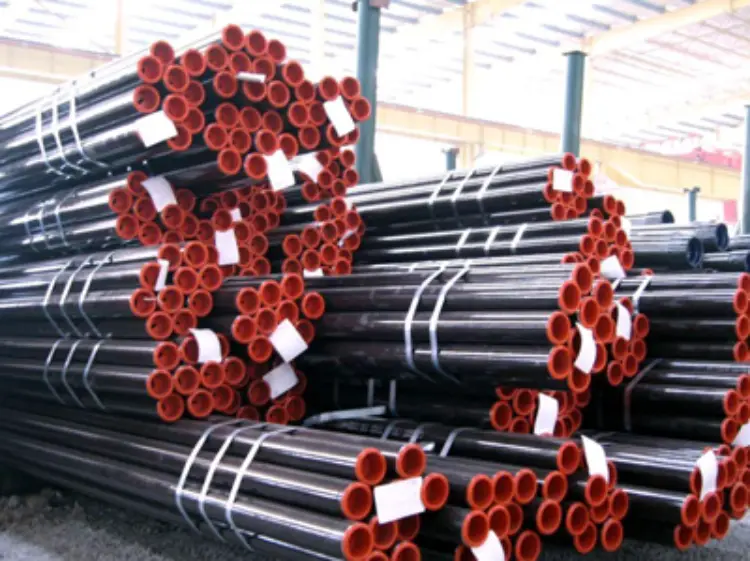
DH32 SSAW Pipe Material
DH32 SSAW Pipe - High-Strength Shipbuilding Steel Pipe for Offshore & Marine Applications
Comprehensive material data for DH32 grade spiral submerged arc welded pipe, including chemical composition, mechanical properties, physical properties, international equivalents and application fields.
Controlled rolling, normalizing, spiral forming and submerged arc welding (SSAW), post-weld heat treatment if required
- Phone : +8618037372205
- Email : [email protected]
- WhatsApp: Contact via Whtsapp
- WeChat: +8618037372205
DH32 SSAW Pipe Introduction
DH32 is a high-strength shipbuilding structural steel grade widely used in the fabrication of hulls and offshore platforms. When supplied as SSAW (Spiral Submerged Arc Welded) pipe, it serves as an essential tubular product for offshore structures, piling, and long-distance fluid transport under moderate to severe service conditions. This grade is defined by IACS UR W11 and classified by major classification societies. DH32 features a minimum yield strength of 315 MPa and excellent toughness at -20 °C, ensuring reliable performance in cold marine environments. The SSAW manufacturing process allows large-diameter pipes with efficient material utilization and consistent quality.
DH32 SSAW Pipe Chemical Composition
The chemical composition of DH32 steel is strictly regulated to balance strength, toughness, and weldability. Carbon equivalent (Ceq) is usually limited to ≤ 0.38% to ensure good weldability. Grain refining elements such as Nb, V, Ti may be present to achieve fine ferrite-pearlite microstructure and meet impact requirements at -20°C. Sulfur and phosphorus are kept low to avoid hot shortness and brittleness.
- Values represent ladle analysis per IACS UR W11.
- Full fine-grained practice is normally required.
| Element | Specified Value (max unless range) | Remarks |
|---|---|---|
| Carbon (C) | ≤ 0.18% | Ladle analysis |
| Manganese (Mn) | 0.90 – 1.60% | Higher Mn for strength and toughness |
| Silicon (Si) | ≤ 0.50% | Deoxidation |
| Phosphorus (P) | ≤ 0.035% | Max limit |
| Sulfur (S) | ≤ 0.035% | Max limit |
| Aluminum (Al) total | ≥ 0.020% | When fine grain practice required (acid-soluble Al equivalent) |
| Niobium (Nb) | ≤ 0.05% | Grain refinement (optional) |
| Vanadium (V) | ≤ 0.10% | Micro-alloy (optional) |
| Titanium (Ti) | ≤ 0.02% | Grain refinement (optional) |
| Copper (Cu) | ≤ 0.35% | Optional; if added, certain limits apply |
| Chromium (Cr) | ≤ 0.20% | Residual element |
| Nickel (Ni) | ≤ 0.40% | Residual |
| Molybdenum (Mo) | ≤ 0.08% | Residual |
| CEV (Ceq) | ≤ 0.38% | Carbon equivalent calculated according to IACS formula |
DH32 SSAW Pipe Thermal and Electrical Physical Properties
Physical properties are typical for low-alloy ferritic steel. These values are not specified by the classification rules but are provided for engineering design purposes. Density, thermal conductivity, and specific heat vary slightly with temperature. The values below are representative for structural steel used in marine construction and may be used for stress analysis, heat transfer calculations, and electrical engineering applications.
- Moduli are given for static conditions.
- Thermal expansion coefficient is averaged between 20°C and 100°C.
| Property | Typical Value | Unit | Test Condition / Remarks |
|---|---|---|---|
| Density (ρ) | 7850 | kg/m³ | 20°C |
| Elastic Modulus (E) | 205 | GPa | Room temperature |
| Shear Modulus (G) | 80 | GPa | Room temperature |
| Poisson's Ratio (ν) | 0.29 | - | Elastic range |
| Thermal Expansion Coeff. (α) | 12.0 × 10⁻⁶ | 1/K | Between 20°C and 100°C |
| Thermal Conductivity (λ) | 50 | W/(m·K) | 20°C |
| Specific Heat Capacity (cp) | 460 | J/(kg·K) | 20°C |
| Electrical Resistivity (ρe) | 0.15 – 0.20 | μΩ·m | 20°C (typical for low-alloy steel) |
DH32 SSAW Pipe Mechanical Properties
Mechanical properties are determined on transverse or longitudinal test specimens depending on product form and thickness. For pipe, longitudinal properties of the parent plate are critical. Charpy V-notch impact tests are performed at -20°C, with a minimum average absorbed energy of 31 J longitudinally. Yield and tensile values apply to all thicknesses up to 150 mm. Thinner products typically show higher elongation. Bending test requirements are given for plate intended for forming; for SSAW pipe, weld zone and base metal testing apply.
- Values meet IACS UR W11 requirements.
- Testing is conducted in accordance with ISO or ASTM standards.
| Property | Specified Value | Unit | Test Condition / Remarks |
|---|---|---|---|
| Yield Strength (ReH) | ≥ 315 | MPa | Upper yield, transverse; for thickness ≤ 150 mm; for plate/coil |
| Tensile Strength (Rm) | 440 – 570 | MPa | Transverse; all thicknesses |
| Elongation (A) | ≥ 22 | % | Gauge length 5.65√So (5d); transverse, minimum for all thicknesses |
| Bend Test (dia. = 3a) | No cracks | - | 180° bend over a former with diameter 3 times the specimen thickness (a) |
| Charpy Impact (KV2) | ≥ 31 (average) | J | Longitudinal, at -20°C; individual minimum 22 J |
| Charpy Impact (KV2) | ≥ 31 | J | Transverse, at -20°C (where applicable for pipe base metal) |
DH32 SSAW Pipe Fully Equivalent Material Standards and Replaceable Grades
| Country / Region | Standard | Grade | Remarks |
|---|---|---|---|
| International (IACS) | UR W11 | DH32 | Base unified requirement |
| China (CCS) | CCS Rules Part 2 | DH32 | Identical properties |
| USA (ABS) | ABS Rules Part 2 | DH32 | Identical properties |
| France (BV) | BV Rules Pt.2 | DH32 | Identical properties |
| Norway/Germany (DNV) | DNV-OS-C401 | DH32 | Identical properties |
| UK (LR) | LR Rules Chapter 4 | DH32 | Identical properties |
| Japan (NK/ClassNK) | NK Rules Part K | DH32 | Identical properties |
| Italy (RINA) | RINA Rules Pt.B | DH32 | Identical properties |
| Russia (RS) | Rules for Classification | DH32 | Identical properties |
| Korea (KR) | KR Rules Pt.2 | DH32 | Identical properties |
DH32 SSAW Pipe Application Introduction
DH32 SSAW pipe combines high strength and excellent low-temperature toughness, making it suitable for critical marine and offshore structural applications. The spiral welded manufacturing allows production of large diameter pipes (406 mm–2540 mm) with wall thicknesses up to approx. 25 mm, depending on the mill capability.
- Offshore engineering: Jacket legs, braces, piles and conductors.
- Marine structures: Docks, jetties, harbor pilings.
- Fluid transport: Water injection, oil & gas gathering lines where pipe integrity under rough sea conditions is required.
- Structural tubular: Transition pieces, monopile foundations for offshore wind turbines.
Product Applications: Spiral submerged arc welded (SSAW) pipes in various diameters, Marine structural tubulars and piling pipes, Hydrocarbon transportation linepipes (when approved by classification), Jacket leg and brace sections for offshore platforms
Processed into products: Pile sleeves and transition pieces for monopoles, Structural columns and bracings for drilling rigs, Conductors and riser sections for offshore wells, Suction anchors and pile clusters, Long span arches for floating docks and port structures
Application industries: Shipbuilding and marine repair, Offshore oil & gas (platforms, subsea structures), Offshore wind energy foundations, Port & harbor construction, Water supply & drainage (large bore steel pipes)
DH32 SSAW Pipe Similar / Alternative Material Recommendations
| Country / Region | Standard | Grade | Remarks |
|---|---|---|---|
| International | IACS UR W11 | AH32 | Identical strength but impact test at 0°C; for less arctic service |
| International | IACS UR W11 | EH32 | Identical strength but impact test at -40°C; for extreme cold conditions |
| International | EN 10025‑3 / DIN | S315G1+N (1.0490)? | Not exact replacement; similar yield, check notch toughness |
| International | API 5L | X52 (L360) | Yield strength ~360 MPa; for linepipe applications but not ship classification |
Notes:
All data are based on the publicly available IACS Unified Requirement W11 and typical values from recognized classification society rules. SSAW pipe specific requirements (dimensional tolerances, weld quality, NDE) should reference additional standards such as API 5L, ASTM A252, or EN 10219, as agreed in the purchase specification. Tolerances and testing for the finished pipe are subject to the order's supplementary requirements. Physical property values are representative for carbon-manganese steel; for precise engineering analysis, product-specific data should be consulted.
- Share



